Published :
09 Sep 2011, 06:30 PM
Updated :
10 Aug 2022, 05:25 PM
Dhaka, Sept 9 (bdnews24.com) – The oral hearing in the Bangladesh-Myanmar maritime delimitation case continued on Friday at the International Tribunal for the Law of the Sea (ITLOS) in Hamburg.
The second day of arguments was dedicated to the delimitation of 12-mile territorial sea, says a foreign ministry press statement.
Professor Alan Boyle from the University of Edinburgh and Prof Philippe Sands of the University College London addressed the tribunal.
For delimitation of territorial sea, Bangladesh put forth two sets of alternative arguments.
The first argument requested the tribunal to delimit the territorial sea on the basis of 1974 'agreed minutes' signed between the heads of the delegations of Bangladesh and Myanmar, which was further reconfirmed in 2008.
According to the agreed minutes, the territorial sea boundary between Bangladesh and Myanmar was drawn from the land terminus point at the Naaf River by joining seven points equidistant from the coasts of Myanmar and Bangladesh (St. Martins).
As per the minutes, Myanmar demanded unimpeded navigation through Naaf River, which Bangladesh has provided for over three decades.
However, during the proceedings, Myanmar declined to accept the boundary agreed upon in 1974 and proposed a new delimitation line totally ignoring the St. Martins Island.
In his speech, Prof Alan Boyle described various rules of international law and precedence of international courts and tribunals to prove that the 1974 agreed minutes was an agreement from which Myanmar could not revert now.
Then Bangladesh proposed a second set of argument for the delimitation of territorial sea.
Professor Philippe Sands argued that under Article 15 of the UNCLOS, which is the governing law in this case, the boundary in the territorial sea must be a median line, equidistant between the coasts of the two states.
Under both the bilateral agreement and the UNCLOS, the boundary in the territorial sea must be the equidistance line, as Bangladesh has constantly claimed.
The argument specifically stressed on the issue of St. Martins Island, which Myanmar claims to have no right to maritime zones, is in fact fully entitled to 12 miles of territorial sea and other maritime zones.
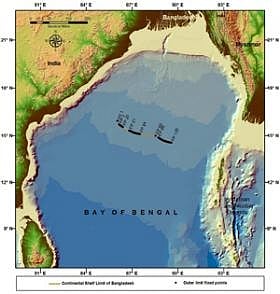
On Monday and Tuesday next week, Bangladesh will present its arguments on the boundary in the exclusive economic zone, up to 200 miles, and in the outer continental shelf, up to 390-460 miles.
bdnews24.com/ssz/nir/2345h