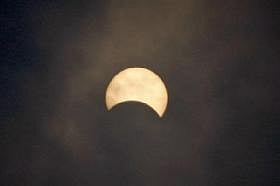
Longest eclipse gets standing ovation in Bangladesh
Under overcast skies with the clock ticking towards the moment of totality, thousands of spectators waited with bated breath at Panchagarh Stadium in northern Bangladesh on Wednesday morning.
bdnews24.com News Service
bdnews24.com
Published :
22 Jul 2009, 01:41 PM
Updated :
12 Aug 2022, 01:29 PM
Panchagarh, July 22 (bdnews24.com) - Under overcast skies with the clock ticking towards the moment of totality, thousands of spectators waited with bated breath at Panchagarh Stadium in northern Bangladesh on Wednesday morning.
With a last blinding flash, the sun disappeared, darkness descended and stars appeared as if by magic. Awestruck, the congregation fell silent while cameras flashed for more than three minutes of totality.
When the sun appeared again, the spectacle of a lifetime ended with a thunderous standing ovation.
A light drizzle was gradually increasing but could not mar this magnificent cosmic event, billed as the longest solar eclipse of the 21st century.
About thirty million people in northern Dinajpur, Lalmonirhat, Panchagarh and Thakurgaon fell in the shadow of totality for 3-4 minutes. Spellbound, viewers described an "indescribable darkness" as crickets sang and stars became visible for a fleeting few minutes on a July morning.
Other areas of the country viewed a partial eclipse. The height of the eclipse took place between 7:55am and 8am ranging between 83 percent in the south and 100 percent in northern districts. Dhaka saw a partial eclipse of 93 percent.
Panchagarh was the epicentre of totality in Bangladesh. Spectators began assembling at the stadium from 5am and by around 7am the place was buzzing with people that had travelled from every corner of Bangladesh and some from abroad.
"Totality was seen at around 7:57am and lasted several minutes," said Dipen Bhattacharya, a professor of astronomy at the University of California, who came to Bangladesh to see the eclipse.
"I am overwhelmed. I did not expect this much. It cannot be expressed in words," he said.
"We saw the chromo-sphere and the corona of the sun ... The temperature dropped as the sun went out."
He said an eclipse was never seen like this in Bangladesh or anywhere else.
The stadium-watch arrangements were made by the National Science and Technology Museum, Bangladesh Astronomical Association and Onusondhitsu Chokro.
"The stadium was packed full," Bangladesh Science and Technology Museum curator Sukallyan Bachhar told bdnews24.com.
"There were clouds, so we couldn't see the entire two-hour event uninterrupted. We got intermittent views as the moon began passing in front of the sun," he said.
"But we were lucky to get an absolutely clear view during the three minutes of total eclipse just before 8am."
"We saw stars in the day!"
"People became very emotional," he said.
Abdul Haque left his house in Boda, Panchagarh, at 4am to view the eclipse.
"I am content today because I have seen what I wanted to see. I saw stars during the day. I have never seen it before and never will again," he said.
'Clouds parted'
At Moinaguri Tea Garden in Panchagarh, where Bangladesh Astronomical Association was hosting an observation camp, sponsored by bdnews24.com, monsoon cloud cover frustrated watchers.
But the experience was still awe-inspiring as a hush descended, said one viewer. "The clouds parted and we saw the famous diamond ring effect."
"It was dark for about three or four minutes, and crickets started chirping as if it was night."
Another said, "It went completely dark. But it was an absolutely indescribable dark."
Eclipse watchers commonly describe an eerie calm descending as the blinding solar disc is blotted out. Just before totality, as the sky darkens, many flowers fold up and birds and animals get confused.
Some people get scared too and superstitions are still rife in many parts of the world. In Panchagarh some were seen running towards their homes as the sudden darkness descended. In some parts, it is thought to be inauspicious to be outdoors during the eclipse.
"But these cosmic events also increase the enthusiasm among general people for science," said Moshhurul Amin, general secretary of the BAA.
Eclipses are scientifically interesting because they allow a rare glimpse of the solar corona, glowing gases near the sun's surface and solar flares, which are normally not visible due to the brightness of the sun.
As the temperature drops, a final diamond-like flash is seen just before total darkness sets in and a few wisps of ephemeral light from the corona are visible and 'daytime' stars appear in the sky.
Temperatures drop, tides rise
All important "clear skies" had been forecast the previous day for viewing the eclipse.
The entire event, as the moon starts edging out the sun, took two hours, from around 7:00-9:00am in Bangladesh, with the full eclipse, visible only in the north, occurring midway just before 8:00am.
Meteorologists said temperatures fell by between 3-5 degrees, from an average 16-18C countrywide, as the sun's rays were blocked by the moon.
The eclipse also affected the tide in coastal districts, as the moon, sun and earth came into alignment, raising it by about 1-2 centimetres above normal. One fifth of the normal tidal pull is caused by the sun and four fifths by the proximity of the moon.
World watches as darkness descends
The world watched on Wednesday as the century's longest total solar eclipse cut a roughly 250 km-wide (155 mile-wide) corridor through Asia, including the world's most populous nations, India and China, plunging hundreds of millions into "darkness after dawn".
Travelling half the globe, the path of totality, or the Moon's umbral shadow, began in India and crossed through Nepal, Bangladesh, Bhutan, Myanmar and China.
After leaving mainland Asia, the path crossed Japan's Ryukyu Islands and curved southeast through the Pacific Ocean where the maximum duration of totality reached 6 min 39 seconds.
A partial eclipse was seen within the much broader path of the Moon's penumbral shadow, which includes most of eastern Asia, Indonesia, and the Pacific Ocean.
The duration of Wednesday's total eclipse will be unsurpassed until June 13, 2132, while Bangladesh will have to wait another 105 years to see another full solar eclipse, on June 2, 2114.
bdnews24.com/corr/mrf/am/dg/rah/1804h