Keep us in loop, Dhaka tells Delhi
Bangladesh calls for prior consultation and transparency in Tipaimukh dealings and issues related to common rivers Updates
bdnews24.com News Service
bdnews24.com
Published :
22 Nov 2011, 02:55 PM
Updated :
10 Aug 2022, 05:50 PM
Dhaka, Nov 22 (bdnews24.com) – Bangladesh, as a co-riparian country, has underscored the need for prior consultation before initiating any intervention on common rivers like Barak.
"This would be critical in avoiding any gap in understanding or allay concerns in Bangladesh," said a foreign ministry media statement issued on Tuesday on recent developments on Tipaimukh project.
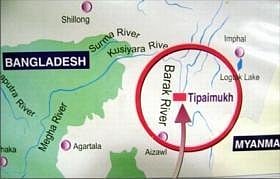
Manipur's government has secretly struck an investment deal with a number of state-run organisations for setting up the controversial hydroelectric power plant and Tipaimukh dam on India's Barak river.
"Given the most cordial relations existing between the two countries, Bangladesh would hope that the Government of India would share all relevant details of the proposed project in full transparency and also about any further step that it may take in connection with the project," the statement said.
Attention of the foreign ministry was drawn to the recent press reports on promoters' agreement for Tipaimukh project, said the statement.
"Dhaka has also noted the press briefing issued by the ministry external affairs of India today (Tuesday), which clarified that the proposed project is designed to be 'a hydro-electric project with provision to control floods'. As such, this project would not involve any diversion of water e.g. for irrigation purposes," the statement added.
Meanwhile, the foreign minister has said that she is expecting some updates on the Indian statement on Wednesday.
"There may be updates (on the Indian statement) tomorrow," Dipu Moni told bdnews24.com in the evening.
Earlier in the day, India through a press statement reiterated that the 1500MW Tipaimukh Hydro-Electric (Multi-Purpose) Project would not involve diversion of water and hence would not have any adverse downstream impact on Bangladesh.
New Delhi said it still stood by its assurance to Dhaka that it would not take steps on the proposed hydro-power plant that could adversely impact Bangladesh.
The assurance came in the wake of media reports on signing of a promoter's agreement by India's state-owned NHPC Limited, Satluj Jal Vidyut Nigam Limited and State Government of Manipur to set up a joint venture company for execution of the Tipaimukh project.
"The only recent development pertaining to the project has been the signing of a 'Promoter's Agreement' with the purpose of setting up a Joint Venture Company (JVC) between the Government of Manipur, NHPC Ltd and Sutlej Jal Vidyut Nigam Ltd (SJVN) on 22nd October, 2011. The JVC will be established under the name and style of 'Tipaimukh Hydroelectric Corporation Limited' or any other name as approved by the concerned Registrar of Companies," read a statement issued by the Indian government's ministry of external affairs.
On May 27, 2010, bdnews24.com had reported that the NHPC Ltd – formerly known as National Hydroelectric Power Corporation Limited – on April 28, 2010 signed a memorandum of understanding with the SJVN Ltd and the state government of Manipur.
It was also reported that the NHPC Ltd would hold 69 percent share in the joint venture company, while the Manipur government and the SJVN Ltd would have five percent and 26 percent stakes, respectively.
As a follow-up to the April 28, 2010 deal, the NHPC Ltd, SJVN Ltd and Manipur last month signed a promoters' agreement to float the joint venture company.
The latest foreign ministry statement was issued by Vishnu Prakash, the official spokesperson and joint secretary of the external affairs ministry.
He referred to the visit of a 10-strong parliamentary delegation from Bangladesh in July 2009 on the invitation of the Indian government. The delegation was led by Abdur Razzak, former water resources minister and current chairman of the Parliamentary Standing Committee on Water Resources Ministry.
"It had been clarified to the delegation that the proposed project was a hydro-electric project with provision to control floods and that this would not involve diversion of water on account of irrigation," said Prakash.
He noted that during prime minister Sheikh Hasina's visit to New Delhi in Jan 2010, her Indian counterpart Manmohan Singh had reiterated the assurance that India would not take steps on the Tipaimukh project that would adversely impact on Bangladesh. The assurance was again reiterated during the visit of Singh to Bangladesh last Sept, he added.
bdnews24.com on Aug 28 reported that the Manipur government had on May 31 this year forwarded a proposal to the ministry of environment and forest (MoEF) of the Indian government, seeking clearance for the controversial project.
The Tipaimukh project was conceived as a multipurpose storage project on the Barak River in Churachandpur district of Manipur, with main objective of hydropower generation along with flood mitigation in downstream area. The project is estimated to generate 3800 million units of electricity per annum and is likely to be completed within seven-and-a-half years after the clearance from the Indian government's Cabinet Committee on Economic Affairs.
A section of environmentalists both in Bangladesh and India are opposed to the project. They believe that the dam over Barak would significantly bring down flow of water in its tributaries Surma and Kurshiara in Bangladesh.
As hundreds of canals and major rivers, which are lifelines for people in greater Sylhet, are totally dependent on the water flow in Surma, it is apprehended that the project could spell doom for a large part of the country.
The proposed Tipaimukh project has been a major political issue in Bangladesh. Main opposition BNP has been raising it repeatedly to question the rationale of the efforts of the Awami League-led government in Dhaka to strengthen bilateral ties with New Delhi.
bdnews24.com/ssz/nir/2240h