


Published : 14 Dec 2012, 02:48 AM
Updated : 09 Aug 2022, 04:35 PM


Most of Japan's voters have not made up their mind about who to vote for in the 'crucial' Dec 16 election to the House of Representatives.
The general elections will be the first for 'Land of the Rising Sun' since 2009, when the Democratic Party of Japan (DJP) won a landslide majority ending almost 50 years of uninterrupted Liberal Democratic Party (LDP) rule.
Prime Minister Yoshihiko Noda currently heads the ruling party.
Septuagenarian Mitsuharu Nakagawa told bdnews24.com that he too, like many others, was confused about his choice.
"So many parties this time… I cannot understand," he said as he observed 12 political parties, highest after 1996, are scrambling to woo voters.
"But no-one talks about the policies that I want them to," Nakagawa said.
"One party talks of economic issues, while another of social safety. But for me both are important… I cannot say to whom I'll vote," he added.
As the official campaign kicked off on Dec 4, a record 1,504 people filed their candidacies gunning for 480 seats – 300 single-seat districts and 180 from the proportional representation segment.
Japanese media reports suggest the three key points for voters to consider in this election would be the fate of the nuclear programme, struggling economy and sales tax hike.
A survey conducted by a local TV station showed almost half of the respondents still 'undecided' about their choice.
Majority of those who responded the Kyodo News survey by telephone, tipped to vote LDP, even though its leader Shinze Abe, commonly termed by local media as hawkish, did not promise to end atomic power.
The atomic energy was at the heart of the political scenario in March 2011, when a massive earthquake and a resultant tsunami devastated Japan's northeast coast triggering the worst nuclear crisis since Chernobyl disaster in 1986, and forcing thousands to evacuate the area surrounding the plant.
As the campaign kicked off, leaders of the parties went to Fukushima, the site of the nuclear disaster, to rally support. There were certain similarities between the Japanese campaign style with Bangladesh's.
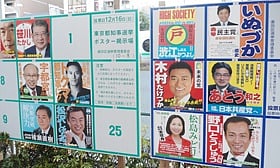
Political parties organised rallies with their volunteers distributing leaflets to pedestrians, and sticking colourful posters on walls in an orderly manner.
On Thursday, volunteers were seen distributing leaflets at a railway station in central Tokyo in favour of Japan Restoration Party (JRP) founded by the Mayor of Osaka, one of the biggest provinces.
Although analysts hinted the JRP and Tomorrow Party of Japan could be a third force, a survey ruled out their chances.
The survey, covering randomly selected 123,700 voters, showed JRP might bag around 50 seats and the Tomorrow Party of Japan could secure around 15.
The survey results showed LDP and its alley New Komeito could together bag around 300 seats from 47 prefectures while ruling DJP could secure only 70, despite its pledge to end atomic power by 2030.
The participation of so many parties is creating a dilemma for the voters as they are used to seeing two-party elections for a long time.
According to a report ran by Japan Times, voters are faced with a difficult choice because of the political parties' 'mix-and-match policy' positions.
The way in which the parties became pro-active before the election suggests that they 'would be no better than their predecessors at breaking the tradition of broken promises in politics', the report said.
A manager of a Tokyo hotel, however, was appeared to have made up his mind.
"The LDP said they would create jobs [if voted to power] and after that the stock market started going up from last week. I think I'll vote for them," the man identifying himself as 'Kawamoto' told bdnews24.com.










