


Published : 04 Dec 2012, 07:41 PM
Updated : 09 Aug 2022, 04:35 PM


The Japanese firm that constructs and oversees the world's major expressway network has offered technological expertise to Bangladesh and other developing countries where people endure accident-prone, decrepit highways.
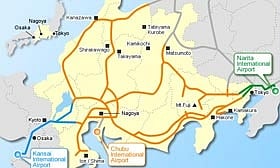
An official of the International Business Team of the Central Nippon Expressway Company Limited, which manages 1,917km highways in central Japan stretching from Tokyo to Nagano prefecture and is constructing another 347 kilometres of expressway , says they are giving 'priority' to technology transfer.
"We're very much proud of our technologies. We now give priority on how we can transfer our technologies to other countries," Oka Toshiyuki said on Tuesday to a group of journalists visiting Japan to see technologies that can be replicated in the developing world.
Toshiyuki said they are sending their young staff to English schools after their work to learn the language so that 'they can communicate well with other countries to promote their technologies.
Devastated during the World War II, Japan opened its first expressway built with the World Bank's loan in 1963 after mastering technologies from the West.
Officials say now they have about 8,000 km expressways spreading across the country with an average 200km adding every year.
The government privatised the sector in 2005 to maintain and keep the expressway 'in a good condition' and to repay inherited debts from the highway public corporations and incremental debts due to new construction of expressway.
The Nippon Expressway Co currently manages the expressways with a 24/7 monitoring system using close-circuit cameras, image-processing traffic controller, meteorological observation facilities and more than 50 patrolling cars per 500 km of the expressway, all watched by a control centre.
On a visit to a control centre on Tuesday at Kawasaki, a 10-strong team was seen keeping eyes on 64 monitors, 64 inches each that shows 30 spots at a time.
They have 750 cameras installed in the 500-kilometre expressway that the control centre oversees.
In emergencies, drivers also can call from telephones installed one kilometre apart.
Travelling through the highways, information boards were seen even 500m apart giving messages of the conditions of the road ahead and how much time needed to reach the destination.
In tunnels, special fire-extinguishing systems have been installed with automatic water sprinkles and emergency evacuation system.
Director of the Centre Kunihiko Hayashi said it takes maximum 30 minutes for their patrol cars to reach any point of the highway in case of emergencies.
He said to prevent accidents their patrol team took 'the risk of removing obstacles' on the highways without interrupting the busy traffic.
"One waves a red flag and another quickly gets back the object. They are trained to do it without interrupting traffic," he said.
To give drivers and passengers fresh starts, 178 rest areas have been set up on the 1,917km expressways.
Expasa Ebina is one of the rest areas visited by the group of journalists from 11 countries.
It is like a mega shopping place with food courts and amusement parks for children.
An official says an area can be as large as 116,000 square kilometres with two-third spaces for the nature.
During holidays, they get as much as 25,000 customers of which 10 percent comes only to visit the area.
There are also spaces for dogs and cats to play as Japanese carry their pets when they travel.
The rest areas also provide information on how the expressways were built. School students aged between 6 and 15 years come to learn about the constructions as part of their curriculum.
Toshiyuki said after privatisation, the expressways have been 'self-financed'.
"It changes the mind of our staff and services to customers. They always think how we can earn more increasing the quality and the number of users."
In the last fiscal year, they earned nearly $7 billion from the expressways that 1.85 million vehicles use every day.
Toshiyuki said the Vietnam government tied up with them to build a 200km expressways.
"But critical point is human resources. After building (highways), maintenance and operations are very difficult," he said.
"It needs very skilled personnel," he said, adding that collaborating with Japan International Cooperation Agency (JICA) they can dispatch their technical experts to any country for training.
JICA says they brought 27 Bangladeshi so far since 2007 and trained them on road safety.
Bangladesh's 3,492 kilometres of national highways and 4,268 kilometres of regional highways have become a death trap for many travellers for a variety of reasons.
According to official statistics, every year about 10,000 people die in around 20,000 road crashes across the country.







