


Published : 05 Dec 2012, 07:57 PM
Updated : 09 Aug 2022, 04:35 PM


Japan is witnessing a 'boom' in the renewable energy sector ever since it introduced a law, and the local firms are now getting more international businesses with their 'expensive' technologies that cut greenhouse gas emissions, industry leaders say.
Under the feed-in tariff system implemented on July 1 this year, businesses, individual households and organisations are being encouraged by the government to generate renewable power, and utilities are under obligation to buy that electricity at a fixed rate for a set period of time.
On their part, the consumers have to pay a surcharge, based on the amount they individually use, for the electricity generated from renewable sources.
"It (the law) has already led to a boom in solar power and other photovoltaic power generation businesses in Japan," Kameda Masaaki, General Manager of Japan Photovoltaic (PV) Energy Association, told a group of journalists visiting Tokyo on the sidelines of an international conference that started Wednesday.
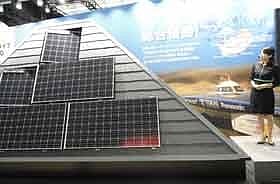
Styled 'PV Japan 2012', the association is hosting the three-day conference with SEMI, the global industry association, at one of the Tokyo's largest conference centres in Chiba that drew 196 companies from different countries, mainly Japan.
According to Masaaki, renewable power was earlier generated mostly for domestic use in Japan, but after the law the non-domestic use also soared.
He said the Japan government introduced the system 'also to lessen the country's dependency on nuclear power generation' after the Fukushima disaster in March 2011, the largest nuclear disaster since the Chernobyl catastrophe in 1986.
Statistics show after introducing the system, PV (renewable energy) projects worth nearly 1.5 GW qualified between July and Sept -- about 60 percent of the total capacity the government was expecting during the period between July 2012 and March 2013.
Masaaki said nuclear power facility could not be an ideal solution for power generation. "But renewable energy is very good, safe and environment-friendly."
"We are targeting the European and the US markets after Japan," he said as they see the conference an 'opportunity to work with international buyers'.
He, however, said that they did not have any target to reach power-starved developing countries like Bangladesh that face massive electricity crisis.
"It's costly, though the price is declining," he said. In Japan, it takes $5,000 to generate per kilowatt of electricity from renewable sources.
"Some 20 years ago, it was $20,000," he said.
He, however, felt that generating renewable energy depends not only on technologies, but also on 'the government's commitment.'
He said they could help in introducing projects in developing countries 'if JICA (Japan International Cooperation Agency) takes steps.'
SEMI's Regional President of Japan Yoichi Nakagawa said the PV Japan conference was 'the best event' for stakeholders to gain knowledge on Japan's renewable energy industry, including solar power.










