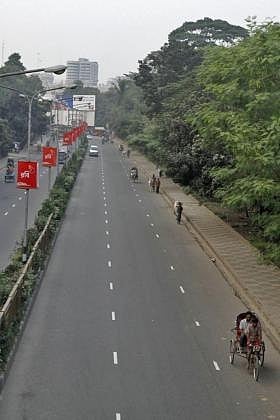
'It's an unusual Dhaka!'
Tens of thousands of people are off to their homes, laying the hustle and bustle of the capital to a temporary rest
bdnews24.com News Service
bdnews24.com
Published :
06 Nov 2011, 03:37 PM
Updated :
10 Aug 2022, 05:45 PM
Dhaka, Nov 6 (bdnews24.com) – Tens of thousands of people have left Dhaka in an annual exodus ahead of Eid-ul-Azha, laying the hustle and bustle of the capital to temporary rest as also giving planners a food for thought for 'planned urbanisation'.
As train, bus and water transport operators said they were struggling to cope with the rush and people were seen travelling perching on outer surfaces of the vehicles, the crowded Dhaka wore a desert look.
"It's an unusual Dhaka," said one Mamunur Rahsid, who was himself headed for Barisal on Sunday to celebrate Eid with his family.
It took less than half an hour for Mamun to reach Gulistan from Agargaon in a public bus. "Usually, it takes two hours or more in a bus packed like sardines."
There is no traffic jam, no unbearable noise, which otherwise spell havoc for over 8 million residents crammed in 360 square-kilometer Dhaka City Corporation area.
"It's no different this year. This exodus happens every year," said chairman of the Centre for Urban Studies Prof Nazrul Islam, suggesting going deeper into the issue.
"That (the exodus) means most of the people living here are migrants. They come for livelihood, but don't settle down," the urban planner told bdnews24.com, estimating that 0.35 million people are adding to the capital's existing population every year.
"Most of them are poor and lower middle class. Their roots are in villages and they rush back whenever there's an opportunity," he said and added that people with low income mostly run the risk of travelling on rooftops of buses and trains, and perish on the way back home.
"If they have an opportunity to get closer to their cities, many of the problems would vanish," Prof Nazrul said soliciting the idea of diverting the flow of urbanisation.
According to Islam, every Muslim having financial means need to sacrifice animal and distribute the meat to the family and the poor, who cannot afford to buy meat even once a year.
bdnews24.com/nih/nir/2120h