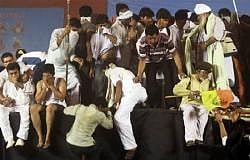
Indian SC wants answers on crackdown
The Indian Supreme Court calls on the government to justify why it sent police to end a peaceful anti-graft protest by yoga guru Swami Ramdev and thousands of his followers.
bdnews24.com News Service
bdnews24.com
Published :
06 Jun 2011, 10:09 AM
Updated :
10 Aug 2022, 04:55 PM
NEW DELHI, June 6 (bdnews24.com/Reuters) - The Supreme Court called on the government on Monday to justify why it sent police to end a peaceful anti-graft protest by yoga guru Swami Ramdev and thousands of his followers, spelling more trouble for embattled prime minister Manmohan Singh.
Around 600 police broke up a mass hunger strike led by Ramdev in New Delhi with batons and tear gas early on Sunday, detaining the guru, who is a TV star, and putting him on a plane to Dehradun. Dozens of followers and police were injured.
Tapping into spiralling voter anger about corruption as Asia's third largest economy booms, Ramdev has called on the government to pursue billions of dollars in illegal funds abroad, and introduce tough anti-corruption legislation.
Ramdev, usually clad in a saffron-coloured robe slung loosely over his bare chest, pledged to fast until his demands were met, adding to a series of planned protests announced by opposition parties and civil society groups.
The court's action suggests it has reservations about the raid. In recent months, the court has become more active in reprimanding the government, particularly over its handling of corruption accusations against its ministers.
"They are displeased over lathi (baton) charging people who were sleeping. It was a peaceful thing until the cops intervened," said D H Pai Panandikar, head of Indian think-tank RPG Foundation.
Ramdev's campaign was the latest embarrassment for a Congress Party-led coalition hit by graft scandals including allegations of kickbacks at the Commonwealth Games and a telecoms scam that may have cost the government up to $39 billion in revenues.
The handling of the protest is sure to further distract the government from working on reforms needed to modernise the economy, which analysts say is growing at around 8 percent not because of government action, but despite it.
Parliament's next session is due to start in July.
"Another disruptive session is inevitable and the continuation of policy paralysis in government; something the country can ill-afford when it is facing up to the serious macroeconomic challenges in high inflation and decelerating growth," Anil Padmanabhan, deputy managing editor of business newspaper Mint, wrote in an editorial.
The opposition Bharatiya Janata Party (BJP) said on Monday it would hold nationwide peaceful protests against the crackdown and has demanded an emergency session of parliament to discuss the raid.
"The government has lost the moral authority of the country," BJP spokesman Ravishankar Prasad told CNN-IBN, attacking Singh's record in office since 2004.
RESIGNATION CALLS RESISTED
Singh has so far resisted calls for his resignation, and his party is unlikely to force him out because it does not have a credible successor lined up.
Congress, re-elected in 2009 and not due to face national polls until 2014, can also count on its allies in parliament to carry on backing it, because they too would be punished in a snap election. Key Congress ally DMK was kicked out of power in Tamil Nadu in local elections last month.
Neither Singh nor party leader Sonia Gandhi have made any statement since the protest controversy began last week and there is increased talk of infighting between Congress and ministers over the debacle.
The handling of the protest has renewed questions about how government works in the world's largest democracy. Singh is widely seen as a weak leader with most key decisions taken by Gandhi and her core group of advisers, a setup increasingly criticised as ineffective.
The crackdown has drawn condemnation from opposition parties on the left and right, as well as civil society and the media.
"The midnight police swoop on yoga exponent and telestar 'Baba' Ramdev and his supporters was arbitrary, brutal and anti-democratic," influential newspaper The Hindu said in an editorial.
Opposition parties called on Gandhi and Singh to apologise.
" Its critics are entirely right to ask why, if the fasting Baba is a charlatan as the government now claims he is, more ministers were sent to receive him at the Delhi airport than has been assigned to greet any visiting potentate, whether Barack Obama or Hu Jintao," The Economic Times wrote in an editorial.
Ramdev has announced he is going back to fasting against corruption and popular social activist Anna Hazare has also said he would start a fast on June 8 in the capital.
Hazare carried out a successful fast in April, striking a chord with millions of Indians and forcing the government to make concessions on an anti-graft bill that effectively gives India an independent ombudsman to battle corruption.
Hazare later said he would pull out of negotiations with the government over the bill to protest against Ramdev's treatment.
bdnews24.com/ach/1556h