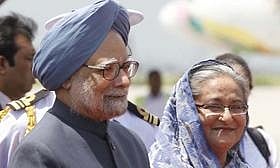
India urged to execute treaties
Delhi needs to show more commitment on trade, transit, other agreements, while Dhaka needs to stress its points emphatically, say experts.
bdnews24.com News Service
bdnews24.com
Published :
10 Feb 2012, 04:47 AM
Updated :
09 Aug 2022, 03:24 PM
Sheikh Shahriar Zaman
bdnews24.com Senior Correspondent
Dhaka, Feb 10(bdnews24.com)— India should be more proactive in implementing agreements with Bangladesh to show its sincerity in maintaining good ties with its eastern neighbour, two experts have said.
According to former finance adviser to the caretaker government A B Mirza Azizul Islam and former Bangladesh Bank governor Salehuddin Ahmed, the Indian government's attitude toward trade with its neighbour has created confusion and, in some cases, dented trust if the agreements remain unimplemented.
They said trade is important but non-tariff barrier should be removed, and Bangladesh must get its benefits in transit.
While welcoming Indian finance minister Pranab Mukherjee's upcoming visit to Dhaka, they suggested that India needs to do more in implementing the Teesta water treaty and land boundary agreements.
Mukherjee is expected to visit Bangladesh in the second half of this month.
TRADE
Mirza Aziz said Bangladesh has a huge trade deficit and the uneven balance in favour of India is not expected to change much, at least in near future.
"Trade is a very important factor in our relationship. It is true that Bangladesh's export to India is growing but it still is very uneven," Mirza Aziz said.
In 2010-11 fiscal, Bangladesh's export to India stood at $512 million, while the country's import was $4.58 billion.
He said India recently extended the duty-free facility for almost all products for entry into its market but Bangladesh's production capacity may pose a problem.
"We need to increase our production base to export more to India," he said.
Former BB governor Salehuddin said it is less likely that Bangladesh would benefit in short time from the zero-tariff facility extended to it. "Non-tariff barriers will be a major factor," he said.
Standard and testing problem, clearance from different agencies and ministries are good examples of non-tariff barriers.
Businesses are aware of them and should speak out against all non- and para-tariff barriers, Salehuddin suggested.
Trade gap between the two countries is heavily tilted towards India. Bangladesh's exports to India was $247 million in July-December period of the current fiscal, while in 2009-10 fiscal it imported goods and services worth $3.2 billion from the neigbouring country.
New Delhi recently extended duty-free facility to all products, except liquor and tobacco-related products.
TRANSIT
Mirza Aziz said the government should emphasise more on regional connectivity rather than providing the facility only to India.
There should be a collective effort to provide transit facility to China, India, Nepal and Bhutan, he said. A taskforce should be formed to expedite the process, he added.
According to him, bilateral arrangements may create problem. "Bangladesh may have transit arrangement with Bhutan or Nepal, and in that case India may have problems with that particular arrangement," he explained.
Salehuddin said Bangladesh's benefit from transit is not visible. "It is obvious that India will benefit but we still don't know how much benefit Bangladesh will get out of the arrangement," he said.
"It is understandable that India will protect its interest but Bangladesh should also prepare itself to safeguard own interest," the former central bank chief said. "The whole process is not transparent; we still don't know what is happening."
Transit has become a thorny issue between the neighbours after New Delhi failed to sign the interim Teesta agreement during Indian prime minister Manmohan Singh's visit last September. Dhaka then declined to sign the protocol on transit instrument.
Bangladesh, meanwhile, formed a core committee on transit to look into all aspects in detail. The committee submitted its report to the government recently.
Finance minister AMA Muhith recently said the government would take a decision shortly.
$1 BILLION CREDIT LINE
Mirza Aziz said both Bangladesh and India should sit together and remove obstacles in implementing the projects under the $1-billion credit line.
India announced the credit during prime minister Sheikh Hasina's visit to India in January 2010. The agreement was signed in August the same year in Dhaka in presence of Pranab Mukherjee.
India has so far agreed to finance about 15 projects, involving about $800 million, but has signed only about five final agreements.
The former finance advisor said India should ease the condition that Bangladesh procure 85 percent Indian manpower and machines under its credit.
Saleuddin said it should be done in a transparent manner. "Both governments should identify the problems and sort them out to implement it soon," he said. "What is the point of taking loans that cannot be utilised?"
He said Bangladesh can reject the fund if it finds the terms too rigid.
The Indian credit line bears 1.75 percent interest per year and it will be repaid in 20 years, with a five-year grace period.
TEESTA AGREEMENT
The former finance adviser said the government should be more serious in resolving the dispute over sharing Teesta water.
"The Indian government has its internal problems and does not want to make a coalition partner (Trinamool Congress in West Bengal) unhappy. But it should take it (the issue) seriously," he said.
About West Bengal chief minister Mamata Banerjee, he said relations between Dhaka and Banerjee seem to have deteriorated. "Bangladesh should communicate with her in an informal or unofficial way to resolve the dispute," Mirza Aziz suggested.
But calling it an "internal matter of India", Salehuddin said the Indian government should solve the matter itself. "There is no point in Bangladesh trying to get Mamata's consent to get the Teesta agreement signed," he said.
He also said when a government signs an agreement it must have proper comprehension of its consequences. He remarked, "When everything is final, they (India) are delaying the process by saying 'Oh, we have this problem, or we have that problem'."
Manmhoan Singh had failed to sign the interim Teesta agreement during his visit to Dhaka last year following strong opposition from Banerjee, whose party is an important coalition partner in Manmohan's Congress-led central government.
LAND BOUNDARY AGREEMENT
Mirza Aziz said India is yet to ratify the land boundary agreement, and West Bengal also has reservations about it.
Salehuddin said India is giving Bangladesh assurance but nothing concrete is taking shape.
bdnews24.com/ssz/std/bd/1000h