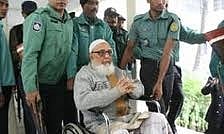
The categorical statement, although not in the form of an order, came from the three-judge International Crimes Tribunal–1 after Azam’s lawyer prayed for a day’s adjournment well before the end of the morning session.
Head of Jamaat-e-Islami’s East Pakistan unit during the 1971 Liberation War, Azam was indicted for five war crimes charges including conspiracy, complicity and incitement.
The former Jamaat chief’s counsel, Mizanul Islam, had begun the morning session with a new prayer to adjourn the proceedings for a week citing his lack of preparation.
The counsel said that his mother-in-law had died two days ago and he only arrived in Dhaka from Rajshahi early Sunday. “Hence I could not prepare adequately.”

Prosecutor Sultan Mahmud said that this was merely another ploy of the defence to delay the proceedings. “They keep citing the ‘unavoidable circumstance’ (a euphemism for general strike in the applications) for not being able to attend court. But it is the not the prosecution that is responsible for such situation.”
The prosecutor was evidently referring to the fact that the opposition parties, BNP and Jamaat-e-Islami, have enforced a string of country-wide strikes.
Most of the senior Jamaat defence counsels are full members of the party, which remains a key ally of the BNP.
Prosecutor Sultan Mahmud also noted that the defence case did not merely depend on Mizanul Islam only. “There are a number of other lawyers. And it is not correct that the defence hadn’t had the time to prepare.”
Tribunal member, Justice Jahangir Hossain said that the petition before them did not state any such grounds. “You have given a brief history of the case, mentioned the number of exhibits and the date of formal charge and so forth.”
The defence lawyer rose to speak but the judge said he would rather see the media heard what was in the petition. “Let us all be transparent here.”
Justice Hossain then noted the outline of the petition. The defence counsel admitted that his personal predicament was not mentioned in the application. “But I can add that and submit another application.”
The Chairman dismissed the proposition saying, “It is not a question of a new application. It is becoming that you don’t want to cooperate with us.”
Upon the defence counsel’s protest, Justice ATM Fazle Kabir spoke again, “The petition makes it very clear. It appears that you do not want to cooperate.”
The tribunal chief noted that even the application says closing arguments had begun on Feb 17 and pointed out to the defence lawyer that there had been ample time for preparation.
The defence counsel, however, kept insisting for an adjournment. Justice Hossain said that the lawyer should begin his deliberations. “And then we shall see.”
Another tribunal member, Justice Anwarul Haque then said, “But you are quite capable of speaking on the most trifling matters for hours!”
Mizanul Islam then began his arguments and dwelt upon few basic points for over an hour and reiterated his adjournment prayer.
It was at this time that the tribunal stated that there were no other cases throughout the week and expected that the defence would present its arguments.
“We have heard the prosecution at length and we would like to hear you as well.”
The tribunal also pointed out that in the defence counsel’s absence, the judges expected someone else of the defence team to continue with the arguments.
Mizanul Islam readily agreed. “Yes of course.”
The tribunal then clarified that it had meant the ‘unavoidable circumstances’ to which the defence counsel said, “I won’t be able to come but I may request others that they do.”
When the tribunal said that it would make arrangements for the counsel to come to court with security, he replied, “I do not have any faith in this police force, no.”
The counsel repeated his distrust of the police force in a way dismissing the judges’ suggestion.
The closing arguments will resume on Monday.
Jamaat Guru in ICT-1
On Dec 12, 2011, the prosecution brought a 52-point charter of charges against Azam and appealed for his arrest. Later, following the tribunal order, charges were re-arranged and presented to the tribunal on Jan 5.
He was produced before the tribunal on Jan 11 and sent to jail the same day. Since that evening, the 90-year old former Carmichael College professor has been kept in the prison cell of the Bangabandhu Sheikh Mujib Medical University for better treatment considering his delicate health.
Ghulam Azam’s indictment hearing began on Feb 15 and the court charged him on May 13.
A former chief of Jamaat-e-Islami, arguably the largest Islamist organisation in the subcontinent, Azam is allegedly among the key people who pioneered anti-liberation efforts in 1971 colluding with the Pakistani military junta of that time.
He is widely perceived to have been among the core group of right-wing supporters of the Pakistani Army, who came out strongly in support of a united Pakistan.
Ghulam Azam, then chief of Jamaat, was instrumental in setting up the infamous Peace Committee at the national level. The Razakars, an auxiliary force set up mainly to actively thwart the liberation forces, are said to have been mobilised through the Peace Committees across Bangladesh.
Among the most notorious vigilante militia are the Al Badr, whose membership is said to have been mainly dominated by the Jamaat's student wing called the Islami Chhatra Sangha at that time.
The Al Badr is alleged to have spearheaded execution of the intellectual elites of Bangladesh just days before the victory on Dec 16, 1971.
Azam also spoke in favour of Pakistan to the Middle Eastern countries during the war, according to the prosecution.
He stayed in London for seven years after 1971 and returned to Bangladesh in 1978 during BNP founder Ziaur Rahman's rule. Having led Jamaat for long, Azam retired from active politics in 1999.
His party remains a key ally of the main opposition BNP. Two Jamaat leaders, also behind bars for war crime charges, have even served as ministers during the BNP's last tenure in government between 2001 and 2006, when Azam's party was part of the ruling coalition.
Azam was indicted on five charges — 61 counts — including incitement, conspiracy, planning and complicity on May 13, 2012.