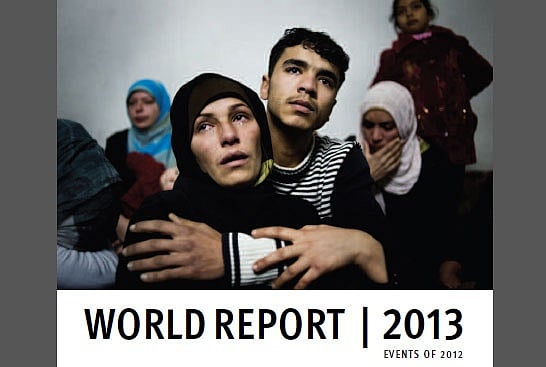
In its ‘2013 World Report’ released on Friday, the rights group criticised the Awami League-led Grand Alliance government harshly.
It said the government narrowed political and civil society space, continued to shield abusive security forces from accountability, and flatly ignored calls by the Human Rights Watch to reform laws and procedures in flawed war crimes and mutiny trials. Civil society and human rights defenders reported increased governmental pressure and monitoring.

The report said, “The government was increasingly hostile in 2012 to civil society groups. Following the July 2012 publication of a Human Rights Watch report on the 2009 Bangladesh Rifles mutiny, Bangladeshi officials threatened action against domestic rights groups who had helped conducting the research.”
It also questioned the trial process of the International Crimes Tribunal, which was set up to expedite the trials of the accused war criminals for crimes against humanity like genocide, murder, arson, rape and loot during the War of Independence in 1971.
In the report’s Bangladesh chapter, the HRW said, “The security forces’ practice of disguising extra-judicial killings as “crossfire” killings or legitimate confrontations between alleged criminals and security forces continued, as did disappearances of opposition members and political activists. A prominent labour activist was kidnapped and killed, and other labour activists threatened.”
“This government came to power promising the end of extrajudicial killings, a liberal environment for activists and critics, and an independent judiciary,” said HRW's Asia Director Brad Adams in a statement released from London on Friday. “But the government no longer seems to even be trying to achieve these goals.”
The rights group said that while Bangladesh has a strong set of laws to tackle violence against women, but the implementation remains poor. Violence against women including rape, dowry-related assaults, and other forms of domestic violence such as acid attacks, sexual harassment, and illegal punishments in the name of “fatwas” continue.
“Bangladesh reported the highest prevalence of child marriages in the world. Archaic and discriminatory family laws for Muslims, Hindus, and Christians, continued to impoverish many women when they separate from, or divorce spouses, and trap them in abusive marriages for fear of destitution. The Law Commission of Bangladesh researched and recommended reforms to these laws in 2012.”
Workers in the lucrative tannery industry continue to suffer physically from terrible conditions inside the tanneries, the HRW said in the report, causing both acute and long-term hazardous health situations, while regulations to ameliorate these conditions have gone unheeded.
“One of the most disturbing trends in 2012 was increased pressure and monitoring of civil society. Non-governmental organisations, including human rights groups, reported increased threats, harassment, and intimidation.”
“Several human rights groups, particularly those openly critical of the government, reported problems with registration and government blocking of funds for their projects. Several leading labour rights activists continue to face criminal charges, some of which carry a possible death sentence.”
The report said the government drafted a bill regulating foreign donations which has the potential to legalise the already arbitrary and non-transparent process by which the government regulates the receipt of foreign funding.
Although not yet passed, NGOs reported that many of the cumbersome mechanisms in the bill were already being put into practice. In August 2012, the government announced plans to establish a new commission charged solely with regulating NGO activities, in addition to the already existing NGO Affairs Bureau, which continues to be accused of routine corruption by the NGOs, it added.
The HRW said it had welcomed a decrease in extra-judicial killings in 2012 by the Rapid Action Battalion (RAB), a force comprised of military and police, but the number of killings remained very high.
“Although an internal investigative unit was set up in 2012 to inquire into and prosecute RAB members, very little is known about what action, if any, this unit has taken. Independent observers reported that the offenses examined by the internal investigative unit are routine disciplinary offenses, and that more serious allegations of extra-judicial summary killings and disappearances remain unexamined.”
“While government and RAB officials claimed that they held abusers accountable, it is still a fact that no RAB officer or senior official has ever been held criminally accountable for any of the well-documented abductions, torture, or killings carried out by RAB,” Brad Adams said in the statement.
“Even in the highly publicized case of the shooting of the school boy Limon, no one has been charged, yet the authorities continue to proceed with a flawed prosecution against him,” he said.
The statement said flawed trials against members of the Bangladesh Rifles accused of mutineering in 2009 continued in 2012.
Human Rights Watch had issued a report in July last year outlining credible allegations of custodial torture and deaths, as well as mass trials in gross violation of due process rights. Instead of investigating the allegations, the government simply dismissed them, with the then Minister of Interior flatly denying any abuses in a meeting with Human Rights Watch before reading the report.
“The government insisted that trials against as many as 800 accused at a time were procedurally sound, despite the fact that many accused had no assistance of counsel and in many cases were unaware of the charges laid against them. Many of these accused in ongoing trials face the death sentence if found guilty.”
The report also said that the trials against those accused of war crimes during the 1971 War of Independence continued, despite calls by the US war crimes ambassador, Stephen Rapp, and several international groups to amend the International Crimes Tribunal Act (ICT Act) to ensure it complied with international fair trial standards.
“The trial chamber allowed several prosecution witnesses statements as evidence, without any live testimony being heard. While the prosecution claimed the witnesses were unavailable, the defence produced safe house logbooks that showed they were available at the time when they were meant to appear in court. However, the tribunal rejected the defence’s claims. In the first trial against the accused Delwar Hossain Sayedee, defence lawyers claimed that they could not produce their witnesses due to intimidation and threats against them by the prosecution. The prosecution denied the claims,” the report read.
In this regard, the statement released on Friday said, “Glaring violations of fair trial standards became apparent in 2012 in the trials of the International Crimes Tribunal (ICT), a wholly domestic court set up to try those accused of war crimes during the 1971 war of independence. One of the present government’s central campaign pledges in 2008 was to ensure that these long overdue trials took place.”
“Human Rights Watch has long called for justice for victims in the 1971 liberation war. However, serious flaws in the law and rules of procedure governing these trials have gone unaddressed, despite proposals from the US government and many international experts.”
It said, “All the ICT trials underway in 2012 were replete, with complaints from both the prosecution and defence. Each side accused the other of witness intimidation. In one apparently serious irregularity, the prosecution claimed that it was unable to produce several of its witnesses and asked that written statements be admitted as evidence, absent any direct or redirect examination.”
“The court granted the request despite the fact that the defence produced government safe house logbooks which appeared to show that some of these witnesses had been in the safe house and available to testify. In one case, when on November 5 the defence attempted to bring one of these witnesses, Shukho Ranjan Bali, to court, he was abducted from the gates of the court house by police officers in a marked police van.”
“In December, The Economist published an article detailing some hacked email and Skype conversations between the Chairman of the ICT and an external adviser based in Brussels. These communications revealed longstanding prohibited contact between the Chairman, the government, the prosecution, and the advisor.”
“They showed direct government interference in the operations of the ICT. The publication of these communications caused the Chairman to resign, leaving a bench in which none of the three judges has heard the totality of the evidence against the accused. Motions for retrials in four of the cases due to these communications were rejected by the tribunal, calling into question its impartiality.”
“The trials against the alleged mutineers and the alleged war criminals are deeply problematic, riddled with questions about the independence and impartiality of the judges and fairness of the process,” Adams said. “This is tragic, as those responsible for serious crimes could end up appearing to be victims of a miscarriage of justice. By dismissing all criticism out of hand without any real inquiry into them, the government shows it is more concerned about winning votes than about following the rule of law.”
The HRW also said that the Bangladesh government flouted its international legal obligations in June 2012 when sectarian violence in Arakan state in neighbouring Burma led to an influx of Rohingya refugees into Bangladesh.
“The government responded by pushing back boatloads of refugees, insisting it had no obligation to provide sanctuary for them. The government also curtailed the activities of NGOs operating in pre-existing Rohingya refugee camps in Cox’s Bazaar.”
The report read, “The government suspended any third-country resettlement of the Rohingya refugees, arguing it would encourage other Rohingya in Burma to seek refuge in Bangladesh. Government officials labelled Rohingya “intruders” and “criminals,” and blamed them for destroying Buddhist temples in mass riots in October, without offering evidence to prove they were responsible.”
“The government seems to view every critic, including reputable domestic NGOs, as part of some vast conspiracy to topple it, instead of organizations genuinely interested in improving the country,” Adams said. “This attitude of ‘you’re either with us or against us’ characterized its reaction to issues ranging from the war crimes and mutiny trials to responsibility for factory fires and labour rights.”