Published :
26 Jun 2013, 09:00 AM
Updated :
09 Aug 2022, 10:50 AM

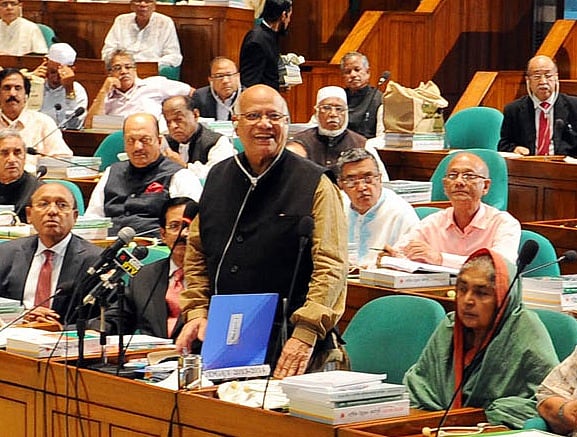
The minister said this in an informal discussion on the bank’s affairs in Parliament on Wednesday.
Senior BNP senior leader Moudud Ahmed said “it will be ‘suicidal’ for the government to try and decentralise its structure”.
He also said the Grameen Bank’s ‘entire power’ and ‘independence’ would be restored if BNP were to return to power.
The BNP leaders’ remark prompted the finance Finance Minister to offer a detailed profile of the institution.
Prime Minister Sheikh Hasina was present through the discussion lasting almost an hour.
Muhith recalled the institution’s founding through the Grameen Bank Ordinance in 1983, giving the government 60 percent of its share and 40 percent for its clients.
The ordinance was amended in 2002, altering the share structure to give 75 percent share to its women clients and 25 percent to the government. This arrangement has been in force since.
“We have no intention to change the characteristics of this bank. Grameen Bank will run as it is.”
The institution and its founder Muhammad Yunus were awarded the Nobel Peace Prize for their role in reducing poverty.
Later, in 2010, a Norwegian TV telecast a documentary claiming that Prof. Yunus had illegally transferred aid money for the Grameen Bank to a sister enterprise.
The controversy prompted the present government to initiate a probe into Grameen Bank affairs. The investigating panel recommended the bank’s decentralisation, according to media reports.
A banks matter is again slated for discussion in Dhaka’s BIAM auditorium on Jul 2.
Nine women directors on the bank’s board had suggested at a press conference on Monday that the government should not pursue the restructuring plan.
Muhith was critical in Parliament of the manner in which the issue blew up into a controversy. “There was suppose to be a seminar with Mr. Yunus at its centre. I don’t know if he has got the invitation. But he orchestrated a press conference in the time being to put the government under pressure. He is truly a politician.”
Muhith said Yunus was a “respectable person” against whom he was reluctant to comment was forced to do so by circumstances.
He also rejected Yunus’s claim that the Grameen Bank had little to do with Grameen Phone. “The statement is untrue. Not correct at all,” Muhith said.
He asserted that all the social businesses in operation were, in fact, Yunus’s personal ventures.
He said he was expecting a report on this within 15 days and promised to place it in Parliament.
The minister claimed Yunus had been working against the bank’s interest ever since he quit being its Managing Director. “He first told everyone ‘withdraw your deposits’. He told its employees: your jobs are over. Go down to the streets to stage protests.”
He said the bank’s operations had improved Yunus’s departure.
“He was never able to devote time to it. Board meetings used to be held but no decision could be taken. Grameen Bank’s activities have now increased compared to what it was under him,” Muhith said.
He cited statistics showing that microfinance accounted for Tk 330 billion Tk 330 billion in the country’s banking sector in December last year while its share was just Tk 160 billion with Yunus at helm.
Muhith informed Parliament about the government’s initiatives to develop the microfinance sector.
Grameen Bank had suffered massive losses because of floods in 1998. The government had provided Tk 4 billion to help the institution out of a financial tight spot, the minister said.
He also said the government had played a vital role in securing UN recognition for microcredit.