Published : 02 Dec 2017, 02:34 AM
Updated : 19 Oct 2022, 03:51 PM


Two days earlier, Parbatya Chattagram Janasanghati Samiti leader Jyotirindro Bodhiprya Larma aka Santu Larma said on the 20th anniversary of the deal that tribal people of the hill tracts were getting frustrated at all the conditions not being fulfilled.
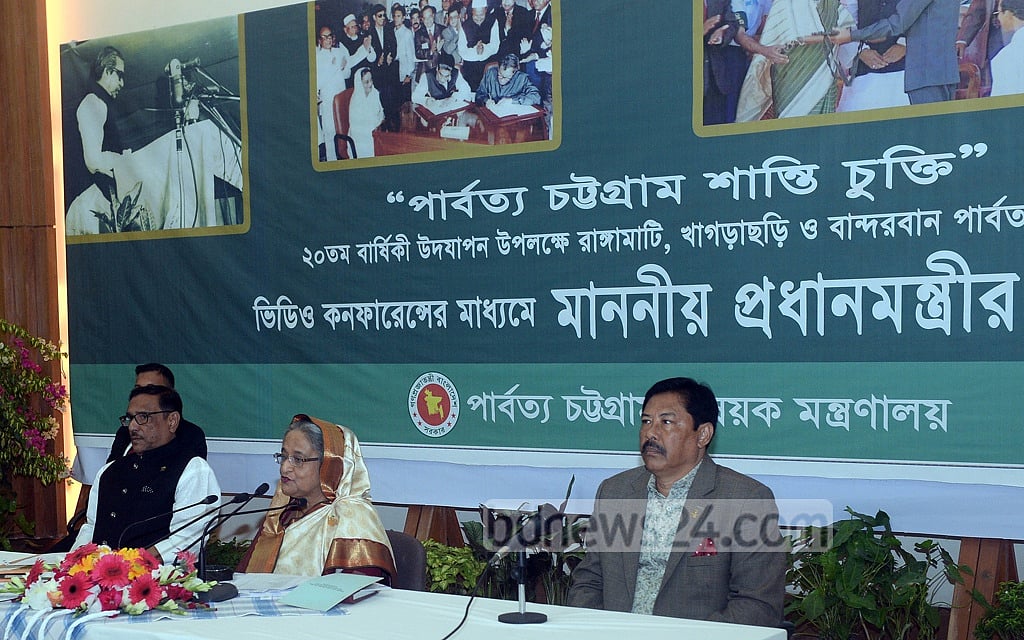
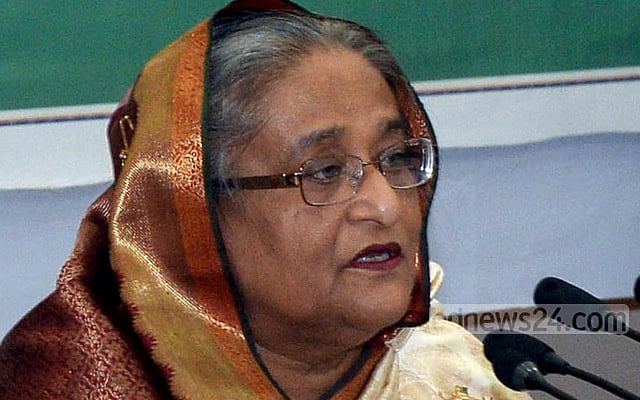
At a video conference from the Ganabhaban with representatives of the three hill districts to mark the anniversary of the deal on Friday, Hasina said 48 of 72 conditions set in the accord have been ‘fully implemented’ while 15 others were ‘partially fulfilled.
“The remaining nine will also be fulfilled,” Hasina said.
She also said her government amended a law in 2016 to fully operationalise the accord.
The prime minister said some duties were supposed to be transferred to the councils of the hill districts in line with the deal.
“The army camps have been withdrawn in line with the deal,” she said.
The prime minister also mentioned her government’s efforts to develop infrastructure in the three districts, expand mobile phone network, establish educational institutions, and expand tourism and commerce in the areas.
She also mentioned the setting up of road links to remote Thanchi and Sajek Valley areas.
“In this way, most parts of the deal have been implemented.”
Hasina, however, admitted that the issue of settling land disputes was ‘complex’ and that her government has formed a land commission to settle them.
“I hope we will be able to implement this as well if the Chittagong Hill Tracts Regional Council cooperates with us,” she added.
The members of the group surrendered arms to Hasina three months into signing the deal.
The prime minister said the Awami League took steps to end the conflict after it formed the government in 1996 and succeeded in signing the deal in a short period.
“Many countries signed such deals, but no one could do it as fast as we did.”
She also blamed the coalition of the BNP and Jamaat-e-Islami, which came to power in 2001, for delaying the implementation process.
“Everyone knows that they objected to the deal.”
She added that the implementation gained pace again when the Awami League returned to power in 2009.