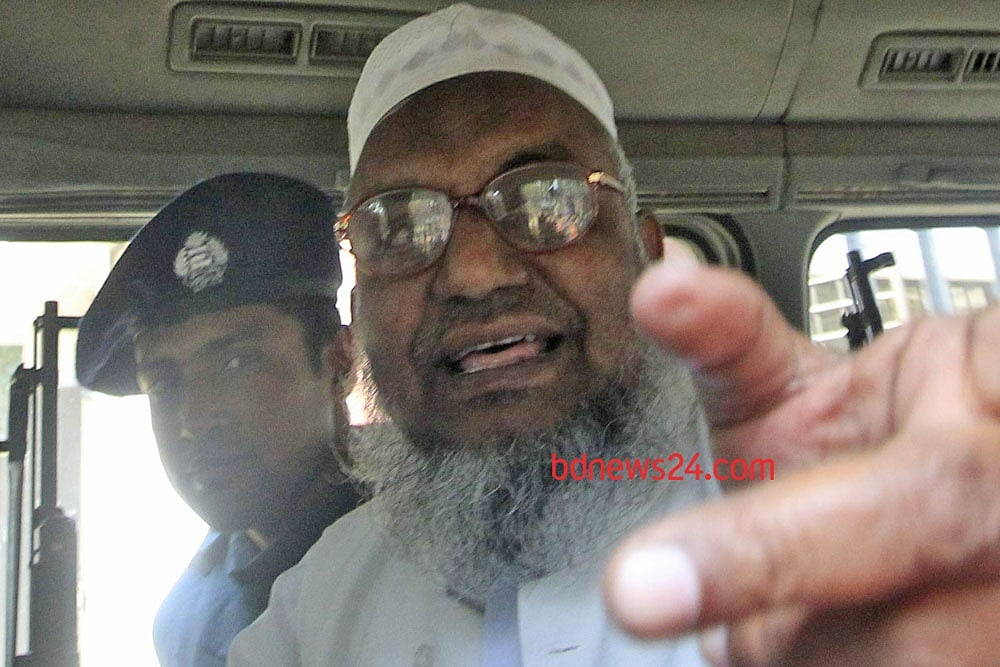
Justice Md Abdul Wahhab Miah, who had differed with the other judges on the death penalty, submitted his verdict on Sunday, said court officials.
Speaking to bdnews24.com, prosecution coordinator in the war crimes tribunal, Additional Attorney General MK Rahman also said: “Writing of the full verdict has finished.”
It was done 68 days after the Supreme Court dismissed Molla’s plea that he be cleared of all war crimes charges.
Instead, it enhanced his life sentence to the maximum punishment possible on a prosecution appeal.
The Chief Justice had led the bench of five judges which delivered the verdict on Sept 17, but Justice AHM Shamsuddin Choudhury wrote the main verdict.
Justice Surendra Kumar Sinha had agreed with the death sentence but also gave separate opinion.
Chief Justice Md Muzammel Hossain and Justice Syed Mahmud Hossain also agreed with the final verdict.
According to the procedure, if more than one judge writes the verdict, the Chief Justice will gather them firsthand. Then the final copy of the verdict will be published with signatures of all the judges.
The bench that heard the appeal had comprised of justices Sinha, Wahhab Miah, Mahmud Hossain, Siddiqur Rahman Mia and Choudhury. But after Justice Rahman’s retirement in June, the bench had been working with five members.

The top appeals court had given the Jamaat leader maximum penalty with a 4-1 majority after reviewing two appeals regarding a verdict handed down by the International Crimes Tribunal-2.
Six charges were levelled against Molla but the ICT-2 acquitted him in one, and sentenced him to life for the rest.
Punishment of the tribunal was maintained on four charges while the fifth one was revised to life term by 4-1 majority.
The verdict said Molla, whose ‘lighter’ life sentence had triggered ‘Bangla Spring’ from Shahbagh, will be hanged until death as he was found guilty of previously unproven murders and rape during the 1971 war.
The sixth charge accused Molla of directing a band of men with him to shoot Hazrat Ali Lashkar, slaughter his pregnant wife and youngest daughter, and slam his 2-year-old son against the ground and kill him on Mar 26 at their Mirpur Section 12 residence.
One of Lashkar’s daughters was also raped.
According to the fourth charge, he had led a group of Razakars and killed hundreds of unarmed villagers in Keraniganj’s Bhawl Khanbarhi and Ghatarchar on Nov 25, 1971.
The ICT-2 had acquitted Molla of this charge, but the Appellate Division revised the punishment and gave him life imprisonment.
The appeals court maintained the tribunal’s punishments on the first, second, third and fifth charges.
The first of the charges accuses him of allegedly ordering the shooting of a Mirpur Bangla College student, Pallab, on Apr 5, 1971.
The second charge said the Jamaat leader had killed poet Meherunnisa, her mother and two brothers on Mar 27 at their Mirpur residence.
He had allegedly picked up journalist Khandkar Abu Taleb from Arambagh and slaughtered him in the Jalladkhana Pump House on Mar 29, according to the third charge.
Molla went to Alokdi village on Apr 24 along with the Pakistan army and a band of Razakars, and went on a killing spree. Over 344 residents of the village were killed in the massacre, according to the fifth charge.
The verdict on ‘Koshai Quader’ or ‘Butcher Quader’, as he was known then, on Feb 5 this year was the first one delivered by the second war crimes tribunal of Bangladesh, set up to expedite the trials of the war criminals of 1971 Liberation War.
People, who had expressed ‘dissatisfaction’ over his life imprisonment seven months ago, hailed the death penalty saying it served the Jamaat Assistant Secretary General right for his war-time atrocities.
On the other hand, his party, which is described in one ICT verdict as a ‘criminal outfit’, had rampaged through parts of Bangladesh by taking out processions, detonating crude bombs, fighting pitched battles with police, setting afire police vehicles and enforcing a 48-hour nationwide shutdown starting from the following day.
The Jamaat also termed the verdict a ‘wrong’ one.
Those seeking maximum penalty, including Shahbagh’s Ganajagaran Mancha, had called for swift execution of the verdict. Prime Minister Sheikh Hasina had told Parliament the war crimes sentences would be executed quickly.
After the final verdict, there was no other way left for Molla, who is currently in the condemn cell at Kashimpur Central Jail, but to seek mercy from the President, former Law Minister Shafique Ahmed had said then.
However, chief defence counsel Abdur Razaq had said that it was Molla’s constitutional right to appeal for a review.
Officials at the Kashimpur jail had said if the convict did not seek presidential clemency or if the President rejected his plea, Molla’s death sentence would be carried out within 21 to 28 days.
Shafique Ahmed had also hinted that the President would reject Molla’s plea. “Clemency, in these situations, is usually not granted anywhere in the world.”
Razzaq said it depended on Molla’s family whether they would seek forgiveness from the President.
Quader Molla was arrested on July 13, 2010 in a murder case that took place during the Liberation War. Later he was charged with war crimes.
On May 28, the second war crimes tribunal of Bangladesh started trying him and sentenced him to life in prison on Feb 5.
Molla had flashed a ‘victory’ sign while leaving court that day and his gesture had triggered an unparalleled uprising from Shahbagh in capital Dhaka.
Millions of people had come out on the streets in full fury and staged non-violent demonstrations for days on end to demand highest penalty for war crimes conviction.
The judgment came after the protests forced the government to amend the appeals right for the prosecution. Previously, the prosecution could appeal only in case of an acquittal.
The defence had sought his acquittal while the prosecution pleaded for maximum penalty.
Hearing on the appeals began on Apr 1 but the defence was quick to question if the amended Act would be applicable since it was done after Molla’s conviction.
After consulting the amici curie, the Supreme Court decided the amendment would be applicable for the Jamaat leader.
After five months of hearing, on Sept 17, the five-strong Appellate Division bench headed by the Chief Justice, had accepted the prosecution plea and gave death penalty to Molla.
Molla in the dock
A case was filed with Keraniganj police on Dec 17, 2007 accusing several Jamaat leaders of the killing of one Mostofa during the Liberation War.
A year later, another case was filed against him at the capital’s Pallabi Police Station. He was arrested in this case.
Prosecution pressed charges of murder, rape, arson and other crimes against humanity on Nov 1, 2011 and tribunal took them into cognisance on Dec 28.
ICT-2 indicted him on six charges on May 28 last year and ordered starting his trial.
The tribunal on Jan 17 had kept the verdict pending after finishing the arguments in the war crimes case. Then it gave its first verdict on Feb 5.
The amici curiae, or friends of the court, appointed during the Appellate Division hearing are former Attorney General Barrister Rafique-Ul Huq, Barristers Amir-Ul Islam, Rokonuddin Mahmud and Ajmalul Hossain QC, former Attorneys General AF Hassan Ariff and Mahmudul Islam, and TH Khan.