November 23, 2026

FM stresses cultural bridges

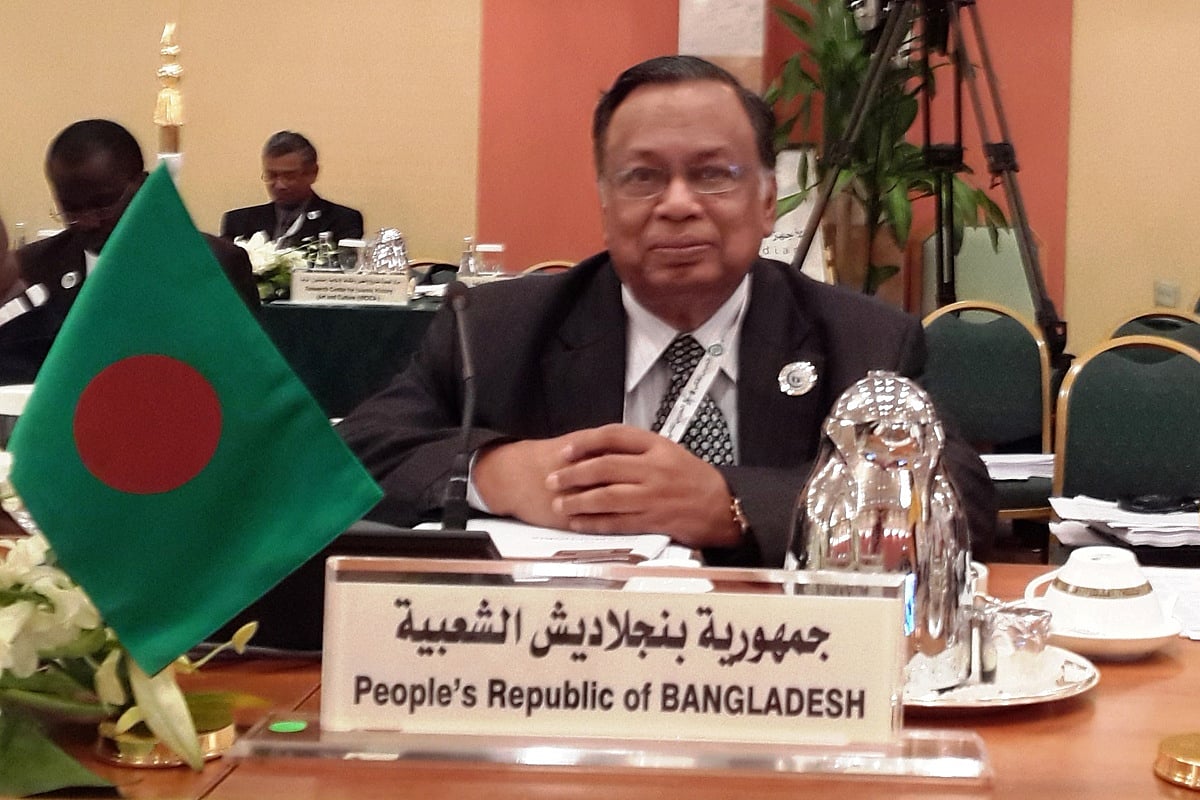
The foreign minister has called for “building bridges” between the Muslim world and the rest while making a forceful plea for “peace, prosperity and development” of Muslims at the OIC foreign ministers’ meeting in Jeddha.

Senior Correspondent

bdnews24.com

Published : 19 Jun 2014, 09:29 PM

Updated : 19 Oct 2022, 07:31 PM

Abul Hassan Mahmood Ali addressed two sessions at the opening of the 41st meeting of the OIC foreign ministers on Wednesday, the foreign ministry said on Thursday.

The Organisation of Islamic Cooperation (OIC, a group comprising 57 Muslim countries, was established in Sep 1969 to protect the interest of the Muslim world in the spirit of promoting international peace and harmony across the world.

The foreign minister said Islam was “a religion of peace”, but expressed his distress that “a large part of the Muslim world is in the conflict zones of the day”.

He hoped that the common faith and cultural affinity of OIC member states would inspire them towards “greater cohesion and solidarity to work hand-in-hand for attaining peace, prosperity and development for the peoples”.

“The OIC member states must strive to expand Islamic cooperation to address the conflicts and divisions,” he said as he observed that those conflicts and divisions were “threatening to the unity of Ummah”.

He called for “building bridges between the Muslim world and the rest of the world, embracing broadness to address sectarian divisions, and zero tolerance to terrorism”.

He also suggested the Muslim world should pursue “inclusive development as elaborated in the 'peoples empowerment and peace-centric development model' of Prime Minister Sheikh Hasina adopted by the 67th UN General Assembly in 2012”.

The foreign minister also called for finding new areas of cooperation under the OIC as the organisation is on its way to adopt a new ten-year ‘programme of action’.

He spoke on behalf of the Asian Group at the opening ceremony on the theme “exploring areas for Islamic cooperation” and, later, he on behalf of Bangladesh, on “Peace in the Changing World: Vision of the Organization of Islamic Cooperation”.

According to the foreign ministry, he also suggested sharing the best practices among OIC member states to “transform societies in a positive manner”.


And in this regard, he expressed Bangladesh’s readiness to share its own stories, particularly those on “maintenance of religious and sectarian harmony, containment of terrorism, contribution to peace-keeping, empowerment of women, flourishing of civil society and innovations for social development”. He also encouraged “cooperation and coordination” on global issues such as sustainable development goals, the post-2015 development agenda, and climate change. He again reiterated Bangladesh’s consistent support for an independent and sovereign State of Palestine and welcomed the recent formation of the national consensus government in Palestine. Speaking at a meeting of the ‘OIC Contact Group on Muslim Minority in Myanmar’ held on the sidelines of the ministers’ meeting, the foreign minister welcomed OIC efforts for engaging with Myanmar. OIC secretariat is interacting with Myanmar on the rights and welfare of the Muslim minority in the country’s Rakhine state. Ali welcomed the appointment of former Malaysian Foreign Minister Syed Hamid Albar as the Special Envoy of OIC Secretary General for Myanmar. He also expressed hope that the new Special Envoy would be able to make progress on issues with the Myanmar government. He said Bangladesh supports OIC efforts to promote the rights and welfare of Muslim minorities in Myanmar’s Rakhine state through cooperation with the Burmese government for a lasting solution to the problem. He also indicated that Bangladesh government has been pursuing its goal of “building a robust, friendly and mutually beneficial relation with Myanmar”. Ali said Bangladesh was “committed to resolving the issues of influx and return of refugees from Myanmar through sustained dialogue, understanding and cooperation”. He sought OIC member states’ support to develop the Islamic University of Technology, a subsidiary organ of OIC based in Bangladesh, into a centre of excellence, to increase the Muslim world’s technological know-how. He particularly sought help to construct a dormitory for female students in the University and form an endowment fund for enhancing its research and development capacity.
Related Stories