


Published : 10 Apr 2019, 12:10 PM
Updated : 08 Apr 2022, 02:07 PM


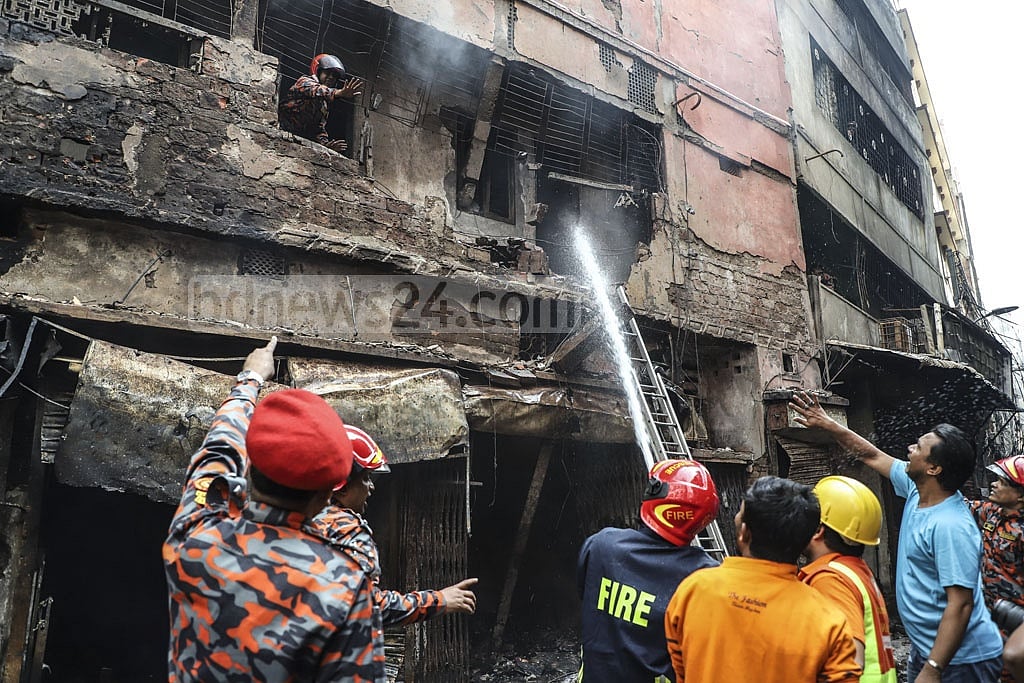
“We need non-stop water supply to extinguish fires. We can’t battle fires without water,” said Ali Ahmed Khan, the former director general of Fire Service and Civil Defence.
He spoke about the issue of a water crisis during fire-fighting efforts to bdnews24.com in the aftermath of a series of blazes which took place in previous years.
Recounting the efforts to tame the flames in Banani’s FR Tower on Mar 28, a fireman said, “The water supply dried up quite a few times during our efforts to douse the blaze which is why the flames reappeared.”
“We could have doused the fire a lot sooner had there been an uninterrupted flow of water,” he added.
Fire fighters had the same refrain in the aftermath of the fatal blaze in Old Dhaka’s Chawkbazar only a month and a half ago. The two blazes left nearly 100 casualties in its wake.
The lack of water hamstrings the fire service’s effort to battle flames, Ali Ahmed lamented.
“We have to depend on the water reserves at nearby buildings when a fire erupts. It is quite troublesome and takes a long time to set up the pumps. Having a water hydrant nearby is the best option.”
Water hydrants are considered the best solution in places which lack adequate water reserves. In developed countries, water hydrants are set up at different places to counteract emergency situations.
Generally, the fire hydrants are set up along the roadside as the water stored in fire trucks is general not sufficient to tackle fires in most cases. The hydrant remains connected to the main water reservoirs in the city. Therefore, firemen can easily tap in to the city’s water supply by connecting the hose to a hydrant in case of a fire incident.
The underground reservoir tanks in city buildings are not enough to battle deadly fires, said Debashish Bardhan, deputy director of the Directorate of Fire Service and Civil Defence.
Having fire hydrants would make the fire service’s job a lot easier, Director Maj AKM Shakil Newaz told bdnews24.com.
A recommendation regarding the installation of fire hydrants is invariably made after a fatal fire but is never implemented, according to members of the fire service.
But the authorities are unclear about which body bears the responsibility of setting up fire hydrants.
The Dhaka Water Supply and Sewerage Authority has distanced itself from the responsibility, as have the Dhaka City Corporation and Rajdhani Unnayan Kartripakkha.
All 870 WASA pumps have fire hydrants in it but it is not the water supply authority’s duty to set up the same on city roads, said Dhaka WASA Managing Director Taksim A Khan.
“We have no plan to set up fire hydrant along city roads. Fire hydrants are part of the city plan. WASA is supposed to supply water only.”
“We can provide the water, but who’ll do the system?” the WASA managing director asked.
On the other hand, RAJUK Chairman Abdur Rahman remarked that it is the duty of the Dhaka WASA to put fire hydrants in the city.
“This is an issue of water and it is Dhaka WASA’s responsibility to supply water,” he told bdnews24.com.
RAJUK’s Purbachal or other housing projects are said to be modern suburbs though they too do not include fire hydrants in the plan.
The upcoming housing projects of RAJUK will have fire hydrants, said Abdur Rahman.
“Fire hydrants will be installed in the third phase of Purbachal, Jhilmil, Uttara projects. Also, we are pondering about setting up fire hydrants in our old projects. It may take some time, but we’ll do it.”
“It’ll be a great help to fight the fire if there are fire hydrants in the streets. But we haven’t had any discussion on it,” Dhaka South City Corporation Mayor Sayeed Khokon told bdnews24.com.
Water reservoir as alternative
Dhaka lacks sufficient water reservoirs which can be an alternative source of water for fight fighting.
The existing water reservoirs can become a solution to the problem if they are preserved, said former fire service director general Ali Ahmed Khan.
“The existing water bodies are filled up or dried. They should be dredged and have water stored in them until we have the fire hydrants set in the city,” he said.
“We could easily get water from the Gulshan Lake when the fire occurred in DNCC Market. But all the lakes are being filled up. We wouldn’t cry for water if all of the lakes were maintained properly,” Deputy Director Debashish Bardhan told bdnews24.com.
The city authorities could not provide actual data on water bodies in the city.
At least 408 square kilometre in their 1,528 square kilometre Detail Area Plan consist water bodies, said RAJUK.
Also, there are 13.717 square kilometre of water bodies in the 306.38 square kilometre of Dhaka Metropolitan area. This includes 10.584 square kilometre in DNCC and 3.133 Square kilometre in DSCC.
Most of these water bodies are part of the flood-prone areas outside the capital.
The Directorate of Fire Service and Civil Defence has identified 99 water bodies in both city corporations in its ‘topographical survey.’
There are two lakes near Siddikbazar Fire Station. Also, there 11 waterbodies near Postogola Fire Station, five near Lalbagh Fire Station, six near Palashi Barack, six in Khilgaon, three in Tejgaon, six in Mohammedpur, three in Hazaibagh, two in Sutrapur, 13 in Mirpur and seven in Baridhara Fire Station area. The highest number of water bodies is found near the Kurmitola Fire Station, with 35.
Experts believe the number of water bodies is insufficient. Some of the water bodies do not have water in it, according to members of fire service.
There are many industrial factories in Tejgaon with a residential area surrounding it. There are only three ponds in the neighbourhood of Tejgaon Fire Station, which is not enough, said Senior Officer Faisalur Rahman.
“It is not enough to have three ponds in such a big neighbourhood. Scarcity of water becomes a big issue while fighting fire,” he told bdnews24.
Khilgaon Fire Station has six water bodies including five ponds and a lake in its neighbourhood. Also, there are some canals nearby. But only the ponds can be used as a source of water, said Senior Station Officer Ali Azam.
“It is easy to get water only from the ponds in case of fire in nearby buildings. It helps to douse the fire. But the lakes are filled now and the canals don’t have water either,” he told bdnews24.com.
RAJUK has taken necessary measures to preserve the water bodies in its DAP area, said its Chairman Abdur Rahman.
“We won’t allow the lowlands along the DAP to be filled and Dhaka WASA to preserve it.”







