November 23, 2026

Fair brings Taher to life

Thirty seven years after he was hanged in a farcical trial, Lieutenant Colonel Abu Taher, who dreamed of building a productive army and a socialist society, was virtually brought back to life at a fair organised on his birth anniversary on Friday.

Suliman Niloy Suliman Niloy

bdnews24.com

Published : 15 Nov 2013, 10:10 PM

Updated : 20 Oct 2022, 03:41 PM

The fair was organised at TSC at the Dhaka University campus to mark his 75th birth anniversary to disseminate the dream and ideals of Taher, who was one of the sector commanders in Bangladesh’s Liberation War, to the new generation.

Newspaper reports and articles on the 1971 Liberation War, Taher and Nov 7 events were displayed and tales from Taher’s life were told at the fair.

One of such tales was about how a 10-year-old Taher prevented a robber from snatching money from a Hindu saint in Sylhet, where Taher’s family were living as his father was working as a railway station master, late in 1947.

The bystanders initially did not dare to accost the robber Shafat Boksh, but by seeing Taher confronting him, they got the courage and joined him.

Taher was born on Nov 14, 1938 at Badarpur in Assam in British India. His ancestral home was in Kajla village under Purbodhola Police Station in Netrokona.

Taher joined the Language Movement when he was a student of Fatehbad School in Chittagong. He got bachelor degree from Chittagong MC College in 1959. He was admitted to Institute of Social Welfare and Research of Dhaka University but later joined Pakistan Army before completing his study.

Taher participated in the Indo-Pakistani War of 1965 in the Sialkot sector of Kashmir. He was injured in the war. He received an award from the Pakistan Army for his heroic role in the war. He trained a group of liberation-seeking youths while he was working at Chittagong cantonment from 1967 to 1969.

After July 20, 1971, Taher along with three other Bengali officers – Maj Abul Manzoor, Capt Ziauddin and Capt ‘Patwari’ – defected from the Pakistan Army to join Bangladesh’s Liberation War and crossed the border near Abbottabad into India. He was later made the Commander of Sector-11.

Taher launched an offensive against the Pakistan Army at Kamlapur, the gateway to capital Dhaka, on Nov 14, his birthday and was injured. He lost one of his legs in the fight.


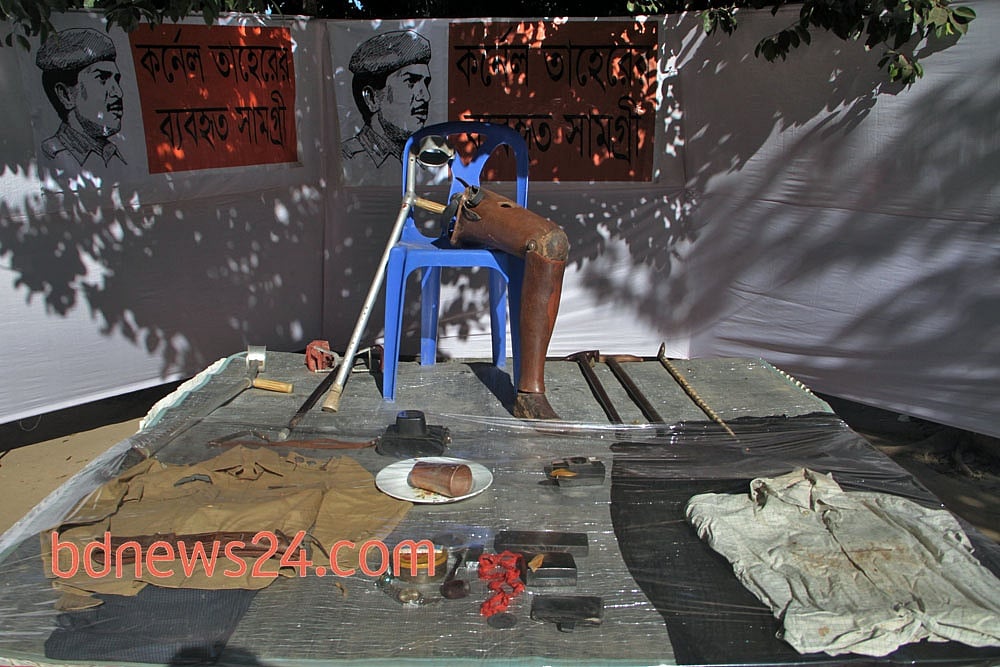
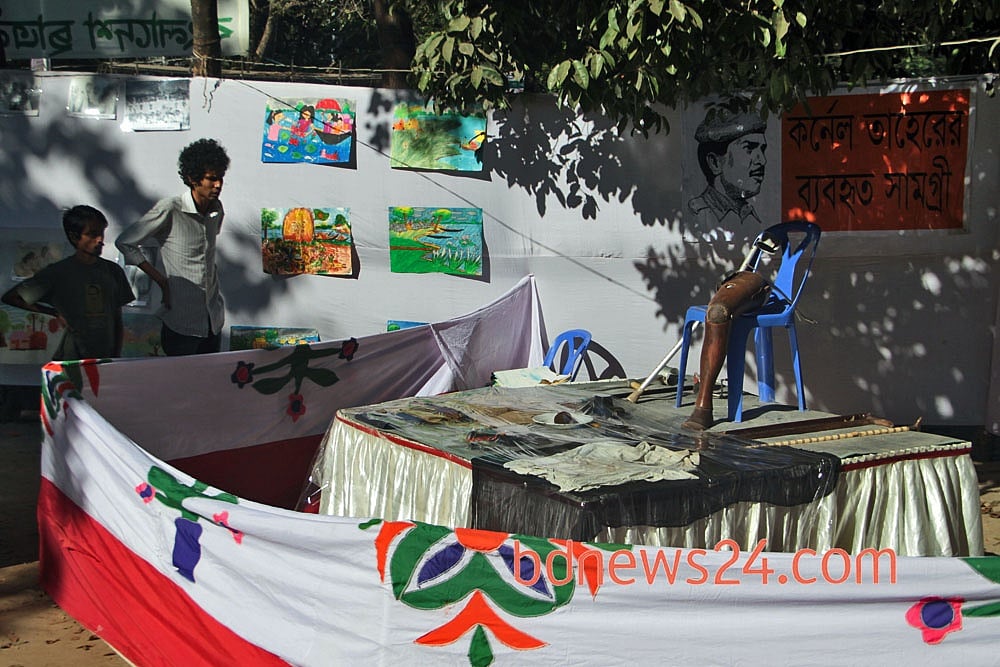
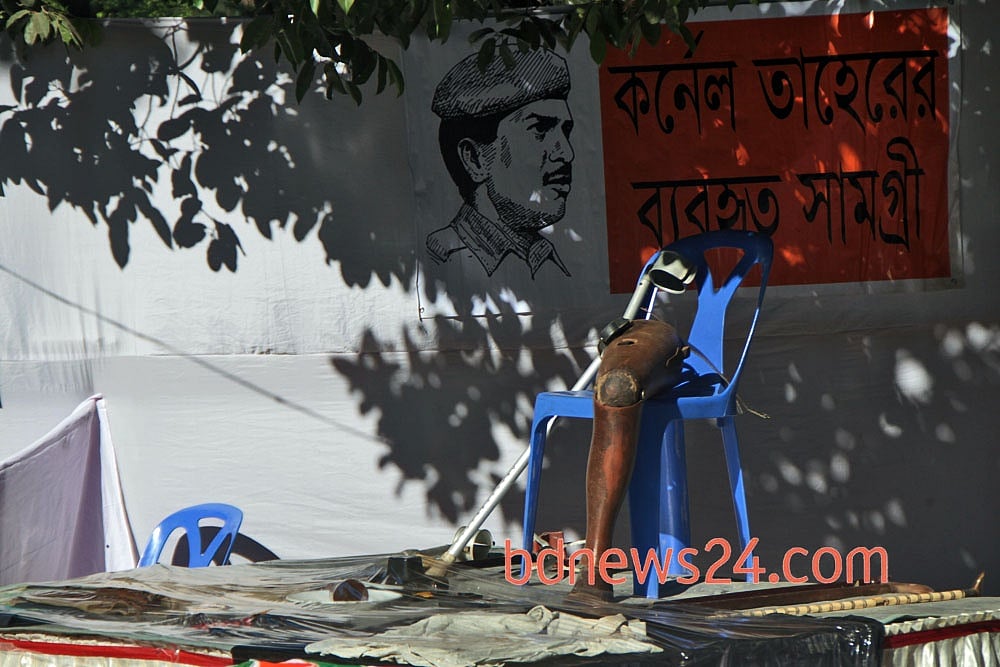
The letters he wrote to freedom fighters during his stay at hospitals in India and his resignation letter submitted to the Pakistan Army were displayed at the fair. In a letter to freedom fighters, Taher wrote: “When you take shelter at any house, you should help them (dwellers of the house) in their everyday work.” He quit the military to protest ‘confinement’ of army personnel to barracks instead of engaging them in ‘productive’ activities. The last letter that he wrote to his wife and relations before being hanged was also exhibited. Several articles used by him, including an artificial leg, crutches, several sticks, military uniforms, belts, pants and a blood-stained shirt, a plate, a glass and a wristwatch were also showcased in the fair. Several paintings from the competition organised on his 36th birthday also found a place in the fair. Dhaka University International Relations department student Mahmudul Hasan Siddiqui, who visited the fair, told bdnews24.com: “Taher was not a leader like others. He was not even like other freedom fighters or Sector Commanders.” He said the fair on Taher was a wonderful event. “Everything has been arranged in a way as if Taher has come to life.” After Bangladesh came into being as an independent country, Taher was appointed the first Adjutant General in the army. He took over as the Vice-President of Jatiya Samajtantrik Dal (JaSaD) after leaving the army in 1972. Following the assassination of Bangabandhu Sheikh Mujibur Rahman and most of his family on Aug 15, 1975, a section of army officers confined then army chief Ziaur Rahman. On Nov 7, Taher led a counter coup and freed Zia. Through the November events, Zia came to the forefront and became the first Martial Law Administrator. Once Zia retook charge of the army, he ordered Taher be arrested on charges of treason and murder on Nov 24. He was tried by a secret military tribunal inside the Dhaka Central Jail and was sentenced to death. He was hanged on July 21, 1976. Taher was laid to rest at his family graveyard in Netrokona. Taher’s six brothers and two sisters also took part in the Liberation War. Four of them were awarded different titles for their heroic roles in the war. The High Court in a landmark verdict on Mar 22, 2011 declared the military tribunal judgment condemning Taher to death illegal. The court ordered to accord martyr status to Taher and file murder case against the tribunal judges. The verdict termed execution of Taher ‘a cold-blooded killing’ planned by Ziaur Rahman. The court observed that it was not possible to try Zia as he was dead but said if anyone responsible for the ‘killing’ was alive he should be tried.
Related Stories