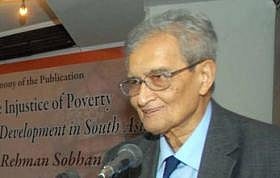
Education must for poor: Amartya Sen
Poverty and injustice have a very close relationship and there is no point enduring social injustice, says Nobel laureate Amartya Sen
bdnews24.com News Service
bdnews24.com
Published :
31 Jan 2011, 04:36 PM
Updated :
10 Aug 2022, 04:17 PM
Dhaka, Jan 31 (bdnews24.com) – Believers of market fundamentals often lose faith in the market and distort it causing failures in society, says Nobel laureate Amartya Sen.
"Market has economic importance and if anybody thinks that there is no need for it, he is wrong," Sen, now in Dhaka, said on Monday.
"But at the same time one should not leave everything to the market," he cautioned while speaking at the launching ceremony of a book titled 'Challenging the Injustice of Poverty' by professor Rehman Sobhan.
"Market gives many benefits, but one must possess some quality to avail of the benefits," he said.
Education and health must be ensured for the poor so that they could avail of the market benefits, he added.
"Poverty and injustice have a very close relationship," Sen said adding, "It has no point to endure the social injustice."
The Nobel laureate said there was nothing wrong in social revolution but it should be comprehensive not like a bit of here and there.
He said Rehman Sobhan's book was all about changes (dinbodal) and it was not about a little change over the last year. "There must be a strong commitment to address the issue of injustice."
Professor Sobhan said he wrote the book to find out the sources of poverty. "There is a deprivation of market access, health and education by the poor and it is visible in South Asia every day," he said.
"In this room, there are many who can afford to have treatment in Singapore, Thailand or Delhi; one does not need to be a genius to understand what treatment most [people] are getting," he added.
It is also true for education as some are going to the best schools but many are attending not-equipped schools, Sobhan said.
"There must be transformation of many people whose fate did not change for many generations," he said.
The economist said many things can be done under the existing system even without drastic political transformation.
"The finance minister is my principal customer and I hope that he will include some prescriptions written in the book in the Sixth Five Year plan," he said.
Speaking on the occasion, finance minister Abul Maal Abdul Muhith said it was a great book even though he had some different opinions on some issues.
"Many of the prescriptions can be usefully applied," he said.
"Sobhan proposed financial and fiscal prescription but in my opinion financial ones are better," he added.
"Profit and competition are important but now justice and injustice are also included in the list," he said.
COMMERCIAL AGRICULTURE
About commercial agriculture, the finance minister said the main problem of implementing it was land registration.
"Without having proper land registration system, it's impossible to have commercial agriculture."
Professor Wahiduddin Mahmud said the book proposed a financial architecture where poor would have access to capital. "The poor will have shares in corporate houses and these can be social businesses," he said.
He said the NGO-led approach was effective in development of self-interest but it was very weak in developing civic activity.
He, however, said microfinance made it clear that poor people could save. "The $3 billion microfinance revolving fund is the proof."
Former caretaker advisor Akbar Ali Khan said poverty will not be removed until the society gets rid of social disparities.
Sobhan has presented the new paradigm of injustice of poverty and on one would deny that manifest injustices pervade the lives of the poor, he said.
Bangladesh Bank governor Atiur Rahman said financial inclusion is a broad-based instrument to combat poverty.
The poor must have access to credit and the marginalised people must be given enough space so that they could change their lot, he said.
Professor of Ulster University, UK SR Osmani said poverty was the state of deprivation and they do not have the ability to take advantage of different benefits of society.
A large number of economists, businessmen and members of civil society attended the function held with former finance minister M Syeduzzaman in the chair.
bdnews24.com/ssz/mr/2230h