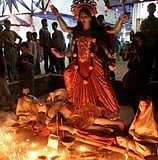
Devotees throng temples on second day of Kali Puja
The second day of the four-day Shyama or Kali Puja, a major Hindu religious festival, was celebrated Saturday. Performed on the night of Kartik Amavasya, which falls in October/November, Kali Puja is an intense invocation to the goddess. On the second day of the puja, 108 dishes are offered to the deity during the Annakut rites. Prasad, or food offered to the deity, is distributed to devotees.
bdnews24.com News Service
bdnews24.com
Published :
10 Nov 2007, 01:46 PM
Updated :
17 Aug 2022, 04:30 PM
Dhaka, Nov 10 (bdnews24.com) – The second day of the four-day Shyama or Kali Puja, a major Hindu religious festival, was celebrated Saturday.
Performed on the night of Kartik Amavasya, which falls in October/November, Kali Puja is an intense invocation to the goddess.
On the second day of the puja, 108 dishes are offered to the deity during the Annakut rites.
Prasad, or food offered to the deity, is distributed to devotees.
During the Mohotshob ceremony, also practiced on the second day, the Kali myth cycle is retold in song and the goddess is offered prayers and salutations.
Kali is the fearsome form of the mother goddess Durga. Her popularity as a deity dates from the composition of the Devi Mahatmya, a fifth- sixth century AD text.
The legend goes that long ago, the demons Shambhu and Nishambhu disturbed the peace of Indra, the king of the gods.
The gods took refuge in the holy mountains, the Himalayas, and sought the protection of Mahamaya Durga.
Kali is said to have sprung from Durga's forehead as Kal Bhoi Nashini, created to save heaven and earth from the growing cruelty of the demons.
Along with Dakini and Jogini, her two escorts, she set off to make war with and vanquish the demons.
In the bloodbath, the wrathful deity abandoned all restraint and began destroying everything in her path.
Seeing the endless slaughter, Shiva devised a plan to end the carnage and lay himself down before the rampaging Kali.
The goddess unwittingly stepped on her own husband, stuck her tongue out in shame, and regained her senses.
The Kali iconography depicts the moment when she treads on Lord Shiva and repents. She holds a sword aloft in one of her four hands, a severed head in an another, and pacifies and soothes her worshippers with the remaining two.
The dark mother is garlanded with fifty human skulls, adorned with severed heads for earrings, and is girdled with severed human hands.
Her black complexion symbolizes her all-embracing and transcendental nature. As the
Mahanirvana Tantra
says: "Just as all colors disappear in black, so all names and forms disappear in her."
Her nudity is primeval like Nature — the earth, sea, and sky.
She is free from illusory covering, for she is beyond maya or "false consciousness."
Her gruesome garland represent the fifty letters in the Sanskrit alphabet, symbolising infinite knowledge.
Her girdle of hands signifies work and liberation from the cycle of karma.
Her sword is the destroyer of false consciousness and the eight bonds that Hindu theology says bind human beings.
Kali's three eyes represent past, present, and future, — the three modes of time — an attribute that lies in the very name Kali ('Kala' in Sanskrit means time).
Eminent translator of Tantrik texts, Sir John Woodroffe in Garland of Letters, writes, "Kali is so called because She devours Kala (Time) and then resumes Her own dark formlessness."
During the puja, priests offer Rakta Joba (a red flower) to the deity during the service which starts at midnight as devotees assemble in devotion.
Bhatriditia, the ceremonial tying by a girl of a cotton bracelet around a boy's wrist which binds him in brotherhood to her, will be celebrated Sunday.
Arati contests, or the chanting of hymns, are scheduled for Sunday.
The festival started Friday with Dipannita Parbon, and will come to a close on Monday with a procession and the immersion of the idols.
Shyama puja takes place at night. Devotees light dwips, little oil lamps, or candles in their homes in the evening.
The offering of lights signifies the defeat of the forces of darkness.
Devotees wait eagerly until late at night to make offerings and pay tributes to Kali after the puja.
A prayer session was held at Govinda Jeo Thakur Temple in Sutrapur on Saturday.
A number of prominent figures including Nitai Chandra Ghosh, Arun Sarkar Rana, Nokul Saha, Balaram Gop, advocate Sushant Bosh, Sudhir Kumar Hazra and Gonesh Chandra Ghosh were present at the prayer session.
The Shyama puja is being observed many temples including at Dhakeswari temple, Ram-Sita temple, Bonogram Radha Govinda Jeo Thakur temple, Ramna Kali temple, Thantari Siva temple, Sutrapur Biharlalji temple, Shankhari bazaar, Tanti Bazaar, Panitola, Laxmi bazaar, North Moushandi, Nobendranath Basak Lane, Postgola Mohashoshan, Lalbagh Shoshan and Dhaka University's Jagannath Hall.
Kali Puja is performed to seek protection against drought and war, for general happiness, health, wealth, and peace.
It is performed only at midnight on Amavasya (new moon night) in November.
The puja will continue for two more days.
bdnews24.com/snd/su/rm/ai/1942 hours