


Published : 25 Mar 2018, 06:55 PM
Updated : 05 Aug 2022, 06:37 PM


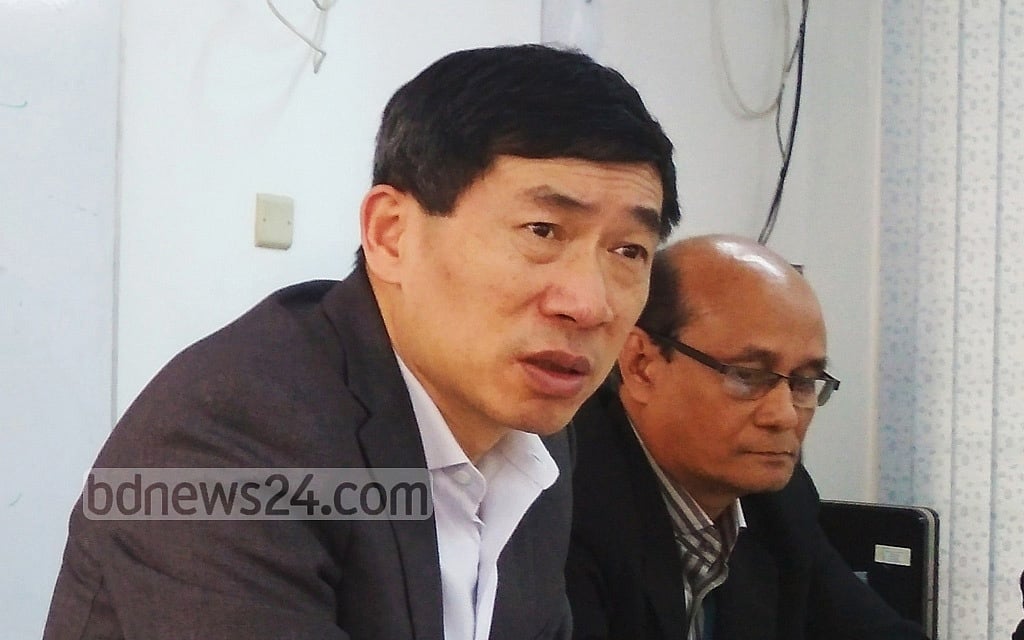
“There are lots of positive benefits to graduation,” visiting UN Assistant Secretary-General Haoliang Xu said as there is a perception that graduating to a developing country status will only mean that Bangladesh will lose all special benefits, including loan and export support, available to LDCs.
Xu talking to a group of journalists in Dhaka on Sunday explained the graduation process, challenges in the way and its benefits and said this would have a “big impact” on the future financing for development.
“As a LDC the signal to investor community is that it is not the best place for investment,” he said, adding that the graduation would send “strong message to investors that Bangladesh is a right place for investments.”
As LDCs, he said the international perception is “your capacity is low, your infrastructure is not sufficient and your institution is not strong”.
“After graduation, the rating agency will rate Bangladesh higher in the rating for investments and what that means that the cost of investment in Bangladesh will be significantly lower, if the volume is significantly larger. The interest rate Bangladesh has to use for borrowing internationally will significantly low.
“This is a big impact on the future financing for development,” he said.
He said as Bangladesh moves through the next step, “there would be more assistance from the UN to work with Bangladesh government to assess the impact of graduation.”
Bangladesh, which has been an LDC since 1975, recently fulfilled the UN’s current criteria to graduate from a ‘least developed country’ to a ‘developing country’, sparking conversation and debate across the country.
Bangladesh has also recently advanced from a low-income country to a low-middle income country on the World Bank’s scale.
According to the UN, a country is eligible to graduate from the LDC category if it has a gross national income (GNI) per capita of $1,230 or above for three years, a Human Assets Index (HAI) of 66 or above and an Economic Vulnerability Index (EVI) of 32 or below.
Bangladesh has fulfilled the three conditions on a very large margin. Bangladesh's current per capita income is $1,610. The HAI is 72.9, while the EVI is 25.
The GNI per capita measures the dollar value of a country’s total income in a year divided by its population. The HAI is a composite index that accounts for education and health.
The EVI accounts for population size, remoteness, merchandise export concentration, share of agriculture, forestry and fisheries in gross domestic product, homelessness owing to natural disasters, instability of agricultural production, and instability of exports of goods and services, the share of population living in low elevated coastal zone.
Bangladesh will undergo a few years of observation and can officially graduate to a developing country by 2024 at the earliest after the next review in 2021.
Xu, who was invited by the government to attend a series of celebratory events around the prospective graduation, said they are “almost certain” that Bangladesh would achieve the status.
He said of the countries who have prospects from graduation - Botswana, Cape Verde, Maldives, Samoa, and Equational Guinea – Bangladesh is much bigger than others with its 16O million people.
“And it is first time in such review a country [Bangladesh] has met all three criteria of graduation that is GDP per capita, the human asset index and also vulnerability index,” he said.
“This is also significant and that means the second review that will come up in 2021, Bangladesh will almost certain meet the criteria again which means that Bangladesh will formally graduate from LDC country in 2024,” he said, terming it a “milestone” for Bangladesh.
“We are proud that we were with the Bangladesh in achieving the milestone,” he said, but lots still remain to be done to achieve a sustainable transition from LDC to middle-income developing country.
“Still there are lots of challenges such as challenges of climate change, job creation, and also have challenges of urbanisation and also the issue of inequality that still exists,” he said, adding that Bangladesh’s economy needed to be diversified.
“Bangladesh needs to invest in research and development. Needs to develop technology sector, needs to increase its competitiveness to increase its productivity. So lots need to be done. But if the past experience is any indication, I think we are very confident that Bangladesh will achieve this goal of graduation, not only graduation but also will achieve sustainable development goals of becoming a prosperous and developed nation.”
He said Bangladesh will have to focus on skills such as entrepreneurship, critical thinking, innovative thinking, risk-taking spirit and leadership as well as traditional type of knowledge in science and language while educating to meet the challenges of the next stages of development.
Xu suggested Bangladesh improve the quality of institutions, and quality of governance.
“You have many years to prepare yourself for the loss of benefits. But you have a lot of years to prepare for reaping in my view much higher level of benefits for not being an LDC,” he said.
Asked about the role of UN in addressing the challenges, the UN assistant secretary-general said the UN’s role would be changed in new Bangladesh.
Xu assured Bangladesh of continuous support by the international community, including the UN, in the process of graduating from LDC.
He said the dependency on overseas development aid or ODA is much low now, 1.4 percent of the total GDP, compared with even 10 or 20 years ago.
He said the UN will change its role from “a donor to a technical support partner”.
“We’ll be equal partner of Bangladesh’s development in terms of sharing best practices and relevant experiences,” the UN assistant secretary-general said.
For example he said, after graduation, many countries remain as middle-income for the long term and that the UN can help Bangladesh learn those lessons for effective transition and avoid that “middle-income trap”.
For NGOs that are worried about the prospect of shrinking aid in middle-income Bangladesh, he said he is not concerned.
“If you rely heavily on international funding, you need to look at domestic resources. You need to be innovative,” he said, adding that civil society organisations still exist in the developed world.
“I don’t think there will be questions about the existence and the vibrancy of civil society organisations in Bangladesh even if you graduate.”













