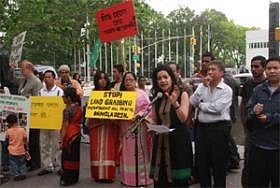
Demos in NY demand CHT deal execution
Two rights groups have demonstrated outside the United Nations headquarters demanding execution of the Chittagong Hill Tracts peace accord and constitutional recognition to the indigenous people.
bdnews24.com News Service
bdnews24.com
Published :
24 May 2011, 06:23 PM
Updated :
10 Aug 2022, 04:51 PM
Dhaka, May 24 (bdnews24.com)—Two rights groups have demonstrated outside the United Nations headquarters demanding execution of the Chittagong Hill Tracts peace accord and constitutional recognition to the indigenous people.
The protest was staged during the 10th summit of the United Nations Permanent Forum on Indigenous Issues (UNPFII) in New York, where the CHT people has significant representation, on Tuesday.
Chakma Raja Devasish Roy, an expert member of the UN forum for 2011-13, is leading the Bangladesh side in the 12-day session that began on May 16.
Devasish Roy while addressing the assembly of some 1,300 delegates expressed his concern over the current policies of the World Bank and other international finance organisations which preached free, prior and informed "consultation", instead of "consent".
UN secretary-general Ban Ki-moon on the opening day called on the nations to make the principles of the UN Declaration on the Rights of Indigenous Peoples (UNDRIP: 2007) into a reality.
In a statement, International Jumma Organisation and Friends of Chittagong Hill Tracts (Bangladesh) on Tuesday said: "In spite of this prominent global position, the indigenous people of Bangladesh have been waiting for decades for implementation of two basic demands—execution of the peace accord and recognition of these people according to the 1972 constitution."
The peace accord was signed in 1997 between the government and Parbatya Chattagram Jana Sanghati Samity to end the decade-long bush war between the indigenous people and the army.
The organisations claimed that most of the crucial provisions of the accord were still unimplemented. These include removal of around 500 all temporary army camps, rehabilitation of war refugees, decentralisation of authority to CHT-specific institutions and resolution of land disputes caused by Bangalee settlers who were transmigrated through army assistance.
"In this vacuum," the statement said, "unlawful killings, rape, arson, land grabbing and other forms of human rights violations by state security forces and Bangalee settlers continue."
The organisations also slammed the current Awami League-led government, who were in power in 1997, for refusing "to include indigenous people's correct identity and rights in the constitution".
They also protested comments from government officials like "Bangladesh has no indigenous people" and terms like "small ethnic groups" and "sub nations", which, the statement said, "indigenous people's advocates find unacceptable".
The rights groups also said that such statements were driven by a misconception, fuelled by a certain section of the media, that "providing constitutional rights to indigenous people would reduce the rights of the majority Bangalee people".
Prime minister Sheikh Hasina expressed support towards UNDRIP in her Adibashi Day message in August, 2010.
bdnews24.com/pks/bd/2231h