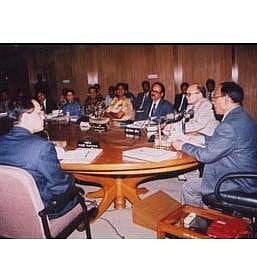
DCs push for govt pay hikes, rationing of essentials
Deputy commissioners, speaking on the first day of a four-day conference Saturday, urged the government to increase salaries and medical allowances of government officials and employees.
bdnews24.com News Service
bdnews24.com
Published :
05 Apr 2008, 05:02 PM
Updated :
24 Apr 2022, 08:23 PM
Dhaka, Apr 5 (bdnews24.com) –Deputy commissioners, speaking on the first day of a four-day conference Saturday, urged the government to increase salaries and medical allowances of government officials and employees.
They also urged the introduction of a rationing system, amendment to the proposed police ordinance and portrayed the problem of manpower and money in issuing passports at the district level.
Chief adviser Fakhruddin Ahmed had earlier in the day asked the commissioners to begin preparatory activities at the local level to create an atmosphere for free and fair elections.
"The main target of the present government is to hold a free, fair and acceptable election by December," Fakhruddin said, inaugurating the conference being held at the Chief Adviser's Office, during the course of which the current food crisis, soaring prices of daily commodities, law and order and issues tied to the professional needs of the district administrators are expected to come up.
Advisers to the caretaker government and senior government officials also presented guidelines to the deputy commissioners on preparations for the upcoming election, taking effective steps to control law and order and containing prices of essential commodities.
At the same time, advisers MA Matin and Rasheda K Chowdhury and cabinet secretary Ali Imam Majumder assured the DCs that they would be able to discharge their responsibilities without fear.
A number of commissioners in their speeches Saturday raised the problems they confront in their day-to-day dealings and demanded a rapid solution to them.
Addressing the gathered DCs on the first day, the chief adviser focused on the upcoming elections, saying the Election Commission has already made a lot of progress towards achieving its goal of holding national polls by the end of the year.
"The EC has held dialogues with the political parties and civil society on electoral reforms," said Fakhruddin.
"The army, district and upazila administrations and different educational institutions are also providing the Election Commission with direct assistance in this work."
The chief adviser also broached the food crisis, saying he hoped a bumper boro crop would be harvested this year.
Fakhruddin mentioned that the government had increased open market sales of rice through the country, and that fair price shops, run by the BDR, army and local authorities, had also gained huge popularity.
The chief adviser said his administration was taking all possible measures to mitigate the impact of the rising cost of essentials in the market, including importing food though both public and private channels.
In tandem with such measures the caretaker government has made progress in extending the nation's social security net, such as vulnerable group feeding programmes, he said.
Fakhruddin told the DCs it was the constitutional responsibility of every employee of the republic to provide round the clock service to the people.
"Your accountability to the state, to its people and the law and constitution of the country must be beyond question."
He reminded the administrators that the judiciary had been separated from the executive branch, saying: "We believe with a strong and independent judiciary, a strong administrative framework is essential for the good of the nation."
"As the chief coordinators at the district level you will have to be increasingly active to add dynamism to development programmes," he said.
A report, prepared by the deputy commissioners ahead of the conference, laid out a number of recommendations to deal with the various problems the country has been confronting.
The report, submitted to the Cabinet Division, said that most of the recommendations made at an earlier conference had not been implemented.
The ongoing conference will discuss the implementation of the 40 recommendations submitted in the earlier conference, held in June last year, as most of them have not seen any execution yet.
The deputy commissioners will present their issues in a total of 19 sessions over the four days of the conference.
Prominent among the concerns of the commissioners in the opening sessions were the need to increase the legal powers of executive magistrates in addition to providing transport and mobile phones for upazila nirbahi officers.
Further requests included increasing the availability of loans to set up private sector industries in northern areas of the country and implementing a campaign to promote alternative food staples to rice.
bdnews24.com/ehb/ahd/mk/eh/am/rah/2240 hours