Published : 30 Jul 2026, 10:09 PM
Updated : 08 Sep 2026, 09:28 AM


Reducing “unaccounted expenses" in the supply chain will be essential to bring down persistently high inflation in food and essential commodities, Commerce Minister Khandakar Abdul Muktadir has said.
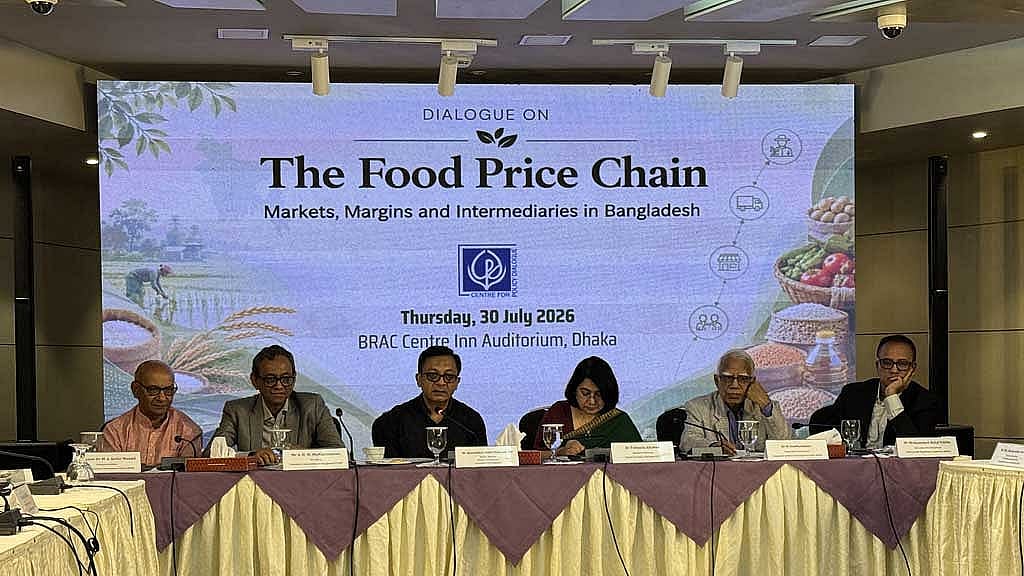
He used the term “unaccounted expenses” to refer to extortion-related costs at a dialogue organised by the Centre for Policy Dialogue (CPD) in Dhaka.
Lowering logistics costs, reducing production input costs and cutting unofficial expenses are key to easing price pressures, he said.
"One way is to reduce logistics costs, another is to reduce input costs," he said. "The third is what someone referred to as extortion. Instead of using such a strong word, I would call it reducing 'unaccounted expenses'."
While stopping short of elaborating on the phrase, he said Bangladesh's logistics costs remain significantly higher than global standards.
"The global average logistics cost is around 10 percent of GDP. In Bangladesh, it is about 16 percent," he said.
Muktadir also pointed to structural weaknesses in the agricultural market, saying farmers often lack access to reliable market information.
"There are serious market asymmetries. We do not have an effective information-sharing mechanism," he said.
Using potatoes as an example, he said Bangladesh has produced over 10 million tonnes annually for the past two years, yet farmers have repeatedly failed to receive fair prices.
"Even after failing to get good prices, and despite producing more than domestic consumption requires, farmers are preparing to produce the same volume again for a third year.
This indicates that they do not have access to proper market information or guidance on switching to alternative crops," he said.
The minister said the government was working to introduce traceability across the agricultural supply chain, from production to consumers, to identify where abnormal costs or excessive price increases occur.
At the event, CPD Senior Research Associate Foqoruddin Al Kabir presented findings showing that prices of green chilies increase by as much as 116 percent between farmers and retail markets, while rice prices double before reaching consumers.
The study found that prices rise by 87 percent for locally produced onions, 78 percent for lentils, 72 percent for eggplants and 50 percent for potatoes along the supply chain.
The research also covered eggs, beef, Rohu fish and poultry, finding that highly perishable products experience greater price fluctuations and higher profit margins between producers and retailers.
Agricultural economists at the discussion argued that farmers' actual costs are often underestimated because production cost calculations typically exclude high-interest informal loans, the long production cycle and household expenses that farmers must cover before selling their crops.
Former Dhaka Chamber of Commerce and Industry Vice-President Shoaib Chowdhury called for allowing agricultural goods to be transported in additional freight coaches attached to nighttime passenger trains to help reduce transportation costs.