'Daughter fulfills father's dream'
Sheikh Hasina's visit would realise Mujib's promise to his Tripura friends, says a lensman who captured Pak 'barbarity' in 1971
bdnews24.com News Service
bdnews24.com
Published :
11 Jan 2012, 05:40 PM
Updated :
09 Aug 2022, 03:17 PM
Agartala, Jan 11 (bdnews24.com)— With the Pakistani army and their local collaborators having unleashed barbarity whose scale was unimaginable in the region, Bangladesh was a difficult terrain in 1971. Especially so for a Bengali 'babu' from Tripura.
Robin Sen still remembers those times with 'Mukti Bahini' members as if they were just the other day. Sepia-tainted the pictures may be, but the haunting horror of the refugee camps are just as fresh in the mind of this renowned photographer and documentary filmmaker even four decades on.
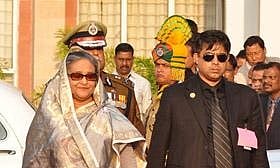
So, as prime minister Sheikh Hasina began her trip to Tripura, Sen said it is a nice gesture of gratitude from Bangladeshis for a state "which played a pivotal role in Bangladesh's Liberation War in 1971".
"Her father could not (visit Tripura) but she will," Sen said on Wednesday. "Though (the visit will come) after 40 years, we are extremely happy that Sheikh Hasina is at last visiting the tiny state of Tripura."
Sen's lenses had captured several rare and historical moments of those days, when the then East Pakistan metamorphosed into Bangladesh.
"Tripura had opened everything for Bangladeshis -- the state not only gave refuge to 16 lakh people, which was more than its own population then, but it was also a safe harbour and training ground for their liberation force, the Mukti Bahini," Sen recalled.
"Six to seven camps under four different sectors operated from here and fought the Pakistani forces during the nine-month war in 1971."
TOTAL RECALL
Struggling to fight back tears while harking back to those dark days of 1971, Sen said he visited different parts of the then East Pakistan -- with 'Mukti Bahini' members as friends and his camera as the sole weapon to capture the barbarity of the marauding Pakistani army.
He witnessed the occupying forces slaughter hundreds and thousands of Bengalis, and he saw the plight of the people in refugee camps -- "even worse than animals".
"It was totally inhuman and barbaric -- even the children and old were not spared," Sen said. "Women were the worst victims, and thus many women committed suicide (even before the Pakistani forces and their local collaborators approached) because they thought it was better to bear the pain of death than to be raped and pillaged."
The acclaimed photographer said Hasina's father Bangabandhu Sheikh Mujibur Rahman was a close friend of former Tripura chief minister Sachindra Lal Singha.
Singha, he said, had opened the state police armoury and handed over many .303 rifles to the Mukti Bahini in April 1971 to fight against Pakistan. This was even before then prime minister of India Indira Gandhi officially backed Bangladesh's liberation war, Sen emphasised.
Singha later fell foul of the Indian Congress high command and was forced to resign in November 1971, barely a month before Bangladesh's liberation.
MUJIB'S UNFULFILLED TRIPURA TRYST
According to Sen, whether Sheikh Mujibur Rahman had visited Agartala or not is a "different matter" but the fact is, in 1968 the "Pakistan government initiated the historic 'Agartala conspiracy case' accusing Mujib as the main conspirator to secede East Pakistan from West Pakistan with the help of India".
"Bangabandhu would have visited Tripura had he not been assassinated in 1975," Sen stressed. "He had promised that, but he could not unfortunately keep his promise of visiting Tripura as prime minister of Bangladesh to meet his friends here.
"But now his daughter is visiting after 40 long years. So this is a historical moment. We are hopeful that this visit will play a vital role in further strengthening bilateral relation between the two neighours."
bdnews24.com/corr/bd/std/2305h