Dahagram-Angorpota's unending miseries
It happened about six years ago in Dahagram. Sakhina Begum had severe complications in her labour. When she and her husband reached the gate of the corridor, it was just past 6.30pm.
bdnews24.com News Service
bdnews24.com
Published :
29 Jun 2010, 08:13 PM
Updated :
11 Aug 2022, 02:13 PM
Lalmonirhat, June 29 (bdnews24.com) — It happened about six years ago in Dahagram. Sakhina Begum had severe complications in her labour. When she and her husband reached the gate of the corridor, it was just past 6.30pm.
They were headed for Patgram Upazila Sadar hospital but the gates were closed. The husband described the situation to the BDR jawans, who then informed their BSF counterparts at the post. They in turn informed their superiors.
"As the process continued, Sakhina collapsed and died at the corridor gate," said Rezanur Rahman Reza, headmaster of Araji Kharibari primary school in Angorpota village.
The inhabitants of Angorpota-Dahagram enclave are fated to meet with such terrible end because of lack of round the clock access to the mainland.
Dahagram and Angorpota are two villages of the enclave under Dahagram Union of Patgram Upazila in Lalmornirhat district. Angorpota is about 4km west of Dahagram. The livelihood of the area mainly depends on the communication with Patgram Upazila Sadar. The lifeline of the enclave, inhabited by some 20,000 people, is a 99 decimal passage known as Tin Bigha Corridor that enables its residents to connect with the mainland.
This passage was opened to traffic in June 1992. Inhabitants of the enclave complain, however, that India has not only ignored the conditions of the treaty but taken some steps that have further ruined their peaceful living.
Under that treaty, Tin Bigha Corridor has been leased out to Bangladesh by India for 99 years on a yearly tax of one taka, which has been raised to two and a half taka in recent years. On June 26, 1992 Tin Bigha Corridor was opened to the Dahagram-Angorpota inhabitants.
The opening of the corridor had been marked with great enthusiasm. They called the opening day as the "Day of Freedom". They still celebrate the day with special fervor, although the treaty or the passage has failed to realise most of their hopes in last 18 years. Every year, cultural functions are organised at Araji Kharibari school, an important public gathering place, on this day.
Saiful Alam Pramanik, chairman of Dahagram Union Parishad said, "According to the 1992 treaty, electricity and water supply lines are supposed to enter through Tin Bigha Corridor into the enclave. This year electricity poles have been posted, but power supply has not yet come."
Golam Mortuza, the executive engineer (distribution and marketing) of Rangpur Electricity Development Board, however, told bdnews24.com that electricity supply was likely to begin from first week of July this year.
One major understanding of the treaty is that the Corridor is to be open for 24 hours a day.
This condition has never been met by India. Initially, they had opened the passage for six hours a day. Later, it has increased to twelve – from 6.30am to 6.30pm.
As a result, the residents of the enclave are completely helpless, particularly when the health related emergencies arise after the gate is closed.
The treaty also says that the entire 178 meter long and 85 m wide space of Tin Bigha is to be leased out to Bangladesh eventually. In reality, though, the Bangladeshi citizens are allowed to use only a 2.5 m wide road built in the Corridor.
According to another condition of the treaty, neither of the parties will build any installations in the Tin Bigha Corridor and the passage is to be controlled by the Bangladesh border forces. India has nevertheless built two check posts at both ends of the corridor and controls the whole corridor with armed troops. BDR personnel have posts only in the two villages of the enclave.
Saiful Alam said, "India is now making barbed wire fences along the zero lines at both sides of the Corridor. It has made the inhabitants extremely panicked." He demanded that Bangladesh border guards should set up two more camps in Dahagram and Angorpota.
A SICK HOSPITAL
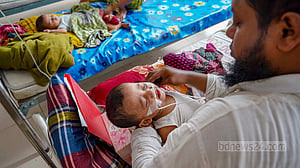
The problem-ridden hospital is yet another headache of the enclave people. It is a 10-bed establishment in Dahagram, the only in-patient facility inside the enclave.
Nazrul Islam and Md. Azizul, both from Dahagram, informed that the government hospital was built in 1992 with foreign donation. Built as a modern treatment centre, it has an operation theatre equipped with up to date facilities, x-ray machine, post-operative ward, high-power generator and ambulance. But lack of skilled manpower has left the hospital largely unused. "All the valuable equipments are left to rot," said Azizul.
At present, there is only a medical assistant working in the hospital who is supposed to be available round the clock, according to Md. Moksed Ali, civil surgeon of Lalmonirhat. "But he is not there when we need him," Nazrul complained.
Ali informed bdnews24.com that a process is underway for the repair of the hospital equipments while the health ministry has approved the appointment of third and fourth class staff for the facility. A doctor would join the hospital in July, he added.
Dahagram-Angorpota is one of many enclaves of Bangladesh in Indian territory. Similarly India also has a number of enclaves in Bangladesh territory. The enclaves were created in 1947 as a result of arbitrary demaracation of land borders during the partition of India and Pakistan.
The inhabitants of the enclave demand the realisation of the treaty signed in 1974 between India and Bangladesh to resolve the border disputes, which is popularly known as Indira-Mujib agreement after the names of the signatories. The treaty, they view, covers a wider aspect to solve the problems of enclaves than the 1992 agreement.
bdnews24.com/ar/pr/am/2330h