


Published : 23 Oct 2021, 03:28 PM
Updated : 14 Oct 2022, 07:01 PM


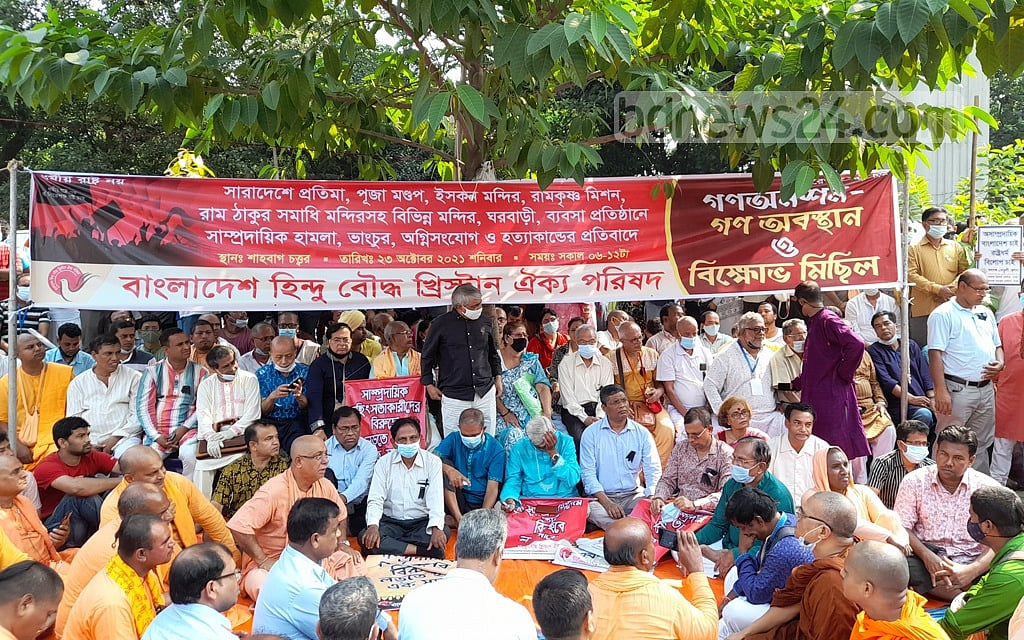
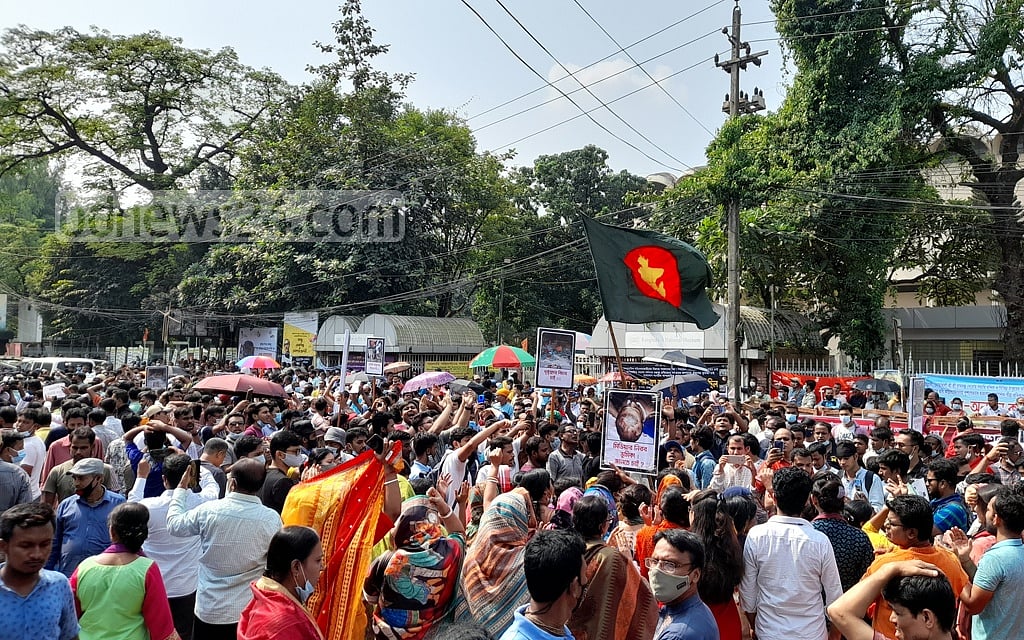
The protest, called by the Bangladesh Hindu Buddhist Christian Unity Council, began in front of the National Museum in Shahbagh at 6 am on Saturday. The demonstrations lasted until around noon, after which the protesters blocked the intersection for an hour before ending the programme with a protest march that ended in front of the Jatiya Press Club.
Around 12:30 pm, human rights activist Khushi Kabir gave the protesters water, ending their hunger strike.
Shahbagh and nearby roads were congested for about an hour during the protest by the religious minority groups.
The protesters announced a ‘March on Dhaka’, where people from across Bangladesh, including Chattogram and remote parts of the country, would march to the Prime Minister’s Office next February, if the demands presented by the Bangladesh Puja Celebration Council were not implemented.
They also announced that Hindu devotees would boycott the traditional Diwali Festival on Shyama Puja and instead, on Nov 4, hold a 15-minute silent demonstration at temples across the country by covering their faces with black cloth. Slogans condemning communal violence will also be put up at temples and puja venues.
THE DEMANDS
1. A judicial commission, headed by a retired Supreme Court justice, must be formed to investigate the communal violence that occurred during the Durga Puja and the days afterwards in a number of places across the country.
2. The government must pay damages for all temples vandalised, pay for the repair of damaged homes and rehouse those who lost their homes, pay compensation to traders who lost their businesses, arrange for the medical treatment of those injured and pay Tk 2 million each to the families of those killed or, appoint a member of their family to a government job according to their qualifications.
3. An impartial investigation must be conducted into these attacks so the perpetrators and conspirators responsible are arrested. They must be brought up on charges under the Special Powers Act and the Anti-Terror Act and special tribunals must be formed to ensure a speedy trial and swift justice.
4. Those members of the administration and law enforcement who failed or neglected their duties in stopping these attacks, despite clear orders from the prime minister, must be identified and immediate disciplinary action must be taken against them.
5. Those who incite hatred and violence on social media against religious minorities and other marginalised groups on social media must be identified, charged under the Special Powers Act and punished in an exemplary manner.
6. Punitive political action must be taken against those public representatives who did not come forward to confront communal attackers despite the clear instructions from the prime minister.
7. The recommendations made by the Shahabuddin Commission, formed by the High Court Division of the Supreme Court to investigate communal violence between 2001-2006, must be published immediately and steps must be taken to implement these recommendations.
8. The constitution of 1972 must be restored and the promises made by the ruling party in the election manifesto published prior to the Eleventh National Parliamentary Election – including the Minority Protection Act, the National Minorities Commission, the Abolition of Discrimination Act and the Restitution of Deeded Property Act – must be implemented quickly.
JaSoD President Hasanul Haq Inu expressed solidarity with the protest.
Gonoshasthya Kendro founder Zafrullah Chowhdury said: “After the attacks, I went to Rangpur and other parts of the country. The people asked me ‘when will our Mother come?’ Honourable prime minister – they are all looking to you. I implore you to go to them, stand with them and comfort them.”
“Those Muslims involved in the attacks should ask the families of those affected for forgiveness. Imams at all mosques must say these acts are un-Islamic.”
“This government has made a business of talking about the ‘spirit of the Liberation War’,” said Gono Forum leader Subrata Chowdhury. “Our constitution calls Islam the state religion, but our state is claimed to be impartial on religious issues. This is the utmost hypocrisy. A hypocritical state cannot function.”
“Bangladesh gained independence through a secular movement,” said Bangladesh Puja Celebration Council President Milon Kanti Dutta. “But is today’s Bangladesh a secular one? If that secularism had persisted, would the Hindu population have dwindled from 19 percent in 1971 to 8.5 percent in 2013?”
“We are attacked and then we protest. But we do not get justice. There hasn’t been proper justice for any communal attacks. That is why we are repeating the same things today.”
“We want exemplary punishment for these attacks,” said Prof Neem Chandra Bhowmik, president of the Hindu Buddhist Christian Unity Council. “And we must have justice for the attacks in the past. If necessary, a special tribunal must be formed to try these cases. Our eight-point list of demands should be accepted quickly.”










