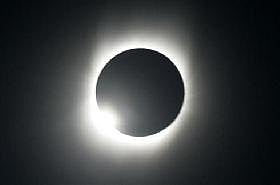
Clouds parted, crickets sang, stars came out
Spellbound by the longest solar eclipse of the century, passing over northern Bangladesh on Wednesday, viewers of the rare event described an "indescribable darkness" as crickets chirped and stars became visible for a fleeting few minutes on a July morning.
bdnews24.com News Service
bdnews24.com
Published :
22 Jul 2009, 02:45 AM
Updated :
12 Aug 2022, 01:29 PM
Dhaka, July 22 (bdnews24.com) - Spellbound by the longest solar eclipse of the century, passing over northern Bangladesh on Wednesday, viewers of the rare event described an "indescribable darkness" as crickets chirped and stars became visible for a fleeting few minutes on a July morning.
About thirty million people in Dinajpur, Lalmonirhat, Panchagarh and Thakurgaon fell in the shadow of the total eclipse. Other areas of the country viewed a partial eclipse.
Panchagarh Stadium saw crowds of excited people arriving from as early as 5:00am to view the rare event, said Bangladesh Science and Technology Museum curator Sukallyan Bachhar.
"The stadium was packed full. We handed out about 1,000 filters for people to watch safely," he told bdnews24.com.
"There were clouds, so we couldn't see the entire two-hour event uninterrupted. We got intermittent views as the moon began passing in front of the sun," he said.
"But we were lucky to get an absolutely clear view during the three minutes of total eclipse just before 8am."
"We saw stars in the day!"
"People became very emotional," he said.
'Clouds parted'
At Moinaguri Tea Garden in Panchagarh, where Bangladesh Astronomical Association was hosting an observation camp, sponsored by bdnews24.com, cloud cover frustrated watchers.
But the experience was still awe-inspiring, said one viewer. "The clouds parted and we saw the famous diamond ring effect."
"It went completely dark for about three or four minutes, and crickets started chirping as if it was night."
Another said, "It went dark. But it was an absolutely indescribable dark. Not like night, and not like day."
Dhaka residents were out on rooftops, verandahs and gathered at observation spots to witness a partial eclipse.
There was patchy cloud around 7:00am, but it had mostly cleared just before 8:00am, when the height of the partial eclipse in the capital, at 93 percent, was visible.
All important "clear skies" had been forecast the previous day for viewing the eclipse.
"There can be cloud cover in the mornings at this time of year, but the skies should be mostly cleared over the country by 7-8am," senior meteorologist Abdul Mannan had told bdnews24.com.
Depending on where you were in the country, the range of the eclipse was between 83 percent and totality.
The entire event took two hours, from around 7:00-9:00am, with the full eclipse, visible only in the north of Bangladesh, occurring midway between 7:55am and 8:00am.
Meteorologists said temperatures countrywide would fall several degrees during the celestial event.
"The morning temperatures at this time of year range between 16-18 degrees Centigrade across the country. They will fall by between 3-5 degrees Centigrade as the sun's rays are blocked by the moon," said Abdul Mannan.
He said the eclipse would also affect the tide in coastal districts, as the moon, sun and earth came into alignment.
"It will cause the tide to be about 1-2 centimetres higher than normal," he said, adding that one fifth of the normal tidal pull was caused by the sun and four fifths by the proximity of the moon.
The moon's shadow swept halfway across the world on Wednesday, from India, over China and out into the Pacific Ocean.
The longest total solar eclipse of the 21st century, lasting over six minutes in some places, to be unsurpassed until June 13, 2132.
The eclipse was first sighted at dawn in eastern India near the town of Guahati before moving north and east to Nepal, Myanmar, Bangladesh, Bhutan and China.
Bangladesh will have to wait for another 105 years to see another full solar eclipse, on June 2, 2114.
bdnews24.com/mrf/am/rah/0903h