Toufique Imrose Khalidi
Dec 13, 2009
While Bangladesh already counts the cost of
climate refugees
, a cacophony of voices inside the sprawling Bella Convention Centre in Copenhagen isn't exactly focused on the thousands displaced, so far, from Kutubdia Island in the Bay of Bengal.
The cry from the slowly-sinking Kutubdia, 35 kilometres off Cox's Bazar, is not easily heard in the huge Plenary Hall or scores of other meeting rooms and delegation offices, where various groups try to get past rivals with speeches and rebuttals, and texts and counter texts.
There are so many claimants to the huge climate pie being promised or planned.
Money -- along with binding pollution reduction targets -- must come for mitigation; funds will be made available for adaptation. Then there is something called Clean Development Mechanism--the World Bank says dealing with this is proving to be mighty tough; the Least Developed Countries, Bangladesh included, aren't too sure about CDM prospects.
Rarely does the Bank make such an admission: "Some CDM decisions have had a disproportionate negative impact on Least Developed Countries."
One can clearly see the CDM point made by Lesotho's Bruno Sekoli, who chairs the grouping of LDCs in the complex negotiations. "It's driven by the private sector. Private sector will go to South Africa or India, but will not go to Nepal or Lesotho."
If South Africa wants to transform a coal plant, says Sekoli, the companies will rush there.
So the poor such as Bangladesh will rely on the public money.
A massive Climate Adaptation Fund is sure to be created. The top UN climate official has indicated something of the size of US$ 100 billion a year by 2020.
For the coming three years, an annual funding of US$ 10 billion will be provided in short-term help to poor countries, particularly in Africa. This is an interim arrangement for the countries to adapt to the effects of global warming before a new climate treaty being negotiated in Copenhagen comes into force in 2012.
There will be a lot of money, if the amounts being talked about do become reality. Well, the $100 billion is equivalent to a good few years' tax revenue in Bangladesh, but nothing compared to what's been spent on unnecessary wars in recent years. (However, Barak Obama, in his Nobel acceptance speech in Oslo, has spoken of the emergence of the concept of a "just war".)
NOT UNTIL MEXICO
Then there are all sort of questions about who gives the money and how much and when. Who gets it, how much and on what conditions.
After a week of wrangling, rhetoric, propaganda and politicking, it seems Copenhagen will surely decide on the creation of the Fund, hear pledges about money and emissions targets, agree on a mechanism on how to manage the Fund or disburse the money.
All these are expected to come under an interim, political understanding -- not a legally binding deal, which will probably be closed at another mega meeting, COP 16, in Mexico in 2010.
In the final week (Dec 14-19) of the current COP, when the so-called high-level segment begins, the delegates from 192 countries will try to break through the barrier, in this chilly Scandinavian capital which is hosting the historic summit herding for the first time ever more than a hundred heads of state or government--in just two days.
ALL BIG POLLUTERS TOGETHER
The heads -- including Barak Obama, whose last minute change of heart about appearance schedule, has helped generate new hopes of a robust deal -- will have to hammer out the final declaration.
President Obama was due here on Dec 9 but then decided to be present during the deal-closing moments of the conference. Diplomatic sources say the US president also impressed upon the Indian prime minister, Manmohan Singh, to attend too. Singh had no plans to come to Copenhagen, was instead preparing to host Sheikh Hasina in New Delhi, but the Obama move pushed the planned visit by the Bangladesh prime minister back by a few weeks.
With President Medvedev of Russia also confirming his participation in the Dec 17-18 summit, all top 15 polluters of the planet--China has overtaken the US as the number one--will be represented at the very top level.
INDIA, CHINA
A lot will depend on China and India when it comes to cutting emissions, setting specific targets, or agreeing on a peaking year--when the world will stop increasing the emissions of greenhouse gases. The UN Intergovernmental Panel on Climate Change clearly specifies that global emissions must peak no later than 2015.
HOPENHAGEN
One of the key reasons why the Kyoto Protocol -- that set binding targets for the reduction of greenhouse gas emissions and was ratified by 184 parties of the UN Climate Convention --failed to get sold in the US was that there was no action involved on part of the major developing countries such as China and India.
How far these two are willing to go to limit the growth of their emissions is one of four key "essentials" identified by the top UN climate official, Yvo de Boer, for a global "political" deal to be reached in Copenhagen, already being called Hopenhagen in numerous posters and billboards decorating the city.
But China is talking tough. A top official, Su Wei, has criticised the US, the EU and Japan for not offering sufficient cuts in their greenhouse gas emissions by 2020. Beijing has said that Washington's promises on both GHG cuts and funding the poor nations' adaptation and mitigation goals are key to the Copenhagen efforts bearing fruit. China also conveniently refers to the Kyoto spirit-- the developing world will not share the global financial costs of climate change nor will it be bound by any emissions targets.
The US has fired back. "The country whose emissions are going up dramatically, really dramatically, is China," says Todd Stern, the top US delegate. "There can't be a new agreement without China."
India, the fifth largest polluter, has made it clear that it will not agree to a peaking year of emissions. The reason, as environment minister Jairam Ramesh puts it, is that "we have a huge backlog of development particularly in expanding rural electricity supply."
Nor will New Delhi agree to international monitoring of its "voluntary" measures to reduce greenhouse gases--by 20 to 25 percent from 2005 levels by 2020. It will rather allow its own media, civil society and parliament to see if enough is being done to tackle climate change. International scrutiny will be allowed only for action supported by the international funding.
India has announced a voluntary target of reducing carbon intensity by 20 to 25 percent from 2005 levels by 2020.
The other key reason why the previous US administration opposed the Kyoto arrangement was its perception that it would harm the American economy. This time, the industrialised world sees a lot for them to gain too. The campaign for clean energy, the planned development of new climate-friendly technologies promise new businesses for countries such as the US. President Obama has added another twist: he has linked climate to security, an argument that sells so well in his country.
But there are many other complexities that seem to dash the hopes. Big oil producers such as the Saudis now say the new climate deal will mean less consumption of the fossil fuel, and therefore claim a share of the Climate Fund as compensation.
AFRICA ... AMBITIOUS
Reports from the African camp have hit headlines here in Denmark. The group of 50 countries has demanded that rich countries pay five percent of their GDPs to developing countries to fund their fight against climate change. A Danish paper describes the proposal, rightly, as ambitious, given the fact the EU has put annual funding need at US$ 130 billion by 2020. Going by the 2008 figures, the US alone will have to pay $722 billion if the five percent demand is accepted.
The Danish paper refers to a draft prepared by the African Group, in which it asks for US$ 400 billion for developing countries from 2010-2012, while the UN estimates the need to be US$ 30 billion for the three years. More than a third of that immediate money has already been promised by the EU. Peanuts, say the African nations. A spokesperson points out the rich nations could manage US$ 1.4 trillion to bail out their financial system.
Sudan's Lumumba Stanislaus Di-Aping, negotiator for 130 developing countries in the Group of 77, has also dismissed the EU pledge as "insignificant" and said the 27-nation bloc has failed to address the long-term financing issue.
The African countries also demand far deeper emissions cuts than any of the rich countries is willing to consider: by 50 percent by 2017 compared to 1990 levels, rising to 65 percent by 2020. For instance, the EU leaders have pledged to reduce their emissions by 30 percent of 1990 levels by 2020.
AOSIS
The small islands such as the Maldives or those in the Caribbean are a group that is still demanding a legally-binding pact. These are some of the most vulnerable of countries that face being submerged by the rising levels of the seas. A spokesperson for the group, a delegate from tiny Tuvalu, has threatened that they would rather leave Copenhagen without anything than committing to one without any significance.
BUILD ON KYOTO
The demand from the Alliance of Small Island States (AOSIS) calling for a new 'Copenhagen Protocol', is similar to Bangladesh's: Build on the existing legally-binding Kyoto Protocol.
Bangladesh has been in the news from Day One. The opening session on Dec 7 heard the IPCC chief, Rajendra Pachauri, tell the world that sea-level rises caused by global warming "could submerge several small island states and Bangladesh".
Then came a new report saying Bangladesh topped a Global Climate Risk Index and had been the worst affected by climate change over two decades from 1990.
The government in Dhaka was quick to seize on the opportunity, demanding a large piece of the pie in the making. "Fifteen percent of the world's climate change victims live in Bangladesh," was the argument from the environment minister to demand 15 percent of the planned Adaptation Fund.
The talks in Copenhagen have not been about which specific country gets how much. "It's a bit premature," a COP veteran says to us here of the minister's plea. "It's been about what or how much the developing world gets and on what conditions."
True, such discussions will take place after Copenhagen or even after Mexico. Indeed, it's been much bigger than that. The stories about the Kutubdia refugees or the loss of the second largest mangrove forest in Chakoria or violent demonstrations in quiet Copenhagen will perhaps put some pressure on the leaders to seal the "political" deal. But negotiations for money-- the money to be spent in Bangladesh -- will be conducted much later under different circumstances.
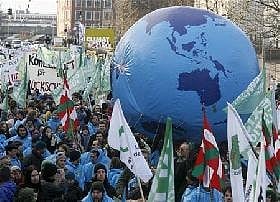
The President of COP 15 has come up with some good news for countries like Bangladesh, coinciding with protests -- at least 50,000 marched in freezing temperatures in Copenhagen--the kind of which her country has never seen before.
Denmark's minister for energy and climate Connie Hedegaard says negotiators have made some progress: accord has been reached on how new green technologies like wind and solar power can be supplied to developing nations, and how to promote the use of forests to soak up greenhouse gases. (Deforestation plays a huge role in climate change – destruction of forests and land use change contributes approximately 20 to 25 percent of the carbon emissions that cause climate change, according to our own report quoting scientists.)
All these new projects will mean money to be made by companies. The big multinationals--along with the NGOs of all hues--have come to Copenhagen with all sorts of "green" and "clean" slogans. The Bella Centre is full of smart kiosks promoting some of the world's biggest brands.
Businesses want clear commitment. Should they start investing now for projects or plants to be in place 30 to 50 years from now? Already, UN's Boer points out, the global recession as well as the low oil price has reduced investments in renewable energy projects. For them too, a clear message has to come from Copenhagen.
© bdnews24.com