Published :
03 Apr 2013, 12:18 PM
Updated :
09 Aug 2022, 10:27 AM
Imran Siddiq deliberated through the day before the first war crimes tribunal countering the allegations against Azam, who has been indicted for five war crimes charges including incitement, complicity and conspiracy.

Dwelling upon conspiracy, Siddiq told the three-judge International Crimes Tribunal – 1 that the prosecution would have to prove several elements beyond reasonable doubt and it had failed to do so.
Ghulam Azam was head of Jamaat’s, what was then, East Pakistan unit in 1971 during the Liberation War.
Siddiq referred to several cases from other war crimes tribunals abroad and showed that in order to prove conspiracy to commit genocide, the prosecution would have to establish beyond reasonable doubt the intention to commit genocide.
“There would have to be some document or witnesses,” said Siddiq also conceding that conspirators do not leave such overt records and such an allegation would have to be proven by circumstantial evidence.
However, for genocide Siddiq repeated numerous times, “It would have to be the only possible inference from the evidence.”
The young lawyer pointed out that while it only needed establishing one’s knowledge of organised and systematic persecution to prove ‘crime against humanity’, genocide required a higher standard of evidence. “It is extremely difficult to prove since the evidence can lead to only one conclusion.”
Siddiq went through the first two charges of conspiracy, with six counts, and planning with three counts and said that the prosecution had failed to prove any of them.
He read from the transcripts of the investigation officer’s deposition and showed that the investigator had not attempted to test the veracity of the newspaper reports submitted as exhibits.
The defence counsel said that the news reports might well have been false or untrue or partial given that it was a martial law period during 1971 and there was strong press censorship.
The investigator could have proven the authenticity of the reports by either producing witnesses of those events or producing the reporters and establishing through them that the events reported had indeed taken place.
“But he said on the stand that he (investigator) took no such measures,” said Siddiq referring to the volume of reports covering Ghulam Azam’s numerous public meetings and reported inflammatory statements.
He said, “The Investigation Officer has single-handedly destroyed the prosecution case due to gross negligence.”
As regards planning, Siddiq said that prosecution would have to establish a nexus between the players and show that the accused had substantial contribution to the commission of specified crimes.
This, the lawyer said, had not been done by the prosecution.
Siddiq is currently deliberating on incitement that will be followed by complicity. These two charges together account for 51 of the 61 counts of war crimes allegations against Ghulam Azam.
Jamaat Guru in ICT-1
On Dec 12, 2011, the prosecution brought a 52-point charter of charges against Azam and appealed for his arrest. Later, following the tribunal order, charges were re-arranged and presented to the tribunal on Jan 5. There are 61 counts under five charges against the former Jamaat leader.
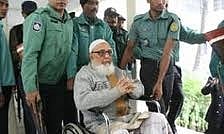
He was produced before the tribunal on Jan 11 and sent to jail the same day. Since that evening, the 90-year old former Carmichael College professor has been kept at the prison cell of the Bangabandhu Sheikh Mujib Medical University for better treatment considering his delicate health.
Ghulam Azam’s indictment hearing began on Feb 15 and the court charged him on May 13.
A former chief of Jamaat-e-Islami, arguably the largest Islamist organisation in the subcontinent, Azam is allegedly among the key people who pioneered anti-liberation efforts in 1971 colluding with the Pakistani military junta of that time.
He is widely perceived to have been among core group of right-wing supporters of the Pakistani Army, who came out strongly in support of a united Pakistan.
Ghulam Azam, then chief of Jamaat, was instrumental in setting up the infamous Peace Committee at the national level. The Razakars, an auxiliary force set up mainly to actively thwart the liberation forces, are said to have been mobilised through the Peace Committees across Bangladesh.
Among the most notorious vigilante militia are the Al Badr, whose membership is said to have been mainly dominated by the Jamaat's student wing called the Islami Chhatra Sangha at that time.
The Al Badr is alleged to have spearheaded execution of the intellectual elites of Bangladesh just days before the victory on Dec 16, 1971.
Azam also spoke in favour of Pakistan to the Middle Eastern countries during the war, according to the prosecution.
He stayed in London for seven years after 1971 and returned to Bangladesh in 1978 during BNP founder Ziaur Rahman's rule. Having led Jamaat for long, Azam retired from active politics in 1999.
His party remains a key ally of the main opposition BNP. Two Jamaat leaders, also behind bars for war crimes charges, have even served as ministers during the BNP's last tenure in government between 2001 and 2006, when Azam's party was part of the ruling coalition.
Azam was indicted on five charges — 61 counts — including incitement, conspiracy, planning and complicity on May 13, 2012.