Published :
26 Jun 2013, 04:11 PM
Updated :
09 Aug 2022, 10:50 AM
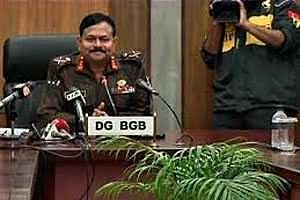
The Border Guard Bangladesh (BGB) has always played a strong role in curbing killings by its Indian counterpart, the Border Security Force (BSF), along the porous border, BGB Director General has said.
"Our (BGB) protests will continue until the [border] killings are down to zero," Major General Aziz Ahmed said at a press briefing on Wednesday.
The media briefing, held at the BGB headquarters, was aimed at highlighting Ahmed’s initiatives during the six months since he took charge.
In the past five months, the BSF gunned down 14 Bangladeshis and injured another 31 along the border.
Maj Gen Ahmed said most border killings took place over cattle trade and added the BGB had always protested them strongly.
Former BSF chief UK Bansal had advocated legalising the cattle trade to curb border killings.
Cattle smuggling is believed to be a TK 10 billion annual contraband trade between India and Bangladesh.
On Wednesday, BGB and BSF held a meeting over the
killing of two Bangladeshis
at Jessore's Putkhali border in Benapole.
Commanding Officer of 23 BGB Battalion Tayeful Haq told bdnews24.com the BSF had assured them of not opening fire on Bangladeshis.
BGB officials said the BSF had regretted the killings, said bdnews24.com Benapole Correspondent.
The BSF have suspended four of its officials over the twin killings which took place within 24 hours of the Indian High Commissioner to Dhaka saying that border deaths had come down to zero.
Various national and international rights groups had pulled up the BSF for its atrocities. The border force had been accused of tortures and killings along the Bangladeshi border. Faced with criticisms, New Delhi had promised to provide it with 'non-lethal' weapons.
Deaths along the border continued to rise, despite India's repeated pledges to bring the number down to zero.
Speaking at the press conference, the BGB chief said anyone entering India illegally can be handed over to the law enforcers and tried under the existing law.
"Killing of unarmed people is not acceptable at all," he said while releasing statistics of border killings over the past four and a half years.
According to BGB data, 214 Bangladeshis have been killed during this period by the BSF and Indian citizens.
Of them, 67 were killed and 80 others injured in 2009. Another 60 were killed and 87 were injured the following year. The death toll came down to 39 in 2011 with 29 others injured. Last year, 34 were killed and 96 others were injured.
The BGB chief claimed there had been a significant progress in bilateral relations with India on various border related issues.
Ahmed said BGB enjoyed a healthy relation with the BSF compared to its Myanmar counterpart.
"We can communicate with the BSF quickly if there's a problem, but it is not possible in Nasaka's case," he said.
Maj Gen Ahmed spoke of getting back three Bangladeshi policemen from Myanmar 13 days after they loitered into the country. He said the problem could have been solved easily had there been regular meetings between BGB and Nasaka.
The BGB Director General blamed Myanmar border watchdog's lack of cordiality for the communication gap.
In 2013, until Jun 11, BGB had detained 2,868 Rohingyaa and sent back 2,857 of them to Myanmar. Another 11 had been handed over to the police.
In 2011, 1,900 Rohingyas were detained, most of whom were later repatriated. Last year, the influx of Rohingyas was higher due to a sectarian violence in Myanmar. A total 6,609 Rohingyas were detained in 2012.
Ahmed said four new regions, four new sectors, four new regional intelligence bureaus, and six new battalions were formed to strengthen the border watchdog.
He said a battalion had been set up at Cox's Bazar's Ramu to check arms smuggling from Myanmar.