


Published : 19 Jun 2013, 02:30 PM
Updated : 09 Aug 2022, 10:49 AM


Bangladesh’s voice matters globally, the United Nations Resident Coordinator Neal Walker has said this while appreciating the country for incorporating governance issue in its country paper submitted to the UN for the post-2015 development agenda.
“What Bangladesh says matters to other countries particularly LDCs in many ways,” he said on Wednesday attributing this to Bangladesh’s large population, long history of ‘pro-active role’ in global debates, and contribution in peace-keeping.
He said challenges faced by Bangladesh reflect the challenges of other least developed countries.
“It’s the country that has the capacity to contribute in global debate,” he said.
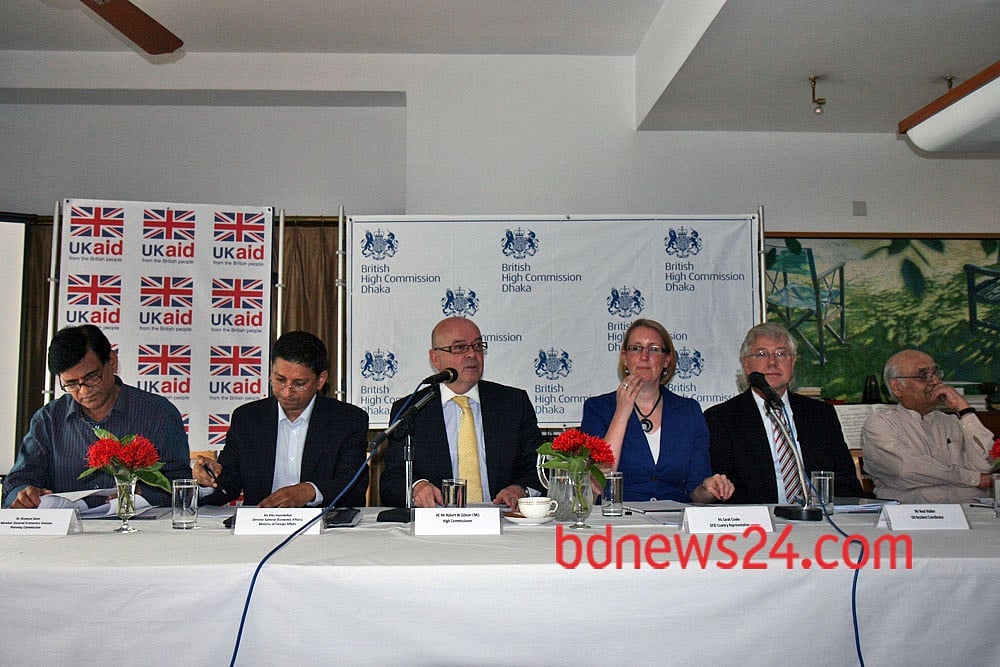
The resident coordinator was speaking at a panel discussion organised by the British High Commission in Dhaka and the UK’s development arm DFID to highlight the key recommendations the UN high-level panel made before the Secretary General Ban ki-Moon in the run up to the post-2015 agenda.
British Prime Minister David Cameron was one of the three co-chairs of the panel that suggested 12 goals and 54 targets after extensive consultations with civil society organisations, major companies, and experts from multilateral organisations and national governments.
The panel recommended ‘five transformative shifts’ for the post 2015 development agenda that British High Commissioner Robert Gibson said ‘bold and optimistic’.
“It says we can and must be the generation to eliminate extreme poverty from the face of the earth,” he said.
In its five transformative shifts, the panel said the vision would be ending extreme poverty in all of its form “in the context of sustainable development”.
The recommendations called not to leave anyone behind the sustainable development target.
It also called for transforming economies for jobs and inclusive growth, and building peace and effective, open and accountable institutions for all.
It also recommended forging a ‘new global partnership’.
Presenting the key issues of the recommendations, DFID’s Results and Evaluation Adviser Laurie Thompson said it was the product of nine months of “listening to what poor people themselves say is important to them”.
He said the panel heard directly from hundreds of thousands of people from all over the world, in face-to-face meetings and through surveys, community interviews, and polling over mobile phones and the internet.
Member of the Planning Commission Shamsul Alam said Bangladesh sent its paper to the UN in the first week of this month.
“We gave a comprehensive goals and targets,” he said, it contained 11 goals and 58 targets.
He said they had bridged ‘the unfinished issues’ of MDGs with the new development goal.
He said many Bangladesh’s recommendations particularly on human rights, gender equality and environment issues had been matched with the high-level panel’s recommendations.
The 27-member panel submitted their recommendations to the Secretary General on May 30. The Millennium Development Goals (MDGs) adopted in 2000 will expire in 2015.
It was agreed at the Rio+20 meeting in June last year that a new set of targets under the Sustainable Development Goals (SDGs) for the next cycle will begin after 2015.
Apart from addressing poverty, health, education and women empowerment issues, the new goals will look at areas like food security and security, nutrition and water resources management.
Ministry of Foreign Affairs Director General on Europe and EU Riaz Hamidullah, however, said the high level panel’s recommendation missed ‘population dynamics’ in their set goals.
He highlighted the need to address population dynamics in the post-2015 sustainable goal as continued population growth, ageing, urbanisation and migration were the ‘challenges and opportunities’ in the 21st century.
Centre for Policy Dialogue’s chairman Rehman Sobhan said the high level panel report hold outs some promise for a better life for the ‘weak and disenfranchised’, but it does “little to address the structural sources of poverty and injustice”.
“To change the lives of those living on the edge we need to recognise that poverty is not just a number since it originates in structural injustices which exclude large number of people from participating on more equitable terms in the opportunities for development,” he said.
DFID Chief Cooke said “there is real consistency between what has come out of the High Level Panel and what has come up in the Government of Bangladesh’s own consultation”.
She said: “In some cases the ambition for the whole world should be the same: no one should live in extreme poverty or tolerate violence against women.
“No one should be denied freedom of speech or access to information,” she added.
But, she said “we learned from the MDGs that global targets are only effectively executed when they are locally-owned and embedded in national plans as national targets”.
“For some targets, each government could choose an appropriate level of ambition taking into account their different capacities and starting points,” she said.
Based on the high-level panel’s recommendations, the UN Secretary General would make his own report to be presented in a special event to the member states in September during the general assembly.







