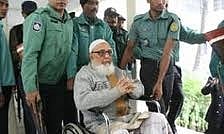
Azam’s defence counsel is currently in the midst of the closing arguments in the war crimes case against the former head of Jamaat facing war crimes charges.
The three-member International Crimes Tribunal-1, set up to try crimes against humanity during the Liberation War, indicted Ghulam Azam for complicity, conspiracy and incitement among other crimes.
Defence counsel Imran Siddiq is currently refuting the charges of incitement and complicity that account for 51 of the 61 counts of war crimes charges levelled against Azam, who headed Jamaat’s East Pakistan unit during the war.

Citing newspaper reports, the prosecution had alleged that Azam incited his followers, which they say included Jamaat members, their student cadres and vigilante militia groups like the Razakar, Al Badr and Al Shams. This incitement, according to the allegations, led to widespread atrocities amounting to crimes against humanity and genocide.
Siddiq said, “None of the newspaper reports had been corroborated by witnesses.” He said that the tribunal could not convict Azam for the crimes based on newspaper reports alone.
The prosecution alleges that when urging his followers to be alert against ‘miscreants’ and ‘Indian intruders’, and foil their attempts, Azam had referred to, among others, peace-loving Bengalis who had sided with the liberation efforts, members of the Awami League and Hindus.
However, Siddiq showed the court, citing prosecution documents — official fortnightly intelligence reports — that ‘miscreants’ had actually meant armed freedom fighters and ‘Indian intruders’ meant Indian armed forces.
He said Azam’s call to resist ‘miscreants’ therefore only meant a call to stand against armed combatants. “Even engaging in combat against the freedom fighters is not a crime under [the International Crimes Act].”
The defence counsel said that a stand against freedom fighters or even active engagement against them would not amount to crimes against humanity.
Regarding one of the allegations of incitement where Azam called for arming the Razakars, Imran Siddiq said the prosecution would have to show that those weapons were subsequently used to commit crimes against humanity about which Azam would have known.
Regarding the allegations of incitement, the defence counsel said that the charges would have to show that Ghulam Azam was explicit in his incitement. “He would have to say, for instance, ‘kill the Bengalis’ or ‘torture the Hindus’ and so on.”
The counsel also mentioned that according to the international conventions, incitement would have to be against a stable group of people, which Siddiq said would have to be ethnic or national groups but not against ‘followers of Awami League’ since that was a political group.
“These groups,” according to the counsel, “would consist of identities that are decided through birth and do not depend upon the desires of individuals.”
Siddiq argued that it would not suffice to show convincingly what Ghulam Azam had said at certain conferences and gatherings but the prosecution to prove incitement. It would depend how the audience perceived his words. In addition, the prosecution should also have to prove genocidal intent of Ghulam Azam if they are to prove incitement to commit genocide.
Jamaat Guru in ICT-1
On Dec 12, 2011, the prosecution brought a 52-point charter of charges against Azam and appealed for his arrest. Later, following the tribunal order, charges were re-arranged and presented to the tribunal on Jan 5. There are 61 counts under five charges against the former Jamaat leader.
He was produced before the tribunal on Jan 11 and sent to jail the same day. Since that evening, the 90-year old former Carmichael College professor has been kept at the prison cell of the Bangabandhu Sheikh Mujib Medical University for better treatment considering his delicate health.
Ghulam Azam’s indictment hearing began on Feb 15 and the court charged him on May 13.
A former chief of Jamaat-e-Islami, arguably the largest Islamist organisation in the subcontinent, Azam is allegedly among the key people who pioneered anti-liberation efforts in 1971 colluding with the Pakistani military junta of that time.
He is widely perceived to have been among core group of right-wing supporters of the Pakistani Army, who came out strongly in support of a united Pakistan.
Ghulam Azam, then chief of Jamaat, was instrumental in setting up the infamous Peace Committee at the national level. The Razakars, an auxiliary force set up mainly to actively thwart the liberation forces, are said to have been mobilised through the Peace Committees across Bangladesh.
Among the most notorious vigilante militia are the Al Badr, whose membership is said to have been mainly dominated by the Jamaat's student wing called the Islami Chhatra Sangha at that time.
The Al Badr is alleged to have spearheaded execution of the intellectual elites of Bangladesh just days before the victory on Dec 16, 1971.
Azam also spoke in favour of Pakistan to the Middle Eastern countries during the war, according to the prosecution.
He stayed in London for seven years after 1971 and returned to Bangladesh in 1978 during BNP founder Ziaur Rahman's rule. Having led Jamaat for long, Azam retired from active politics in 1999.
His party remains a key ally of the main opposition BNP. Two Jamaat leaders, also behind bars for war crimes charges, have even served as ministers during the BNP's last tenure in government between 2001 and 2006, when Azam's party was part of the ruling coalition.
Azam was indicted on five charges — 61 counts — including incitement, conspiracy, planning and complicity on May 13, 2012.