


Published : 15 Apr 2016, 11:38 PM
Updated : 19 Oct 2022, 05:13 PM


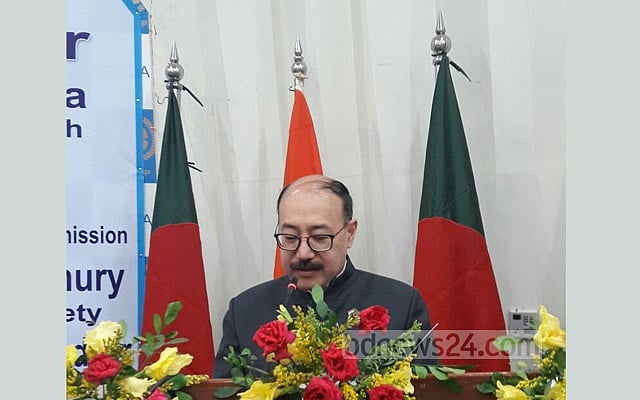
“His life, his legacy and his contributions to building an egalitarian society are unparalleled,” he adds.
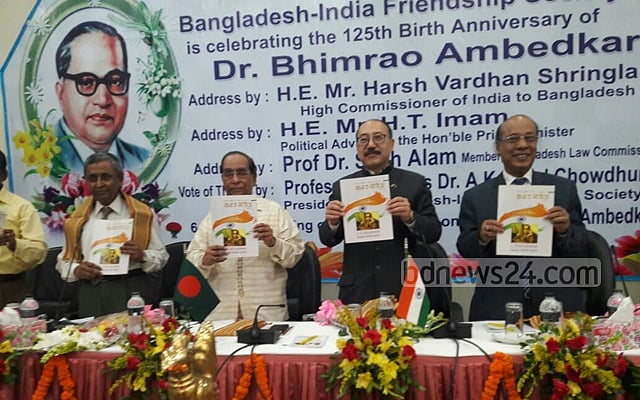
He was recalling the contribution of Independent India's first law minister and the main architect of the Indian Constitution Ambedkar in Dhaka on Friday.
The High Commission of India and the Bangladesh-India Friendship Society jointly organised the discussion on the occasion of his 125th birth anniversary.
Prime Minister's Political Adviser HT Imam, Member of the Law Commission Shah Alam, and President of the Bangladesh-India Friendship Society AK Azad Chowdhury also spoke at the discussion, among others.
The high commissioner said Dr Ambedkar was “foremost” among the “few men” in modern history who continue to inspire and remain relevant beyond the passage of their time.
He continues "to be a beacon of hope and inspiration to millions of people."
For the first time, Dr Ambedkar’s birth anniversary is being observed across the world as recognition to his role and importance in the fight against inequality.
"Today's celebrations are not just to pay homage to his life and his legacy but also to remind ourselves of the goals he set for our societies."
He was born on April 14, 1891 in Mhow Cantonment in Indore in the then central provinces.
As Chairman of the Drafting Committee of the Constitution, he was at the forefront of the painstaking and meticulous efforts which went into producing the Indian Constitution.
The Indian Constitution is a complex but comprehensive document.
Ambedkar’s ideas and philosophy are “writ large” on the Indian Constitution.
His vision of democracy based on social justice and equality find their imprint in the Constitution.
“They have been translated into policies which have transformed the social fabric of our country into a more egalitarian and just society”.
Ambedkar's own life story is a history of struggles and painful realisations about the reality of socio-political life in the subcontinent.
He was born in a community which had access to limited opportunities and faced discriminations by virtue of birth.
He overcame these difficulties and became the first person from his community to earn a doctorate degree from Columbia University and from the London School of Economics.
He returned to India and immersed himself into the cause of political struggle for the marginalised.
He is an “icon” for people across the board for champions of equality and democracy, for secularism, for movements against caste-based discrimination and for gender justice and women's rights.
“We all know of Dr Ambedkar’s contributions to forging a strong political movement against caste-based discrimination in the subcontinent.”
“But he also fought tooth and nail in the Indian Parliament to ensure the passage of laws which gave equal rights to women.”
He had a special connection with Bengal as he was elected to the Constituent Assembly in 1946 before partition by the people of Bengal, which then included Khulna, Jessore, Barisal and Faridpur.
“His legacy belongs not just to India or a community, but across social groups, religious divides and boundaries,” the envoy said.
With the destinies “inter-linked”, the goals of both Bangladesh and India “too are the same - removing poverty and providing socio-economic justice and development for our people.”













