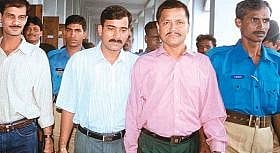
Anup Chetia could be handed over soon
Anup Chetia, the Indian insurgent leader now in Bangladesh jail, could be handed over to the Indian authorities soon, ostensibly to facilitate upcoming peace talks between the authorities and the insurgent group, according to official sources here.
bdnews24.com News Service
bdnews24.com
Published :
03 Dec 2010, 03:59 PM
Updated :
24 Apr 2022, 05:49 PM
bdnews24.com New Delhi correspondent
New Delhi, Dec 3 (bdnews24.com)—Anup Chetia, the Indian insurgent leader now in Bangladesh jail, could be handed over to the Indian authorities soon, ostensibly to facilitate upcoming peace talks between the authorities and the insurgent group, according to official sources here.
India's Border Security Force hopes that Chetia, general secretary of the outlawed United Liberation Front of Assam, or ULFA, might be in its custody by the end of this year or early 2011.
"There are chances of getting him (Chetia) before the talks commence (with ULFA)," said Inspector General (Assam and Meghalaya Frontier) of the BSF, R C Saxena.
India's central government as well as the state government of Assam has long been trying to start peace talks with the United Liberation Front of Assam.
The possibility of early commencement of talks brightened after tacit counter-terrorism cooperation between Dhaka and Delhi apparently resulted in several top ULFA leaders' landing in Indian custody. Most of them were spotted near the country's border with Bangladesh in late 2009.
Chetia (real name Golap Barua) was arrested in Dhaka on December 21, 1997, under the Foreigners and Passports Act for illegally entering into Bangladesh and for carrying foreign currencies and satellite phone.
He could not be handed over to India due to absence of any extradition treaty between the two countrieschet. Chetia was sentenced to imprisonment by a court and he had already completed serving his sentence. New Delhi is believed to have been requesting Dhaka to hand him over to India.
But Bangladesh reportedly clarified that Chetia could not be handed over under the Agreement on Transfer of Sentenced Persons, signed during Prime Minister Sheikh Hasina's visit to India in January 2010, as it only covered people who were still serving sentences.
According to Indian media reports, Chetia is still in the protective custody of the authorities in Bangladesh. His petition seeking political asylum in Bangladesh is also reportedly pending in court and the government in Dhaka has apparently not yet taken a decision on him.
Saxena said the Indian home ministry officials had gone to Dhaka recently to discuss the modalities of Chetia's transfer.
India's Home Minister P Chidambaram, however, told journalists in New Delhi that he was not aware of any move to bring the ULFA general secretary back to the country. He, however, said that the BSF would arrest Chetia if he was seen illegally crossing over to India.
Dhaka's tacit cooperation with New Delhi in November and December last year resulted in the arrest of as many as five ULFA leaders. They were its chairman, Arabinda Rajkhowa, deputy military chief, Raju Barua, finance secretary, Chitraban Hazarika and foreign secretary Sashadhar Choudhury and Rajkhowa's bodyguard Raja Bora.
The ULFA has been waging an armed rebellion against the Indian government since 1979 with the professed objective of liberating Assam from what it calls "colonial rule of New Delhi".
With both the central and state governments keen to find a political solution to end the insurgency, efforts are on to start peace-talks with the outlawed organization.
The Indian government appointed a former chief of its Intelligence Bureau P C Halder as the principal interlocutor for the peace process with the ULFA. Several top ULFA leaders – including some of these arrested – were also released from jail on bail over the past few months to create an atmosphere conducive for peace talks.
The ULFA chairman Rajkhowa, who is still in jail, reportedly conveyed to Halder that he was ready for talks with the government, but made it clear that he wanted Chetia to join the process too.
Assam Chief Minister Tarun Gogoi recently indicated that the peace talks could begin as early as this month itself or in January next year.
Chetia's brother Suren recently travelled from Assam to Dhaka, but returned reportedly without meeting him.
ULFA'commander-in-chief Paresh Barua is the only top-ranking leader to remain a fugitive. India had earlier alleged that Barua, the chief of the ULFA's military wing, was also living in Dhaka and other Bangladeshi cities, although intelligence agencies believe that he had possibly shifted to another South East Asian country.
In March 2008, Mohammed Hafijur Rehman and Din Mohammed, both prime accused in the Chittagong arms haul case, had confessed in the court that the 10 truck-load of weapons and ammunitions that was seized in 2004 had in fact been meant for the ULFA. Rehman also revealed that Barua, himself, had supervised the arms-smuggling operation.
bdnews24.com/corr/am/2124h