


Published : 02 May 2014, 10:46 PM
Updated : 08 Aug 2022, 06:43 PM


The eminent teacher of Bangla said people’s representatives were the ones who would thrash out outstanding problems.
It was “unfortunate”, he added, that several issues remained unresolved between the two countries despite “improved” relations in recent years.
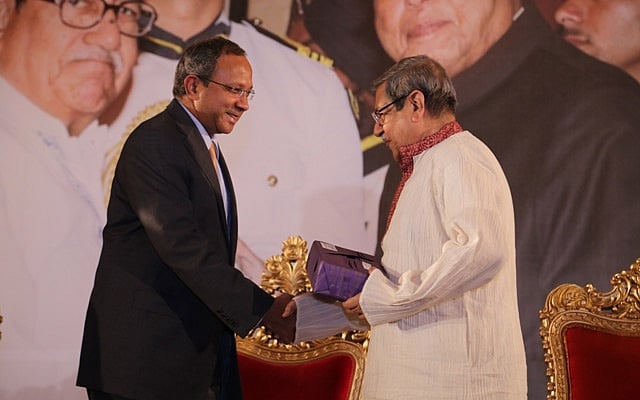
Indian High Commissioner in Dhaka Pankaj Saran felicitated the Professor Emeritus of Dhaka University for getting the award in recognition of his contribution to Bengali literature and education.
Ministers, political leaders, secretaries, teachers, editors, businessmen, and cultural personalities joined the ceremony.
Indian President Pranab Mukherjee had conferred the award on him at a glittering ceremony at the Rashtrapati Bhavan in New Delhi on Mar 31.
He is the first Bangladeshi to receive the award.
Prof Anisuzzaman, who taught Bangla at both Dhaka and Chittagong universities for several decades, has dedicated the award to a “greater bondage” between India and Bangladesh.
He said “relationships had their ups and downs, so had the relationship between India and Bangladesh”.
India-Bangladesh relations witnessed a whole range of engagement in the last term of the Awami League-led government, but the much-talked-about Teesta water-sharing treaty and ratification of land boundary agreement were not done.
Prof Anisuzzaman, however, said there were other ways of improving relations and pitched for more people-to-people contact.
He said if people came closer and got to know each other, fear and suspicion fade.
He thanked the Indian government and its High Commission in Dhaka for the award.
He received a number of awards for his contribution to Bengali literature including ‘Ekushey Padak’. But he said “it never crossed my mind” that someday he would get the Padma Bhushan.
India awarded 127 personalities with four Padma awards, of whom seven were foreigners and non-resident Indians.
High Commissioner Saran said Prof Anisuzzaman had been awarded “in recognition of distinguished service in the field of literature and education”.
He said the recognition was “not only of his personal contributions, but also a tribute to the values for which he stands and the great intellectual and literary traditions for which Bangladesh has always been known”.
His citation notes that his researches have opened up “new vistas into the history of Bengali literature and society”.
Saran said his works “inspired generation of scholars” in Bangladesh and around the world, especially in India.
“His role in the struggle for democracy and secularism and promotion of international outstanding has been exemplary,” he said.
The envoy said when a country recognised “outstanding work of a citizen of another country it is an act of honouring values on which the country of the recipient stands for”.
“It is a reminder of universality of goodness that cuts across borders,” he said.
“Such acts of recognising and celebrating each other’s achievements are an example for the rest of the world.
“They contribute to building better understanding and better world citizens,” he said.
Prof Anisuzzaman also called upon all to strive for “world citizenship” that Rabindranath Tagore, world poet and common poet of India and Bangladesh, advised.
Professor of English, Dhaka University, Syed Manzoorul Islam delivered the felicitation speech of his “teacher”, though they were from different worlds of literature.
“He is a person of profound humanity,” Islam commented on Anisuzzaman. “He has been a guiding force for generations”.
“He is a person I have never seen unwelcoming of any criticism,” he said, citing his wealth of contribution for the language and democracy of Bangladesh.










