SC resumes hearing president's reference
The Supreme Court started hearing the presidential reference on the BDR mutiny trial on Wednesday for the fifth day with amicus curiae Dr Kamal Hossain resuming his statement.
bdnews24.com News Service
bdnews24.com
Published :
02 Sep 2009, 05:13 AM
Updated :
12 Aug 2022, 01:43 PM
Dhaka, Sept 2 (bdnews24.com)--The Supreme Court started hearing the presidential reference on the BDR mutiny trial on Wednesday for the fifth day with amicus curiae Dr Kamal Hossain resuming his statement.
An 11-strong full Appellate Division bench, headed by chief justice M M Ruhul Amin, began hearing opinions at around 10:20am.
Hossain said on Tuesday that trial of the Feb 25-26 Peelkhana mutiny was not possible under the Army Act.
He said a notification to try the accused under the Army Act could not have retrospective effect to cover the events of February.
He said two questions were raised by the president's reference: Whether the provisions of the Army Act, 1952, can be applied against the border guards involved in the mutiny; and, if not, whether the provisions of the Army Act can be applied against the mutineers by issuing notification under Section 5 of the Act.
Hossain said, "The Bangladesh Army Act, 1952 in Section 2 defines the persons who are subject to the Act. The BDR personnel do not fall within the definition of Section 2."
"The second question to be answered is by reference to Section 5 of the Act. Under Section 5, by a notification, the Army Act could be extended to members of a disciplined force raised and maintained by the government."
"But under the existing law, such a notification cannot have retrospective effect," said Hossain.
"Therefore, since the question addressed to the court is whether the Army Act can by notification be applied to [the BDR mutineers], the answer is that this cannot be done as the alleged offences were committed on 25 and 26 February and the notification cannot be given retrospective effect."
Another amicus curiae Amir-ul Islam concluded his observations on Tuesday, resuming from last Thursday. He also said the trial of the mutiny could not be held under army law.
"It is impossible to try the crimes mentioned here under the Army Act," he told reporters after Tuesday's hearing.
"There is no scope for application of the Army Act here. It cannot be given retrospective effect," he said.
Islam also said there were numerous crimes committed, including torture, murder and hiding bodies in drains. "This was not just murder, it was crimes against humanity."
"The trial of such crimes should be held in a special tribunal," he said.
Islam also said last week that that the mutineers should be tried according to the crimes committed during the Feb 25-26 mutiny, which included murder, rape, torture and looting.
He said the crimes of the mutiny should be classified.
Prior to Islam, three amici curiae TH Khan, Khandaker Mahbubuddin Ahmed and Rafique-ul-Haque presented their observations last week.
Difference of opinion
Ahmed and Haque said that the government could try the BDR mutineers under the Army Act by issuing a notification, while Khan said that the military trial of the BDR mutineers was not possible.
Ahmed said the government can issue two notifications—one to bring the trial process under the Army Act and the other to suspend the effectiveness of BDR laws on those who would be tried.
The killing of army officers, in particular, could be tried under the Army Act, he said. He also said the border guards were under supervision of the BDR director general who is deputed from the armed forces.
But he too observed that Article 35 of the Constitution might be a hindrance here as it states that the perpetrators should be tried under the law that was effective on the day of the occurrence.
TH Khan, in the first day's hearing, said BDR personnel cannot be tried under the Army Act.
He said all forces are run by their respective laws including the trials of their offenders. He said defence personnel committing crimes may be court-martialled, but BDR jawans cannot be subjected to such.
Court yet to hear from five amici
President Zillur Rahman sent a reference to the Supreme Court on Aug 17 seeking directives on the trial process.
The court has appointed 10 senior lawyers as amici curiae, literally 'friends of the court', to advise on the reference.
The court has yet to hear from five amici: Mahmudul Islam, Rokanuddin Mahmud, Ajmalul Hossain, ASM Mesbahuddin and AF Hassan Ariff.
An inter-ministerial meeting on the BDR trial decided last month that the president would seek the chief justice's opinion on the BDR trial process as opinions varied widely on whether the accused mutineers should be tried under BDR, army or civil laws.
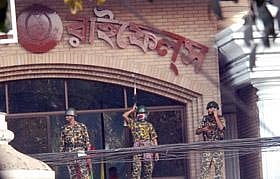
At least 73 people, including 57 army officers deputed to the paramilitary force, were killed in the bloody Feb 25-26 mutiny at the Peelkhana headquarters in Dhaka.
Attorney general Mahbubey Alam, presenting the reference before the court on Aug 25, said the mutiny case filed in Dhaka saw 1, 779 people arrested so far.
Another 40 cases filed in connection with BDR rebellions outside Dhaka saw 1, 721 persons arrested.
A total 3,500 people are facing trial in the cases, said Alam.
bdmnews24.com/at/su/bd/1123h.