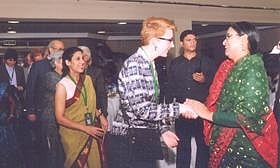
A 'home coming' for foreign friends
It's a nostalgic journey down the memory lane for them as they recall the troubled times preceding the birth of Bangladesh
bdnews24.com News Service
bdnews24.com
Published :
26 Mar 2012, 03:21 PM
Updated :
09 Aug 2022, 03:35 PM
Dhaka, Mar 26 (bdnews24.com) – The 'foreign friends' of Bangladesh, who once contributed to its liberation and birth, are today proud to be part of the country's history.
"Bengali people should also be awarded for their role in the Liberation War," Simon Dring of the UK told a luncheon organised in the honour of the foreign friends by the foreign ministry at Ruposhi Bangla Hotel on Monday.
"Curfew was lifted on Mar 27, 1971 and some of us staying in Intercontinental Hotel dared to go out and documented the situation in Dhaka…," he said.
Simon, a young reporter then, came to Dhaka in March 1971 to cover the political situation in Bangladesh.
"I was there at Ramna Racecourse field when Bangabandhu Sheikh Mujibur Rahman gave his historic speech and I could understand only of the sentences – 'this struggle is for emancipation, this struggle is for independence'," he said.
"When I heard those words, I immediately understood what he was saying," he added.
Simon said a French photographer was also with him who later died in Vietnam, and urged the government to recognise him also.
Professor Tsuyoshi Nara, a true friend of Bangladesh, said, "I am half Bangladeshi, half Japanese."
"I was here for two years in 1974 as a language teacher and came to Bangladesh 20 times," he said in his grammatically correct Bengali speech.
"Whenever I came, I received love and respect from you.
"Many were with us in 1971 and some of them later died … I am receiving the award on behalf of them," said the elderly professor.
He said Bangladesh is making progress but advised not to make haste.
"Slow and steady is the way," he said.
Moharani Bibhu Kumari Devi said, "I feel we are all part of this family."
She hoped to meet the foreign friends of Bangladesh in the future again.
"We saw the atrocities of Pakistan that created havoc in Bangladesh, forcing seven million people to cross the border which was more than the total population of Tripura," she pointed out.
The Moharani opened her castle so that refugees from Bangladeshis could stay there.
Dr. Kirsten Westergaard of Denmark said: "If someone asked me when I first arrived in Bangladesh, I said Mar 26, 1971."
"I was here in Mar 1971 and saw a burning Dhaka from Intercon Hotel," she said adding, "I heard terrible bombings on Mar 25 and 26."
"When I went back to Copenhagen, I started campaigning and formed Action Bangladesh," she said. "We were lucky as the press was very cooperative."
David Weisbrod of the USA said: "I was a young graduate student watching the events in horror in Dhaka."
"I was working with the Cholera Research Institute in Dhaka," he said.
"We mobilised the United States and tried to influence its foreign policy," he added.
bdnews24.com/ssz/nir/2109h