Published : 23 Sep 2026, 12:02 AM
Updated : 23 Sep 2026, 01:17 AM


When Senowara Begum fled Rathedaung Township in Myanmar’s Rakhine State on Aug 25, 2017, homes were burning behind her.
At that moment, she was not thinking about her house or the land the family was leaving behind. Let everything else go, she thought. At least let us stay alive.
Through rain and mud and across the Naf River, Senowara, her husband, and their two children made their way to Bangladesh.
Their first refuge was a school building in Ukhiya, Cox’s Bazar.
Later, along with hundreds of thousands of their compatriots, the family found a new address in the Kutupalong refugee camps.
On a hillside, they put together a tiny shelter of bamboo and plastic sheeting and began life as refugees.
Humanitarian assistance from the Bangladesh government and international agencies has since helped strengthen the roof and bamboo supports.
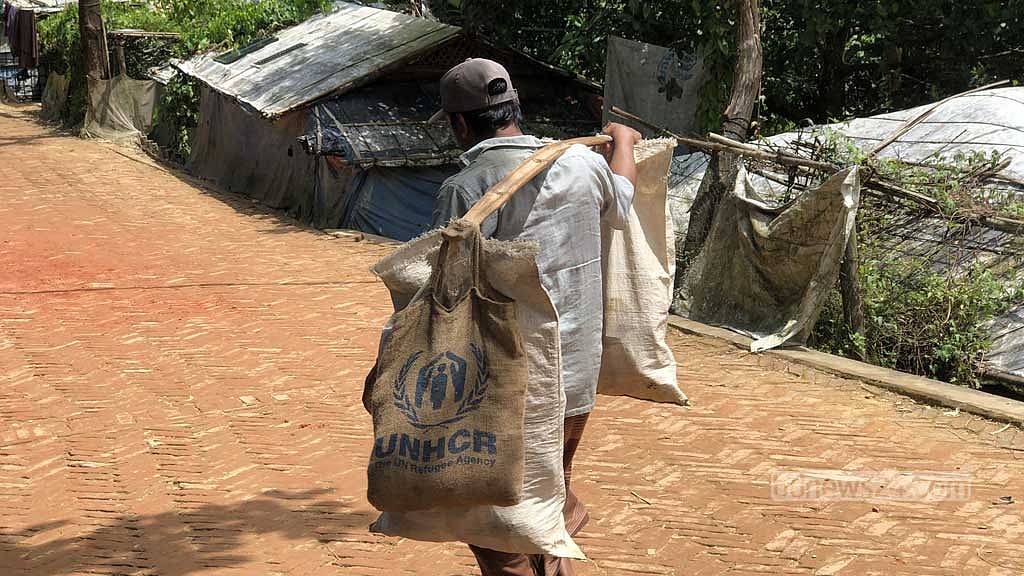
The shelter itself has not grown. The family has.
Two more children have been born since they arrived.
At first, they somehow managed on food assistance. Later, Senowara’s husband found a way to earn some money by working as a volunteer in the refugee camps.
Senowara herself received handicraft training under a project run by British aid organisation Oxfam. She now earns money selling items she makes, including embroidered quilts, bed sheets and handbags.
Compared with the terror and uncertainty of nine years ago, life has acquired a measure of stability.
But Senowara says her heart remains in her village in Rathedaung.
And one question never leaves her in peace: what future will her four children have?
“We came away with nothing but our lives,” Senowara said. “Now we are absolutely ready to go back.
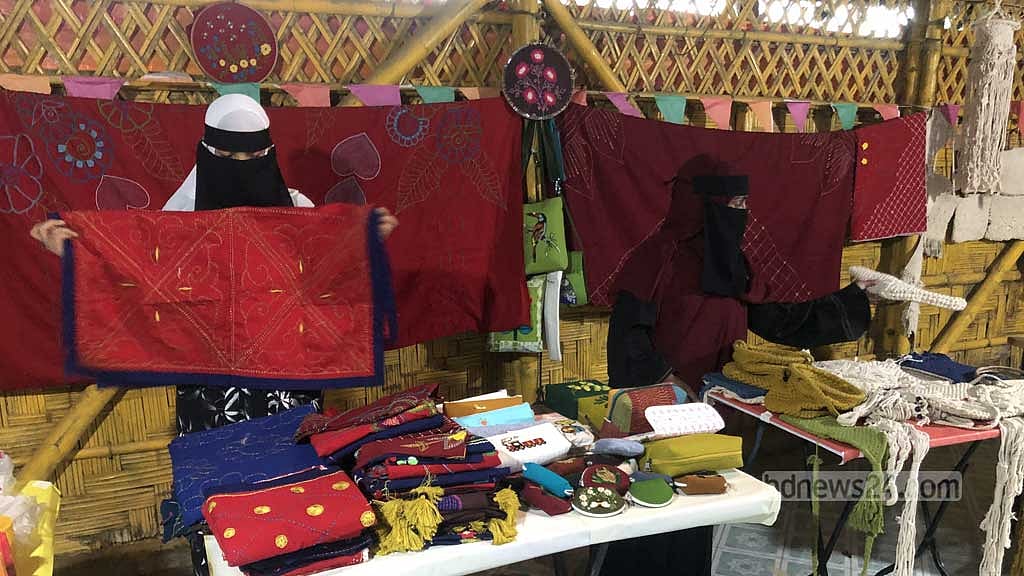
“But because the situation there is unstable, it needs to become stable first. If they tell us to go once that happens, we will leave immediately. We will go wearing whatever clothes we have on.”
More than 750,000 Rohingya entered Bangladesh after Aug 25, 2017, as homes burned and reports emerged of killings, rape and other atrocities in Rakhine.
The then UN human rights chief described Myanmar’s military operation against the Rohingya as appearing to be a “textbook example of ethnic cleansing”.
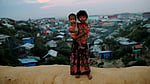
Across the hills of Teknaf and Ukhiya, the refugees built shelters from bamboo, rope and tarpaulin.
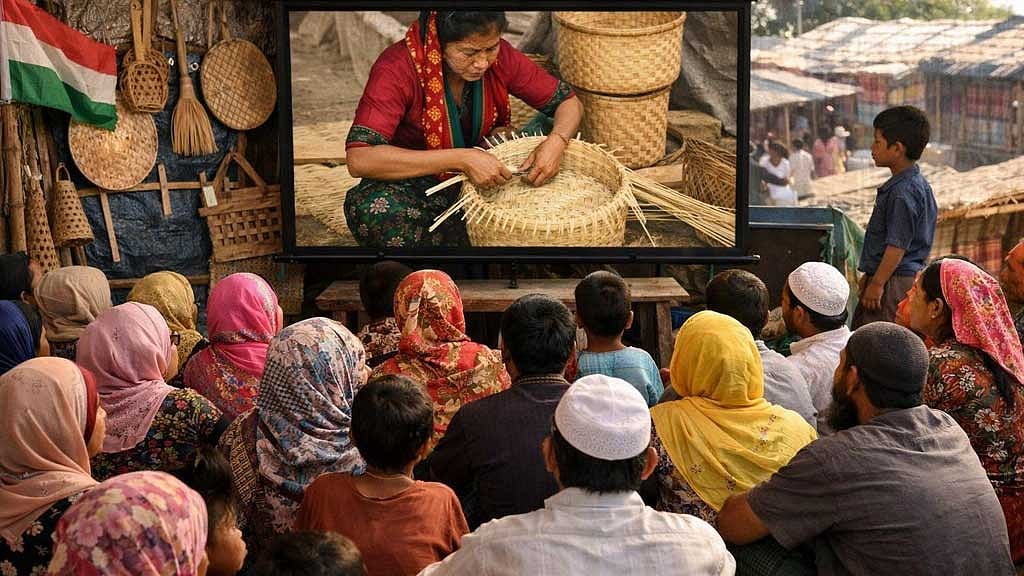
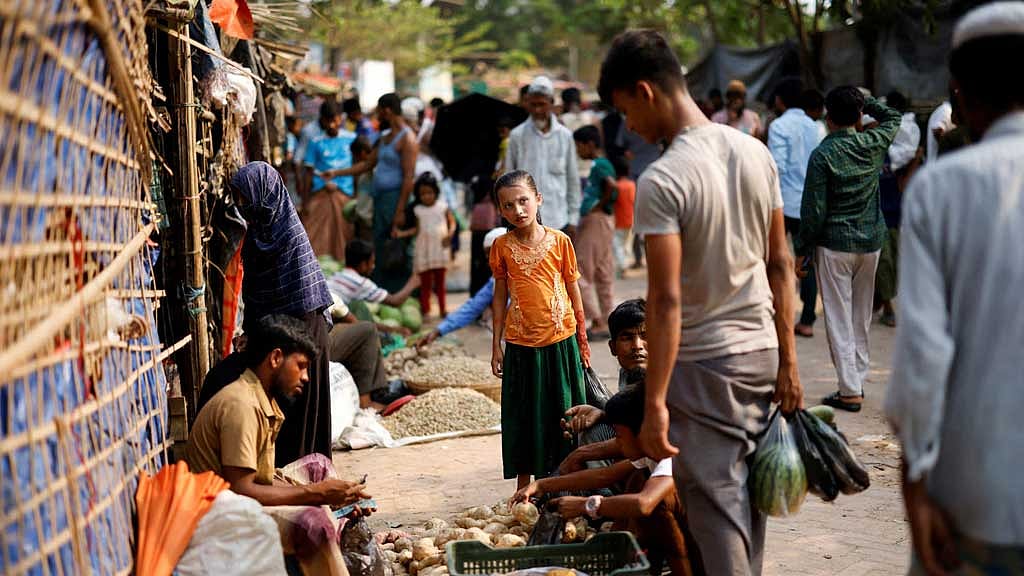
Ukhiya became home to the world’s largest refugee settlement, with about 45,000 refugees living in every square kilometre in parts of the sprawling camp area.
The numbers have continued to grow.
Renewed ethnic conflict in Rakhine has driven around another 150,000 Rohingya into Bangladesh since 2024.
At the same time, around 30,000 children are being born in the camps each year.
The result is that, combining earlier and more recent arrivals, Bangladesh is now sheltering more than 1.2 million Rohingya, according to UN figures.
Despite years of international pressure and repeated promises from Myanmar, not one Rohingya from the post-2017 influx has returned through an organised repatriation process.
Instead, as the crisis entered its ninth year, Myanmar again revived an old narrative: that there is no ethnic group called Rohingya in the country and that those living in Rakhine are “Bengalis”.
UNHCR and Bangladesh have records for more than 1.2 million Rohingya, but Myanmar says about 540,000 “Bengali” residents crossed into Bangladesh after 2017.
In an Aug 15 statement, Myanmar’s foreign ministry said Bangladesh had submitted 828,824 names for verification as of Jul 31, 2026.
Myanmar said it had verified 426,545 people and identified 308,797 of them as former residents of Rakhine State.
The statement said Myanmar would take back those whose identities had been confirmed once conditions in Rakhine were favourable.
Syed Ullah, president of the United Council of Rohingya Representatives, dismissed that promise as “drama”.
Bangladesh challenged Myanmar’s account.
The foreign ministry in Dhaka summoned Myanmar’s ambassador following the statement and said Naypyidaw’s position relied on “erroneous statistics”, arguing that the UN-run registration process provided a more accurate picture of the Rohingya population in Bangladesh.
Dhaka also rejected Myanmar’s description of the Rohingya as “Bengalis”, stressing that they have their own ethnic identity.
Bangladesh urged Myanmar to accelerate the verification process on the basis of the bilateral understanding between the two countries.
It also said children born in the camps and Rohingya who fled to Bangladesh in different waves after 2017 must be taken into account.
While the refugees’ stay in Cox’s Bazar grows longer, the international aid available to support them is shrinking.
They remain crowded into densely populated camps, living with uncertainty and little scope to build normal lives.
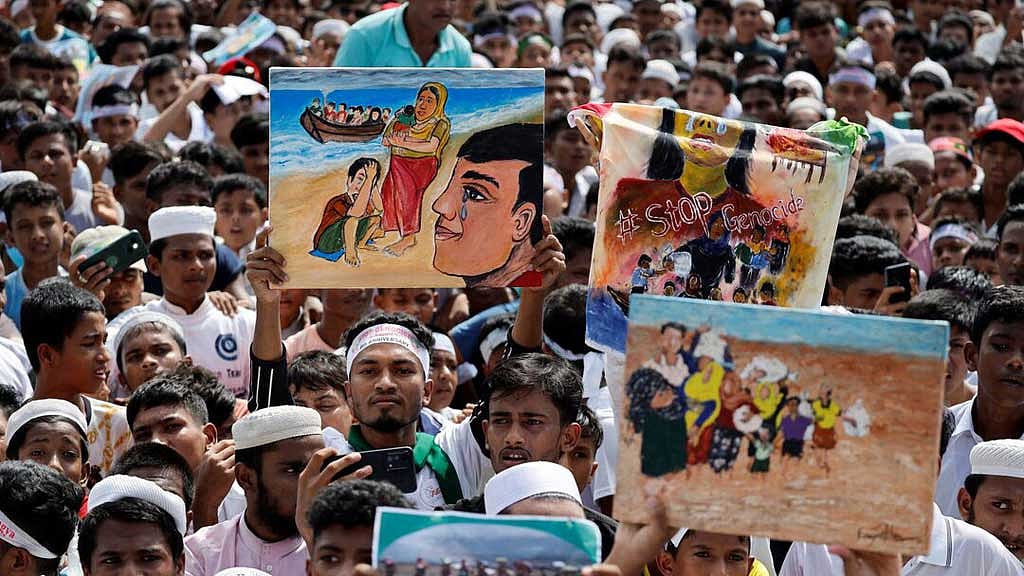
Bangladesh authorities are also increasingly worried about security.
A section of the refugee population has become involved in drug trafficking and other crimes, adding to the government’s concerns over the consequences of such a large displaced population remaining in the camps indefinitely.
Others are falling into the hands of traffickers, risking their lives on boats in an attempt to reach other countries.
UNHCR describes the route through the Bay of Bengal and Andaman Sea towards Southeast Asia as one of the deadliest refugee and migrant sea routes in the world.
More than 6,500 Rohingya attempted sea crossings in 2025, with nearly 900 reported dead or missing. That’s about one in every seven people who made the journey.
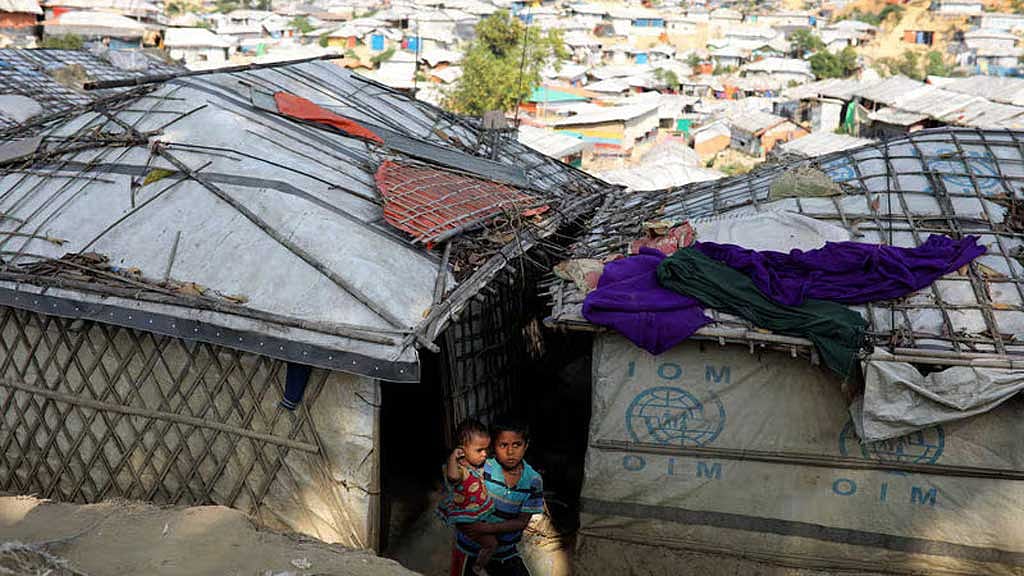
The Bangladesh government’s own language suggests it sees little prospect of a quick end to the crisis.
Speaking at an event on Aug 23, shortly before the ninth anniversary of the 2017 influx, State Minister for Foreign Affairs Shama Obaed Islam said Bangladesh had taken responsibility for the Rohingya on humanitarian grounds but was now itself confronting the challenge of a prolonged political crisis.
The problem was created in Rakhine, she said, and its solution lay in the Rohingya returning there.
Calling for international action towards that goal, she delivered a simple warning: “Ten years should not become 20.”
Fear Has Grown
Jahidullah was 19 when he fled Myanmar in August 2017 with his father and his brother’s family. He is 28 now.
At the time, Jahidullah, his father and his brother ran a shop in Buthidaung in Rakhine State and lived a relatively comfortable life. Another brother was already living in Malaysia.
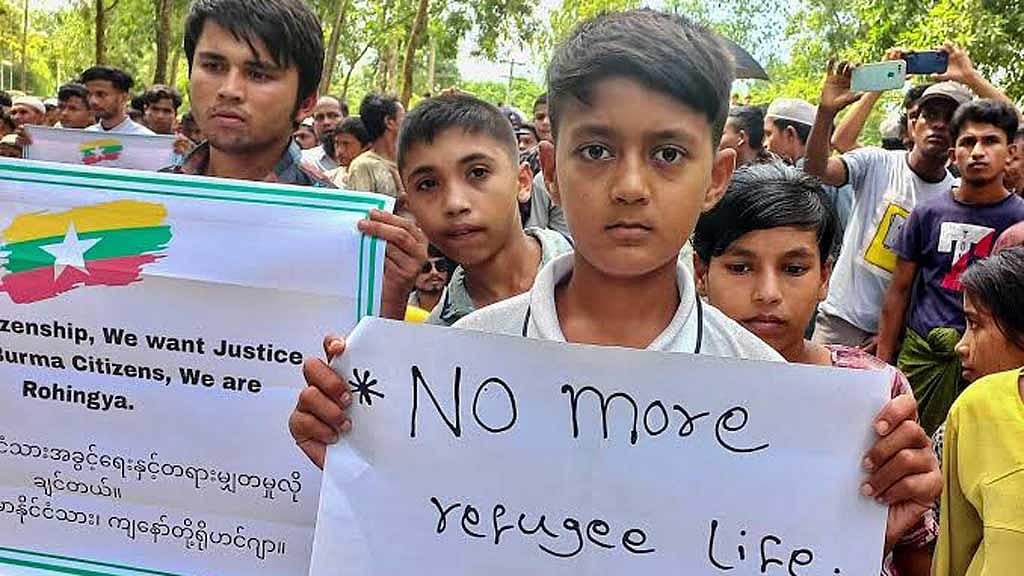
But their freedom was severely restricted.
“We were like cattle shut inside a cattle farm,” Jahidullah said, recalling life in Myanmar.
“We could not move around and we could not study.
“Then the military forced us out, beating us. On the way here, I saw people lying dead and rotting with my own eyes. They had set houses on fire.”
The family crossed canals and rivers before entering Bangladesh through the zero point near Teknaf.
Disorientated and exhausted, they were taken with other newly arrived refugees to a school in Kutupalong.
They stayed there for eight days before Red Crescent workers arrived.
Jahidullah said they were then taken to what is now Camp 4 in Kutupalong, where they were given bamboo and tarpaulins and allowed to put up a makeshift shelter.
They built it themselves. That was the beginning of another uncertain journey.
Not long afterwards, Jahidullah, then 19, found work as a volunteer with the Community Development Centre (CODEC) inside the camp.
Apart from a break of seven or eight months in 2022, he has continued working there.
Several years after arriving in Bangladesh, Jahidullah married in the camp. He now has a daughter and a son.
His income from CODEC, combined with humanitarian assistance, has allowed the family to live what he describes as a somewhat “better” life.
The family is managing, he said. Their shelter should not require major work for another three or four years. His children are growing up.
But he still wants to return to his own village in Rakhine.
“If we get our rights, I will take whatever I have here and go,” Jahidullah said in the Rohingya language.
At one point, he says he would leave “today -- today itself”.
But the words are quickly followed by memories of past persecution and fear of the situation that exists in Rakhine now.
The region that Jahidullah fled in 2017 has since been transformed by renewed war between Myanmar’s military and the Arakan Army.
And for him, that has created not one source of fear but two.
“We have no security there,” Jahidullah said.
“On one side, the Arakan Army will come and beat us. On the other side, the government will come and beat us.
“Before, we were beaten only by the government. Now we will get a double beating.”
‘Repatriation Is the Only Solution’
For Bangladesh, managing more than 1.2 million people in such a confined area is becoming harder by the day.
The government’s position remains what it was in the early days of the crisis: repatriation is the “only solution”.
According to figures from UNHCR and the Bangladesh government, 1,202,034 Rohingya were registered in Cox’s Bazar and on Bhasan Char as of Jul 31.
More than half of them are children. The figures show 575,557 refugees aged 18 and above.
Another 626,477 are children, ranging from newborns to 17-year-olds.
Of those children, 450,518 are under the age of 11 -- equivalent to 37.5 percent of the entire Rohingya refugee population.
The government has repeatedly raised concerns about the future of the huge number of children growing up with limited access to formal education, as well as the longer-term security consequences of leaving an entire generation with few prospects.
International organisations have recommended creating more livelihood opportunities for the Rohingya.
Bangladesh opposes broader access to the domestic labour market, arguing that the country’s own economic capacity makes such an arrangement unrealistic.
For that reason, livelihood programmes and skills training for Rohingya are largely being kept within the boundaries of the camps.
Asked about the prospects for repatriation, Bangladesh’s Refugee Relief and Repatriation Commissioner Mohammed Mizanur Rahman said there was no viable alternative.
“I think the only solution to this problem is repatriation,” he said.
“There really is no other solution.”
Two other options commonly considered in prolonged refugee crises — local integration and resettlement in third countries — are effectively impossible in this case because of the sheer size of the Rohingya population, he said.
“Considering the number of people, third-country resettlement is impossible,” said Mizanur, an additional secretary to the government.
“And integration is politically impossible.
“Bangladesh is a small country with 180 million people. We are already struggling to protect the living standards of our own population. It is not possible for us to integrate 1.2 million people from another country.”
As humanitarian assistance contracts, Bangladesh says it is also trying to keep the Rohingya crisis visible on the international stage.
As part of that effort, the government has organised a side event on the Rohingya crisis on Sept 23 on the sidelines of the UN General Assembly in New York.
Foreign Secretary Asad Alam Siam said on Sunday that Prime Minister Tarique Rahman would use the event to seek effective international support for returning the Rohingya to Myanmar as soon as possible.
Asked what would make this year’s event different from similar initiatives in previous years, Siam said the reason for raising the issue again was precisely that it remained unresolved.
“You know the Rohingya crisis is an ongoing problem,” he said.
“So, as we go to the United Nations for the leaders’ summit, once again, as we have done every time, we will present to the global gathering the enormous scale of the Rohingya problem, the challenges it poses and the international cooperation, assistance and support that Bangladesh needs.
“We will seek that support from everyone.”