Published : 28 Oct 2026, 09:42 AM
Updated : 28 Oct 2026, 09:42 AM


The long-term trend in cyclone formation in the Bay of Bengal shows no clear rise in the number of storms in October.
But any low-pressure system that forms in the month is more likely to become a cyclone in favourable conditions.
Meteorologist Abul Kalam Mallik said data from 1900 to 2025 shows the total number of October cyclones in the Bay has fallen, but the share of those that grow into very severe or catastrophic storms has risen.
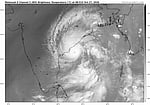
Cyclone Arnab, which formed in the Bay two days ago, has already become a very severe cyclonic storm.
It is racing towards India’s Andhra Pradesh coast with winds of 150kmph.
The Indian Meteorological Department has forecast that Arnab may cross the coast around noon on Wednesday.
Its direct impact on Bangladesh is unlikely, but rain may fall in parts of the country.
Deadly Cyclones of the Past
Several devastating cyclones that hit Bangladesh’s coast in the past came in October-November or April-May, killing people and wrecking homes, crops, livestock and coastal infrastructure.
The Nov 12, 1970 cyclone is among the deadliest natural disasters in the country’s history.
The government’s Department of Disaster Management says about 300,000 people died, and other sources put the toll higher.
More than 138,000 people died in the Apr 29, 1991 cyclone, which had maximum wind speed of 225kmph, according to official figures.
Cyclone Sidr devastated the southern coast on Nov 15, 2007, killing 3,363 people, according to official data. Homes, crops, livestock and the Sundarbans were also damaged.
Cyclone Reshmi struck in October 2008. Cyclone Aila hit on May 25 the next year and caused heavy damage in the southwest. The disaster management department’s figures record 190 deaths from Aila.
Cyclone Hudhud hit India’s Andhra Pradesh coast in October 2014, causing heavy damage there. Its impact on Bangladesh was comparatively limited.
Cyclone Bulbul crossed India’s West Bengal coast and entered Bangladesh in November 2019, causing deaths and losses, and affecting the Sundarbans.
Preparedness Limits Damage
Associate Prof Mohammad Moniruzzaman Khan, director of Dhaka University’s Institute of Disaster Management and Vulnerability Studies, said early warnings, public awareness, moving to safe shelters and relocating livestock play a key role in cutting cyclone damage.
“Compared with disasters like 1970, 1991, Sidr in 2007, Aila in 2009 and Amphan, deaths, livestock losses and other damage have definitely fallen over the past 10 years, by various indicators,” he said.
“We cannot change our geography, but there has been huge improvement in the past decade in getting messages to people on time, raising awareness, reaching safe shelters in time and moving animals.”
Deaths and damage cannot be stopped entirely, the disaster management expert said.
He argued that more effective steps are needed against weak coastal embankments and river protection works, unplanned urbanisation and the impact of industrialisation.
He advised paying more attention to infrastructure problems, especially to cut the yearly losses when river or coastal embankments breach and water enters settlements.
Call for Sundarbans Protection
Moniruzzaman also stresses conserving the Sundarbans to limit cyclone damage.
He said the forest is an important natural barrier for the coast, but failure to protect its ecosystem and biodiversity could raise long-term risks for coastal communities.
“The Sundarbans is a natural resource and a wall that takes the first blow of a cyclone and protects coastal communities,” he said.
“Local unplanned development, river transport and various projects nearby have long-term negative effects on its internal ecosystem and biodiversity.”
He said effective monitoring is needed to stop irregularities such as felling of Sundari trees, fishing with poison, killing of deer and other wildlife, Golpata theft and honey collection.
Administrative monitoring alone is not enough, he said. Alternative livelihoods must be arranged for local people, and local representatives and communities must be brought in for joint conservation efforts.