November 21, 2026

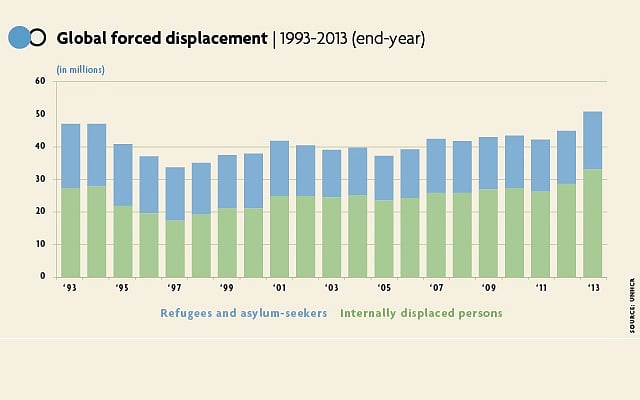
51 mn refugees in 2013

Asia and the Pacific region have the largest number of refugees, over 3.5 million, the UN refugee agency has said in a report.

Staff Correspondent

bdnews24.com

Published : 20 Jun 2014, 12:43 PM

Updated : 19 Oct 2022, 07:32 PM

UNHCR's annual Global Trends report published on the World Refugee Day on Friday put the number of forcibly displaced people at 51.2 million at the end of 2013.

The number is six million higher than 2012 and the highest since the post-World War II era, the agency said.

What is more astonishing is the fact that half of the world's refugees in 2013 were children.

Displacement data in the annual report covers refugees, asylum-seekers and the internally displaced.

An UNHCR press release said Bangladesh had the ninth-highest number of refugees in relation to its national economy.

There are more than 30,000 refugees from Myanmar registered in two official camps with an estimated 200,000 to 500,000 more unregistered living outside.

In 2013, Bangladesh took up a strategy to “list” the unregistered Myanmar population. "It would be a positive step towards recognizing the existence of this population,” the agency said.

It hopes the move will grant these people access to documentation, assistance and justice.

Bangladesh has agreed to improve the shelter and living conditions in the two camps to alleviate the stress and daily sufferings of registered refugees. "We are happy that education in the camps is being extended to the secondary level," Stina Ljungdell, UNHCR's representative in Bangladesh, said in the press release. She said the UNHCR was enhancing efforts to address widespread gender-based violence in the camps, with deployment of female police. The agency said vocational training and Burmese language classes are run regularly in the camps to build self-reliance and prepare the refugees for their voluntary return to Myanmar, when the situation in Rakhine state improves. The surge in the number of refugees is caused mainly by the war in Syria, which, at the end of 2013, forced 2.5 million people into becoming refugees and made 6.5 million internally displaced. Major new displacement was also seen in Africa – notably in Central African Republic and South Sudan. "We are seeing here the immense costs of not ending wars, of failing to resolve or prevent conflict," UN High Commissioner for Refugees António Guterres was quoted in the report as saying. Afghanistan remained the biggest refugee producing country. By region, Sub-Saharan Africa trailed the Asia and Pacific zone with 2.9 million refugees, while the Middle East and North Africa had 2.6 million. "Peace is today dangerously in deficit. Humanitarians can help as a palliative, but political solutions are vitally needed. “Without this, the alarming levels of conflict and the mass suffering that is reflected in these figures will continue," Guterres said.
Related Stories