Published : 20 Aug 2026, 06:27 PM
Updated : 08 Sep 2026, 09:34 AM


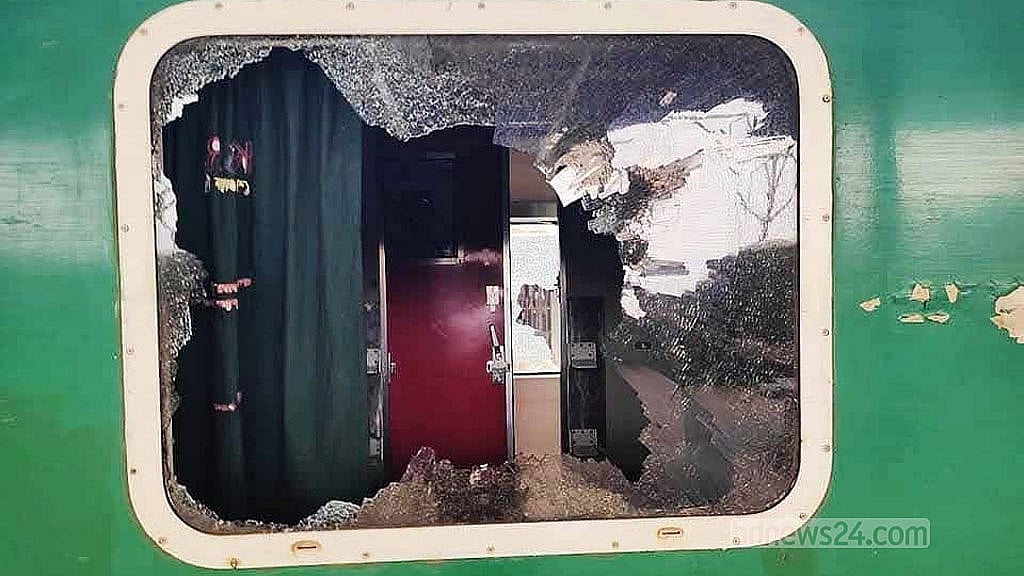
Mahiuddin, a resident of Maijdee, was sitting by the window on the Upakul Express bound for Noakhali when a deafening crash shattered the glass beside him.
A stone had come hurtling through as the train passed Cumilla's Rajapur Railway Station, striking him in the head and leaving him slumped in his seat.
Panic swept through the coach. Railway staff rushed to stem the bleeding, and the businessman, in his 50s, was admitted to hospital on reaching Noakhali.
He had never faced anything so terrifying in his life, the victim, said. "The moment the train crossed the station, I felt a sudden, violent blow to my head and collapsed.
“At first, I couldn't tell what had happened. Then I saw blood streaming down my head, and realised a stone had struck me from outside."
The incident aboard the Upakul Express on the night of Jul 30 was no isolated case.
Such attacks have become routine on the Dhaka-Chattogram, Laksam-Noakhali and Laksam-Chandpur routes, as well as other stretches across the Cumilla and Chattogram regions.
Railway Chattogram Region Assistant Transport Officer-2 Md Moniruzzaman said 62 stone-pelting incidents were recorded on trains running through Cumilla and Chattogram between March and July this year.
"At least 15 people, including ordinary passengers and security personnel, have been injured in these documented cases. I've also heard that some suffered permanent injuries," he said.
While stone-pelting on the Dohazari-Cox's Bazar route has drawn the most attention recently, the figures tell a different story: of the 62 incidents recorded over the past five months, 37 occurred on the Brahmanbaria-Cumilla-Chattogram route alone.
A further 19 struck the Chattogram-Cox's Bazar route, four hit Laksam-Noakhali, and two occurred on Laksam-Chandpur.
Unofficial estimates put the real figure even higher, those familiar with the matter say.
Moniruzzaman said the attacks do not just injure passengers, they damage state property too. "Every single incident has shattered a train window."
"We've seen cases where damage to just one window in an air-conditioned coach renders the entire coach unusable, until it's repaired, it simply can't be put back into service."
He said communities living along the railway tracks need to be made aware of the consequences.
Passenger Anxiety Mounts
Railway Chattogram Region oversees 200km of track between Chattogram and Akhaura, 147km between Chattogram and Cox's Bazar, 48km between Laksam and Noakhali, and 50km between Laksam and Chandpur.
Twenty-six pairs of intercity and mail express trains run along these routes, carrying roughly 25,000 passengers daily.
The relentless stone-pelting of moving trains, long regarded as the country's only safe and affordable mode of transport, is now stoking growing anxiety among passengers and their families.
Fearful passengers say they board trains expecting a safe journey, but now travel haunted by the fear of not knowing when or from where a stone might strike.
Fahima Chowdhury, a passenger on the Mohanagar Provati travelling from Dhaka to Chattogram, said, "We take the train to travel safely. But when a stone suddenly comes flying in while the train is moving, it's impossible not to feel terrified.
"We travel with children and elderly family members. If a stone hits someone in the eye or the head, it could cause a major accident. A single stone doesn't just break glass, it can end a person's life."

She said the authorities should identify high-risk zones and take firm action. "Those responsible need to be swiftly identified and brought to justice."
Sarwar Babu, a university student also travelling on the train, said: "A stone comes flying out of nowhere and shatters the window glass in an instant. Passengers of all ages are getting hurt.
"Some are struck in the head, others in the eye, nose or ear, suffering serious injuries. There have even been deaths. Now passengers feel a sense of dread just boarding a train."
He said, "We usually hear that teenagers do this as some kind of prank, or that drug users throw stones. I heard recently that someone even lost an eye in one such incident."
"But passengers have no way of knowing who's throwing the stones. It should fall to whoever is responsible for law enforcement or surveillance on the train to send someone to the spot immediately when an incident happens and try to find out who did it. Otherwise, the culprits will never be traced."
Who's Behind Stones?
Railway officials say they initially suspect a mix of schoolchildren, drug users and petty criminals are behind the stone-pelting on moving trains.
They say CCTV or action cameras mounted at the front and rear of trains could help identify exactly where and by whom stones are being thrown during each incident.
Omar Faruq, a Grade-1B train conductor based at Chattogram headquarters, said: "We operate the Dhaka-Cox's Bazar intercity train. Those on duty aboard the train are always occupied with some task or another. When a stone-pelting incident happens suddenly, it's not immediately possible to tell who did it.
"That said, we've generally observed that unruly teenagers, drug users or careless individuals living near the tracks tend to be behind such acts. If action cameras were fitted at the front and rear of the train, they would capture whoever is responsible."

Masud Alam, a journalist based in Cumilla, believes those responsible for stone-pelting incidents should be properly investigated and identified, with their identities made public.
"If any of them turn out to be children or teenagers, their guardians should be informed."
He said it falls on the railway authorities to ensure passenger safety. "If those involved in stone-pelting can be guaranteed punishment, accidents can be brought down.
“Otherwise, simply blaming unruly teenagers or drug users won't achieve anything."
Incidents Keep Piling Up
Despite the mounting toll of incidents, neither the railway security force nor the police have managed to arrest anyone involved in stone-pelting so far.
Passengers are asking why, despite so many incidents, culprits have not been identified, and why surveillance has not been stepped up in high-risk zones along the tracks.
The Railway Police (GRP) offered no clear information on the identification, arrest or action taken against those involved in the stone-pelting incidents.
Railway Chattogram Police Station Sub-Inspector Sahadev Kumar Sarkar said, "There's a tendency for stone-pelting around Dulahazara, Ramu and Dohazari on the Chattogram-Cox's Bazar stretch. Twelve cases have been filed over such incidents since 2024, but none has led to an arrest or detention."
He said, "Stone-pelting on fast-moving trains typically happens at night, making it difficult to pinpoint exactly where the incident occurred. Even so, we're conducting beat policing and awareness campaigns in these areas based on the complaints received."
Railway Laksam Police chief Jasim Uddin said, "Two recent stone-pelting incidents, near Feni station and at Rajapur in Cumilla, that left passengers injured have generated considerable discussion.
"But no one files a formal complaint over these. We log the incidents ourselves and run awareness campaigns at the affected sites."

Push For Greater Awareness
Md Salahuddin Bhuiyan, chief of the Railway Security Force's RNB unit in Laksam, said the trend of stone-pelting is rising compared with previous periods.
"Alongside stepping up patrols, we're taking various initiatives to build public awareness. We're conducting regular patrols to prevent stone-pelting incidents.
"We're also distributing leaflets and running other activities to raise awareness among local residents."
Railway Eastern Region General Manager Md Subokhtagin said, "While incidents have eased somewhat on the Chattogram-Cox's Bazar route, stone-pelting has recently increased in the Cumilla region.
“We're investigating whether this is mere mischief or whether there's some organised sabotage behind it."
He said efforts were under way to build public awareness to prevent stone-pelting on moving trains.
"We're trying to counter these incidents both socially and administratively. We're distributing leaflets in settlements along the railway tracks to highlight the dangers of stone-pelting."
He added that district and Upazila administrations, along with various NGOs, were also being roped in to help prevent such incidents.