November 21, 2026

Rhymes of water

Watery landscapes and imagined spaces rhyme on paper in the works of ten renowned artists now on display at the exhibition ‘Water Rhymes-2’.

bdnews24.com

Samin Sababa

bdnews24.com

Published : 27 Apr 2014, 10:36 AM

Updated : 19 Oct 2022, 07:28 PM

Image
Photo: bdnews24.com
Image
Photo: bdnews24.com
Image
Photo: bdnews24.com
Image
Photo: bdnews24.com
Image
Photo: bdnews24.com
Image
Photo: bdnews24.com
Image
Photo: bdnews24.com
Image
Photo: bdnews24.com
Image
Photo: bdnews24.com
Image
Photo: bdnews24.com
Image
Photo: bdnews24.com

The display at Uttara's Galleri Kaya is sponsored by ADN Telecom and bdnews24.com is the media partner for it.

Paintings of Hamiduzzaman Khan, Alokesh Ghosh, Jamal Ahmed, Kazi Rakib, Ranjit Das, Shishir Bhattacharjee and Goutam Chakraborty were showcased.

Works of young artists like Kamaluddin, Shohag Parvez and Md Shahanoor Mamun were also exhibited there.

The range portrayed in the images vary widely -- from the horizon of a village to murky swamps, to golden sunsets to Cambodian water villages to Old Dhaka streets and much more.

“We almost lost watercolour to other mediums” said Prof Samarjit Roy Choudhury, while inaugurating the exhibition on Saturday.

Image
Photo: bdnews24.com

Photo: bdnews24.com

Image
Photo: bdnews24.com

Photo: bdnews24.com

“Our mentors Zainul Abedin, Quamrul Hassan and Aminul Islam came up with some masterpieces in water colour, but eventually left it behind when they travelled abroad and brought back oil and ceramic,” said Choudhury, a supernumerary professor at Dhaka University’s Faculty of Fine Art. But young artists have brought it back beautifully following the gap that emerged after the 1960s, said Kamaluddin, a painter from Cox’s Bazar. “I paint the landscapes of my home and the people there,” he said, standing in front of his painting of fishing trawlers on a beach at Maheshkhali. His boats bore light, transparent strokes of earthy violet, and minute use of bright green and orange. Veteran Jamal Ahmed paints a sublime vision -- the back of dark woman clad in a saree, against a golden Char landscape dotted by white cranes. Her hair was wet and the fading light brightened one of her shoulders. “I use watercolours to get away from what is jarring,” said Ranjit Das, “Almost anything can be achieved in this medium but it’s where simplicity is best expressed.” He recently visited Cambodia and painted Angor Wat, the world’s largest temple complex, amid violet trees. "That's the view of a dreamland,” said Das. Even veteran sculptor Hamiduzzaman Khan appreciates how ‘instantly’ watercolour lets him express. “I have been sculpting since morning. It’s laborious and might take years to finish” Pointing at his depiction of a forest green midnight landscape, he said, “This allows me to merge elements and create depth.” The youngest artist of the exhibition, Md Shahanoor Mamun, a ceramics graduate, had an array of radiant artworks, representing the changing hues of the seasons. “Watercolours can be a difficult but it is the mother medium. It is magic, because it lets me paint light and time in the way I think is the best.”
Image
Photo: bdnews24.com

Photo: bdnews24.com

Image
Photo: bdnews24.com

Photo: bdnews24.com

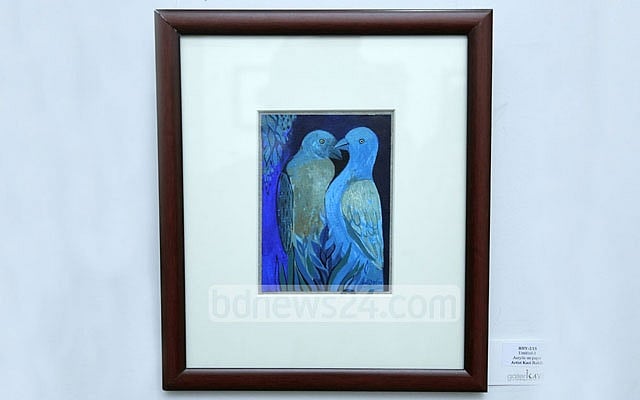
Kazi Rakib has captured the solitude of birds in the muted elegance he painted with bright colours within his miniature frames. Goutam Chakraborty also brought in contemporary style miniatures - parrot-bright elephants and Charlie Chaplin, a tiny Mother Teresa, shrouded in her ubiquitous white saree with blue borders. “They are the icons who move me. They compel me to present them in the context of my own time,” said the Galleri Kaya director. “A gallery is different from an art shop or a museum,” he explained. “It is supposed to do more than just sell or preserve tested art works. A gallery is where artists and their ideas are promoted.” He said his effort to revive watercolours in Bangladesh goes back to 2012 when the first ‘Water Rhymes’ was held with 16 artists. “There was no market for art 10 years ago in Bangladesh but we have grown a lot since then. But we are yet to synergise and develop a value system for art,” said Chakraborty. Prof Samarjit Roy Choudhury said artists were valued for their work and Bangladesh was unique in the way even those less affluent were enthusiastic about owning an original artwork. “Some buyers believed watercolours are of less value because they think painting in oil and acrylic can be preserved for much longer.” He said the old days were gone and the city had also changed.
Image
Photo: bdnews24.com

Photo: bdnews24.com

Image
Photo: bdnews24.com

Photo: bdnews24.com

“We would go to Rayer Bazar or the Race Course (Maidan) and sketch away. Animals roamed in the bushes where the national museum now stands,” said Choudhury, who recently received the Ekushey Padak for his contribution to Bangladeshi art. “This exhibition will help us see where we are going.” The watercolours and the few acrylics will be at Galleri Kaya until May 7. The works by the ten artists can also be viewed online on www.artitude.com.bd. Department S consulting joined hands with Galleri Kaya on Saturday for the venture and is looking to showcase artworks for a larger audience in collaboration with the Art centre. “The recent political unrest and the deadlock we suffered gave us the idea to have exhibitions online,” said Reza Amin of Artitude.
Related Stories