Published : 05 Oct 2026, 11:48 AM
Updated : 05 Oct 2026, 11:48 AM


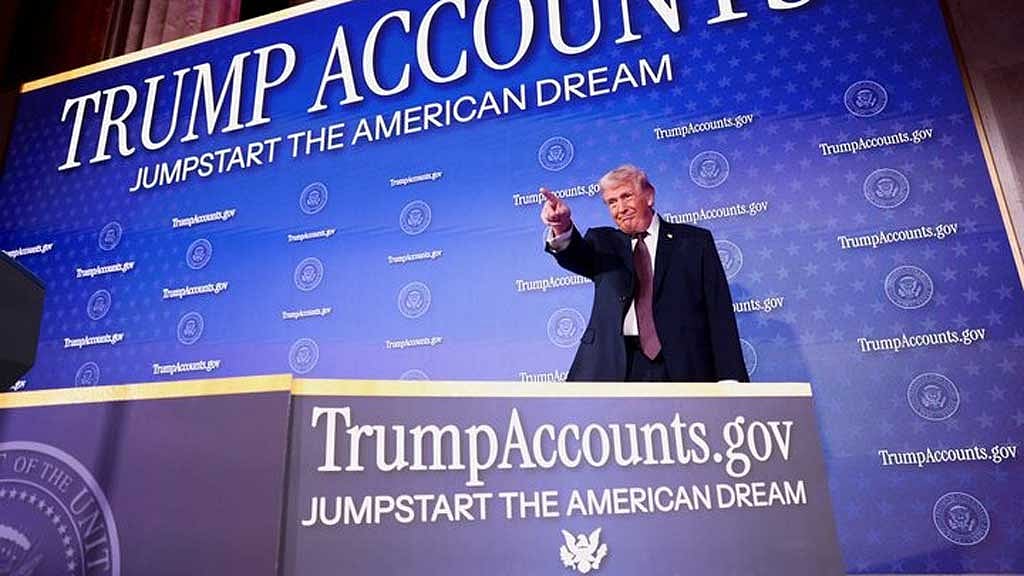
Almost every American child now has a federal nest egg stamped with two names: their own, and President Donald Trump's.
The US Treasury Department has automatically enrolled more than 60 million children in the accounts, The New York Times reports.
The Treasury announced the move on Thursday, covering every eligible child, meaning anyone with a Social Security number who will not turn 18 before the year ends.
Known as Trump or 530A accounts, the tax-deferred savings vehicles were introduced in July.
They are essentially starter individual retirement accounts (IRAs). Parents, guardians and others can put in up to $5,000 a year, while relatives, employers, philanthropists, governments and charities can also contribute.
The money grows tax-deferred in an ultra-low-cost stock index fund. The hope is that nonprofits and government donors will contribute more once every child has an account, the American newspaper says.
Until now, parents had to sign up on their own. By late July, about seven million children were enrolled, roughly 10 percent of those eligible, while only 5 percent of low-income families had opened accounts, according to a September survey by the nonprofit Commonwealth.
The newspaper says automatic enrolment removes that hurdle, putting every eligible child in line for outside contributions.
“The research was overwhelmingly clear that auto enrollment is the way to get to full participation, especially for low-income folks, and I think Treasury listened,” said Ray Boshara, a senior policy advisor at Washington University in St Louis who has helped policymakers from both parties develop children's savings plans.
Parents need do nothing to receive contributions from philanthropic groups and state and local governments.
But they must claim the account to make their own deposits and receive employer matching funds, as well as elect the $1,000 federal seed contribution available to eligible children born from 2025 through 2028.
Bank of New York Mellon will act as trustee until a parent or guardian takes control through the Trump account mobile app.
They must verify their identity, confirm their relationship to the child, review the child's details and accept the account terms, a Treasury spokesman says.
Michael and Susan Dell will give $250 to many children born from 2016 through 2024 who live in ZIP codes with a median household income below $150,000.
They pledged the gift to 25 million children, yet only about 1.2 million eligible children had opened accounts to receive it. Deposits will now go first to children in the lowest-income areas until the target is reached.
“Kids shouldn't miss out simply because their family didn't know about the programme or hadn't opened an account,” said Lucy Neugart, a spokeswoman for the Michael & Susan Dell Foundation.
Hedge fund manager Ray Dalio has also committed $75 million for children in parts of Connecticut. The newspaper says more pledges are likely.
Many financial experts see a benefit for every child because the account can serve as a collection basket for outside contributions, the newspaper says.
Not every household should contribute, though. Saving for a child's retirement usually ranks below emergency funds, debt repayment, parents' own retirement and college, while more flexible accounts already exist for several of those goals.
The money is largely locked until Jan 1 of the year a child turns 18, when the account becomes an IRA they control.
Withdrawals can be penalty-free for uses such as buying a home or paying for college, but may be taxable as ordinary income and could affect financial aid.
Individuals can contribute up to $5,000 a year, while employers can add up to $2,500 towards that limit. Government and philanthropic contributions are uncapped.
The Treasury will continue enrolling children periodically, though parents must still claim the accounts.
Newborns will also be enrolled when parents request a Social Security number. Each account tracks its own contributions, but the money is invested collectively through a master group trust in a stock fund managed by State Street Investment Management.
The accounts were authorised under the 530A provision of the tax code created by a 2025 law. The Internal Revenue Service (IRS) has issued temporary rules to speed implementation and proposed final rules for public comment.
The administration had faced pressure from policymakers, philanthropists and researchers to enrol children automatically, but had to find a structure that kept federal tax-return information confidential -- a hurdle the Treasury and IRS had previously considered major.
Parents cannot currently opt out or close a claimed account, though the Treasury and IRS are considering a process for doing so.
The accounts are projected to cost just over $15 billion through 2034, according to the Joint Committee on Taxation. More than 95 percent of that is tied to the $1,000 federal contribution, according to the Economic Policy Innovation Center, rather than the tax advantage.
Unclaimed accounts remain available to parents or guardians at any time, or to the child in the year they turn 18.