


Published : 27 Mar 2014, 09:55 PM
Updated : 28 Jul 2022, 10:32 AM


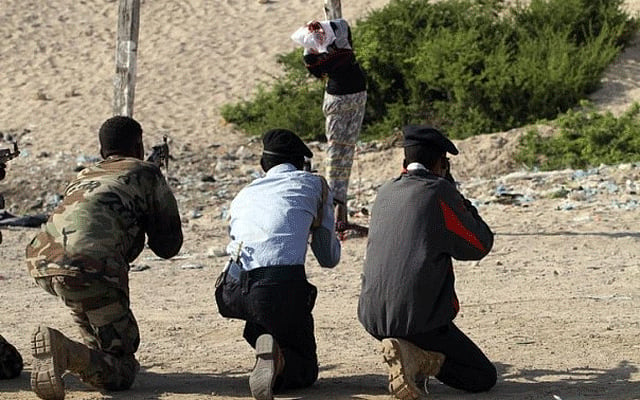
Almost 100 more people were put to death around the world in 2013 than in the year before - a jump of almost 15 percent, according to the Amnesty's death penalty review.
Excluding China, at least 778 people were put to death in 22 countries in 2013, compared to 682 in 2012.
The real figure may be much higher because Amnesty's total does not include the thousands of executions that it says occur secretly in China.
While China tops the list, the number of executions in Iran (at least 369) and Iraq (169) put them in second and third place in the death penalty league table.
Saudi Arabia (79) and the United States (39) took fourth and fifth place with Somalia (34) in sixth.
Indonesia, Kuwait, Nigeria and Vietnam all resumed use of the death penalty.
Despite the setbacks in 2013, there has been a steady decline in the number of countries using the death penalty over the last 20 years, and there was progress in all regions last year, Amnesty said.
It also compiled these 5 myths and facts about the death penalty to mark the release of the report:
MYTH
The death penalty deters violent crime and makes society safer.
FACT
There is no convincing evidence that the death penalty has a unique deterrent effect. More than three decades after abolishing the death penalty, Canada’s murder rate remains more than one third lower than it was in 1976. A 35-year study compared murder rates between Hong Kong, which does not have the death penalty, and Singapore, which has a similar size population and executes criminals regularly. The death penalty had little impact on crime rates.
MYTH
The threat of execution is an effective strategy in preventing terrorist attacks.
FACT
The prospect of execution is unlikely to act as a deterrent to people prepared to kill and injure for the sake of a political or other ideology. Some officials responsible for counter-terrorism have repeatedly pointed out that those who are executed can be perceived as martyrs whose memory becomes a rallying point for their ideology or organisation. Armed opposition groups have also said the use of the death penalty is a justification for reprisals, thereby continuing the cycle of violence.
MYTH
The death penalty is fine as long as the majority of the public supports it.
FACT
History is littered with human rights violations that were supported by the majority but later looked upon with horror. Slavery, racial segregation and lynching all had support in the societies where they occurred but constituted gross violations of human rights. Ultimately, the duty of governments is to protect the rights of all individuals, even though sometimes this means acting against the views of the majority. Public opinion often changes depending on political leadership and when objective information on the death penalty is provided to the public.
MYTH
People who are executed have been proved guilty of serious crimes.
FACT
Hundreds of prisoners are executed after grossly unfair trials. This can include the use of “confessions” extracted under torture, the denial of access to lawyers and inadequate legal representation. The countries that execute the most are also the ones where serious concerns exist about the fairness of the justice system, such as China, Iran and Iraq. The 144 exonerations of death row prisoners recorded in the United States since 1973 show that, regardless of how many legal safeguards are in place, no justice system is free from error. As long as human justice remains fallible, the risk of executing the innocent cannot be eliminated.
MYTH
Relatives of murder victims demand capital punishment.
FACT
The worldwide anti-death penalty movement includes many who have lost their loved ones to, or have themselves been victims of, violent crime, but for ethical or religious reasons do not want the death penalty imposed “in their name”. In the United States, organisations such as “Murder Victims’ Families for Human Rights” are driving the movement to abolish the death penalty.







