Published : 17 Sep 2026, 11:22 PM
Updated : 17 Sep 2026, 11:22 PM


Scientists have solved one of astrophysics' more colourful puzzles: when black holes "burp" -- launching powerful jets of material into space after devouring stars.
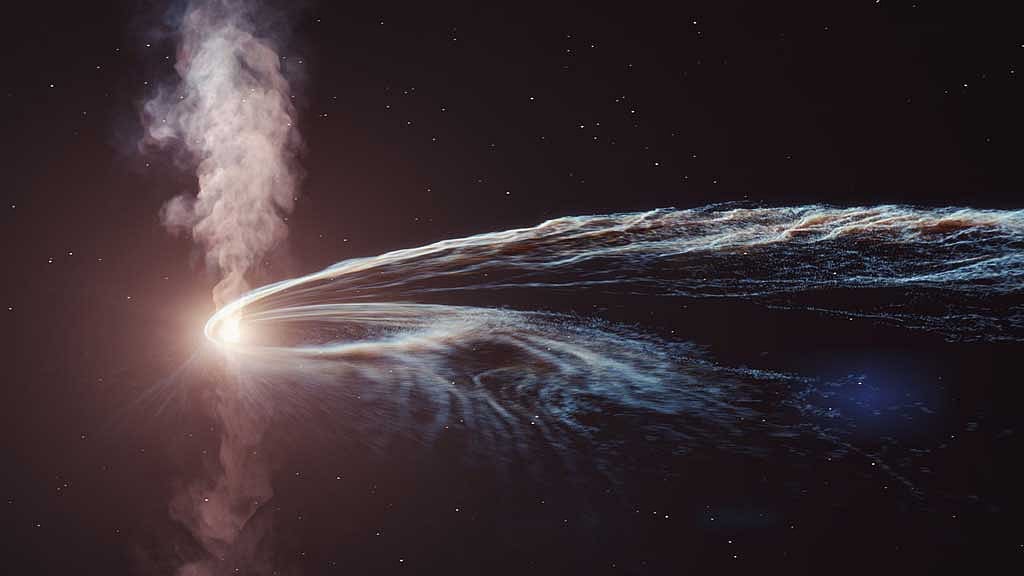
When a star strays too close to a black hole, it is torn apart in a process called spaghettification, reports The Guardian.
Only about half is swallowed; the rest is blasted back into space in jets powerful enough to shape entire galaxies. Scientists call this a black hole burp.
The timing of these burps had long been a mystery -- sometimes jets appeared a year after the star was destroyed, sometimes three to five years later.
Now a study in Nature Astronomy has the answer. Dr Adelle Goodwin of Curtin University and co-author Dr Andrew Mummery used radio telescopes to study 20 instances of stars being consumed by supermassive black holes, finding that burps occur at two distinct points in the feeding cycle.
The first happens when feeding rates are at their peak.
The second occurs hundreds to thousands of days later, when the rate drops to roughly 2 percent of its maximum -- the same threshold that triggers jets in much smaller black holes.
The consistency across black holes of vastly different sizes suggests a universal feeding mechanism governs the timing, according to The Guardian
Scientists can now predict when jets will fire, allowing telescope time to be focused more precisely.