



Published : 03 Feb 2026, 07:45 AM
Updated : 28 Aug 2026, 03:42 AM


For decades, Rangpur was the unshakable heartland of the Jatiya Party, where the Ershad family’s shadow dominated every ballot. Now, as the post-Uprising election approaches, that dominance faces its sternest challenge yet.
The Awami League, once a decisive force here, is absent from the contest following its ousting on Aug 5, 2024, and the turbulence that followed.
In its absence, Rangpur’s six constituencies are bracing for fights that are, by local standards, unusually open -- some three-cornered, others head-to-head -- between the Jatiya Party, the Bangladesh Nationalist Party (BNP) and Jamaat-e-Islami.
What makes this election distinct, voters say, is Jamaat’s clear assertion of strength in two seats -- an ambition it has never signalled so openly before. Those seats are Rangpur-1, centred on Gangachara Upazila along the Indian border, and Rangpur-5, comprising Mithapukur Upazila.
RANGPUR-1: AN OPENING FOR JAMAAT?
Rangpur-1, formed by Gangachara and nine wards of Rangpur City Corporation, has historically seen the Awami League, Jamaat and the Jatiya Party as its principal contenders, with the last usually emerging strongest.
After Aug 5, Jamaat sharply expanded its organisational activity in the zone. When the election schedule was announced, many expected a fierce three-way fight among the BNP, Jamaat and the Jatiya Party.
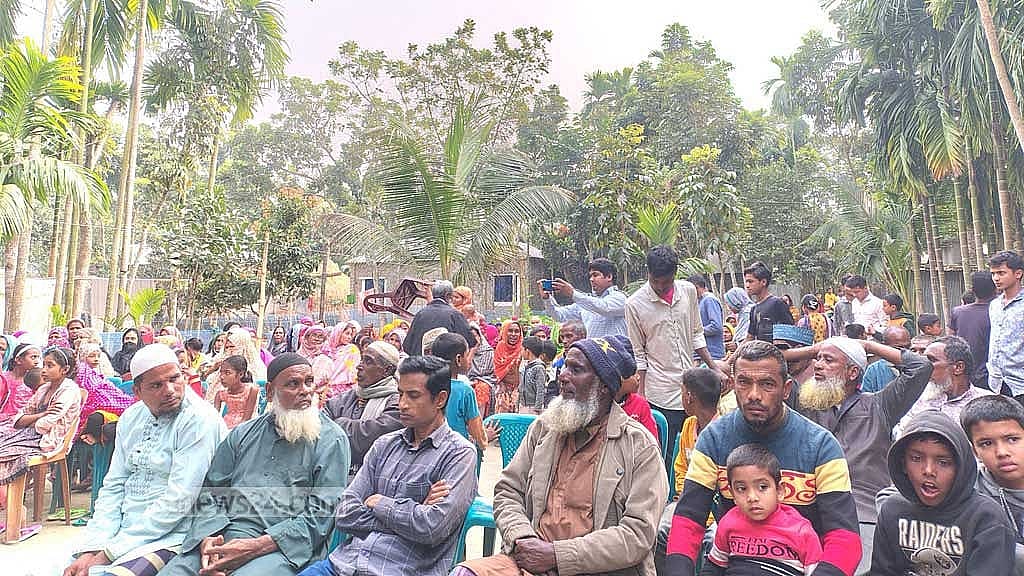
That equation changed dramatically when Manjum Ali, contesting for the first time as a Jatiya Party candidate, saw his nomination challenged over dual citizenship.
Although he was initially cleared on appeal by the Election Commission (EC), BNP candidate Mukarram Hossain Sujan took the matter to the High Court.
The Appellate Division ultimately ruled against Manjum, leaving a seat that the Jatiya Party had won in eight previous elections without a Jatiya Party candidate this time.
The question now dominating Rangpur-1 is simple: Does Jamaat benefit most from that absence?
The contest is between BNP’s Sujan, a district committee member, and Jamaat’s Rangpur city Secretary Raihan Siraji. Many believe the votes that once went to the Awami League and the Jatiya Party will determine the outcome.
Other candidates include ATM Golam Mostafa of Islami Andolan Bangladesh, Ahsanul Arefin of BaSaD (Marxist), and Md Anas of Islamic Front Bangladesh.
Rangpur-1’s 375,227 voters include 188,831 men, 186,392 women, and four registered third-gender voters.
RANGPUR-2: A THREE-WAY TEST
Rangpur-2, covering Badarganj and Taraganj Upazilas, has seen the Awami League win seven times in 12 elections, the Jatiya Party five times, and the BNP once, in February 1996.
With the Awami League not in the picture, Jatiya Party supporters argue their candidate, Anisul Islam Mondol, is ahead.
BNP candidate Mohammad Ali Sarkar is campaigning on the claim that his party will form the next government, promising development and jobs if the Sheaf of Paddy wins. His advantage, party workers say, is a lack of internal division.

Jamaat’s candidate here is its senior Nayeb-e-Ameer ATM Azharul Islam who spent years in prison under a death sentence for crimes against humanity committed in 1971 before being acquitted by the Appellate Division in May last year.
Azharul has contested in three elections from this seat. In 2008, he received just over 36,000 votes, while Anisul won with more than 166,000.
Also contesting are Ashraf Ali of Islami Andolan and Azizur Rahman of JSD.
Rangpur-2’s 380,921 voters include 192,286 men, 188,624 women, and nine registered third-gender voters.
RANGPUR-3: JATIYA PARTY’S ‘CITADEL’
For nearly four decades, Rangpur-3, centred on the Sadar Upazila, has been a Jatiya Party stronghold.
Former president Hussain Muhammad Ershad, his wife Raushan Ershad, their son Saad Ershad, and now GM Quader have all represented the seat.
Despite repeated splits within the party, voters often describe Rangpur-3 as the Jatiya Party’s “private estate”. This time too, Ershad’s brother GM Quader is the candidate.
Despite BNP’s Shamsuzzaman Shamu campaigning vigorously with Chairman Tarique Rahman’s backing, voters still see GM Quader as the frontrunner. Jamaat’s Mahbubur Rahman Belal is also canvassing door to door.

Other contenders include Amiruzzaman Piyal of Islami Andolan, Abdul Quddus of BaSaD, Anwara Hossain Babul of BaSad (Marxist), and independent candidate Rita Rahman, daughter of BNP founder Masihur Rahman Jadu Miah.
Rangpur-3’s 508,223 voters include 252,370 men, 255,848 women, and five registered third-gender voters.
RANGPUR-4: THE ‘INDUSTRIALISTS SEAT’
Formed by Pirgachha and Kaunia Upazilas, Rangpur-4 is known locally as the “industrialists’ seat”. Business figures have dominated contests here for three decades.
From 2008, the seat was held by Tipu Munshi, a businessman and former commerce minister. Before him, Karim Uddin Bhorsa represented the constituency for a decade.
This time, BNP has nominated businessman Emdadul Haque Bhorsa, son of the late MP Rahim Uddin Bhorsa. The Jatiya Party’s candidate is central leader Abu Naser Shah Mahbubar Rahman, eager to reclaim the seat.

Adding intrigue is Akhter Hossen, member secretary of the National Citizen Party (NCP) and a prominent face of the Uprising. Contesting as a candidate of the Jamaat-led 11-party alliance, he has drawn interest from younger voters.
Rangpur-4’s 501,106 voters include 250,788 men, 259,113 women, and five registered third-gender voters.
RANGPUR-5: TWO ‘RABBANI’ CANDIDATES
In Mithapukur’s Rangpur-5, Jamaat historically finished third behind the Awami League and Jatiya Party, with the BNP fourth. The Awami League has held the seat since the ninth parliament, but its absence has unsettled old assumptions.
Voters are divided over whether the BNP and the Jatiya Party can contain Jamaat’s organisational push. If the Awami League votes split between the BNP and the Jatiya Party, and Jamaat mobilises fully, some believe the party could make history here.

Adding to the intrigue, both Jamaat and BNP candidates are named Golam Rabbani, prompting curiosity among voters. Jamaat supporters say they have been preparing for this moment for the past year and a half.
Rangpur-5’s 479,189 voters include 232,462 men, 236,723 women, and four registered third-gender voters.
RANGPUR-6: A ‘VIP’ BATTLEGROUND
Known as a “VIP constituency”, Rangpur-6 in Pirgonj has elected a former president, a former prime minister and a former speaker. Since independence, the Jatiya Party and the Awami League have each won five times, the BNP twice.
This time, voters expect a tight BNP–Jamaat contest. BNP candidate Saiful Islam is campaigning amid unverified rumours of support from a former Awami League Upazila chairman. Jamaat candidate Nurul Amin, a popular religious speaker, is promising development.

The seat also carries symbolic weight as the home of Abu Sayed, the first slain in the July movement; both Tarique and Jamaat chief Shafiqur Rahman have visited his grave.
Rangpur-6’s 355,737 voters include 176,103 men, 179,630 women, and four registered third-gender voters.
CONFIDENCE FROM ALL SIDES
Jatiya Party Presidium member SM Yasir says public response has been “unprecedented”.
“People are looking to the Jatiya Party as an alternative force,” he says, adding that the party expects to recover all lost seats “if the election is fair”.
BNP’s Saiful is equally confident: “We will win all seats in Rangpur. People will not make mistakes again.”
Jamaat candidate Belal from Rangpur-3, strikes a generational note: “The youth of this city are our greatest strength. They have become messengers of change.”
In Rangpur, long a fortress of familiar power, the election heralds change and could reshape decades-old allegiances.







