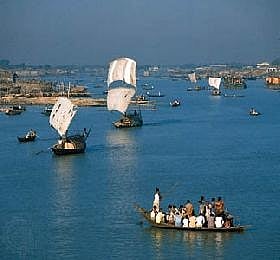
Once fierce rivers are being tamed beyond recognition
The rivers of Bangladesh, once revered as among the mightiest in the world, are being tamed without adequate measures to protect them from extinction. Rice cultivation has spread on the riverbeds of the great Brahamaputra across regions through which it once flowed fiercely. This fate does not belong to the Brahammaputra alone, as bdnews24.com's Maruf Mallick describes.
bdnews24.com News Service
bdnews24.com
Published :
01 Mar 2008, 01:54 PM
Updated :
24 Apr 2022, 08:15 PM
Maruf Mallick
bdnews24.com Correspondent
Dhaka, March 1 (bdnews24.com) – The rivers of Bangladesh, once revered as among the mightiest in the world, are being tamed without adequate measures to protect them from extinction.
Rice cultivation has encroached the riverbeds of the great Brahamaputra across regions through which it once flowed fiercely.
This fate does not belong to the Brahammaputra alone, but many other major rivers are confronting the same destruction.
During January-May, rice cultivation on the banks of the rivers, small or big, has become a normal practice now-a-days.
Experts and officials say the rivers are dying due to withdrawal of water upstream, excess siltation, and encroachment of river banks.
HS Mojaddad Faruque, director general of Bangladesh Water Development Board, said the damage to different rivers varies.
"Some gather huge amounts of siltation, some face erosion while other rivers fall prey to encroachment. Some are dying because of pollution," he told bdnews24.com.
"The overall condition is worrying," he said.
bdnews24.com has failed to find any consistent or comprehensive statistics on how many rivers or which are facing the most destruction. Only the major rivers come to be studied.
According to the available statistics of the River Research Institute, there are 500 rivers in the country.
However, in a book titled, 'The rivers of Bangladesh' published by the Water Development Board the figure has been put at 320.
Muhammad Inamul Haque, director general of the Water Resources Planning Organisation, has said there are 700 big and small rivers in the country.
The Water Development Board regularly monitors the water flow of 112 rivers. The water level is measured at 170 points while salinity of water is measured at 100 points once a month.
The waterways of 60 major rivers are also monitored.
According to the WDB, 10 to 12 rivers become totally waterless during the dry season.
Ainun Nishat , country director of ICUN, said the condition of the country's rivers pitiable. "If the trend continues many small rivers will face certain extinction," he said.
WDB officials said the condition of the Brahmaputra has reached its worst peak
The river separating from the Jamuna river in Jamalpur runs through Mymensingh before ending up in the river Bhairab. But many points become dry each year.
The Brahmaputra flows with a narrow stream at numerous points from Jamalpur to Bhairab. The flow has been blocked at Jamuna point. At Manohardi in Narsingdi it is almost totally silted up. The width of the river flowing in Mymensingh stands at 10 to 15 feet at some points.
The sources of many rivers have been closed due to silt deposition, where water can not flow.
The Jamuna is collecting massive amounts of silt at its source in Dhalesawari at Ilashin, Tangail. The Dhaleswari stream has slowed down at Porabari due to silt deposits.
In the northern region the water levels of Teesta, Karotoa, Jamuneshwari, Katakhali, Boral, Atrai, Karotoa and Ghagot rivers drop drastically during the dry season.
The flow of the Teesta has dwindled to a great extent. The water flow of the Surma and the Kushiara has dropped at in Sylhet. The Gorai is dying down.
According to waterway officials, dredging activities by the government are not nearly adequate.
Only the Inland Water Transport Authority conducts dredging activities to reclaim waterways from siltation, but that is not enough to keep the rivers alive.
The practice is also costly and time-consuming, officials say.
Though the rivers are in a pitiable condition, Bangladesh stands third in the world in contributing water supply through rivers to the sea.
Some 7.95 lakh cubic metres of water flow into the Bay of Bengal every year through the Padma-Brahmaputra-Meghna river system.
The Amazon river system in Brazil carries the highest amount of water to the sea every year, with the Congo river in Africa is second position.
bdnews24.com/mrf/eh/jr/rah/1920hours