


Published : 24 Feb 2014, 09:14 PM
Updated : 08 Aug 2022, 06:31 PM


India had announced duty-free access to all Bangladeshi products except 25 in 2011.
Since then, Bangladesh’s exports to India rose to $563 million in the last fiscal year from $498 million in 2011.
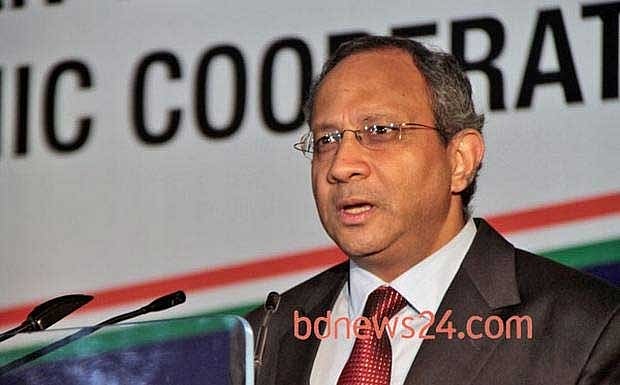
But the envoy, Pankaj Saran, on Monday said “there seems to be drop in the current fiscal”.
He was addressing the quarterly luncheon meeting of the Metropolitan Chamber of Commerce and Industry (MCCI) at its office in Dhaka.
The envoy said “nimble-footed entrepreneurs will adapt their business models to factor this market into account”.
“There will be teething troubles of entry but all of us know of the success stories that are already emerging”.
He sought MCCI leaders support to increase bilateral trade and investment, and said “you are an influential and essential voice in policy-making. Above all, you are critical stakeholders in Bangladesh’s economic success”.
But he said there were many other factors like institutional framework, trade agreement, dispute settlement, ease of travel and information that influence trade.
The bilateral trade between the two countries was $ 5.34 billion in the last fiscal with $ 4.2 billion Indian exports.
The envoy, however, said in over a decade Bangladesh’s exports to India grew ten times, while India’s exports only four fold.
He sounded optimistic about the investment of Indian businesses in Bangladesh.
The total Indian investment registered with the Board of Investment until last year April was more than $ 2.5billion.
“Several Indian giants are in Bangladesh such as Airtel, Tata, Sun Pharma, Asian Paints, Dabur, Marico, Aditya Birla, Godrej and so on. This list is by no means exhaustive. Moreover, some important investments are in the pipeline”.
He, however, suggested more exchanges and dialogue to identify areas of convergence and common interest, and “remove suspicions about each other”.
File Photo







