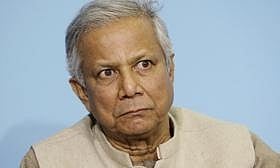
Govt to probe 'extra' Yunus stint
The government is also going to declare an ordinance with changes in the rules for appointing Managing Director. Updates
bdnews24.com News Service
bdnews24.com
Published :
02 Aug 2012, 09:09 AM
Updated :
09 Aug 2022, 04:05 PM
Dhaka, Aug 2 (bdnews24.com)—The government will examine whether Muhammad Yunus continuing in the office of Managing Director of Grameen Bank beyond the mandated age of 60 was lawful as the ongoing saga continues to play out.
The government is also going to declare an ordinance with changes in the rules for appointing Managing Director of the Nobel prize-winning microlending institution founded in 1983 through a martial law ordinance.
The changes will come through the 'Grameen Bank Ordinance (Amendment) 2012', the draft of which the Cabinet endorsed at a meeting chaired by Prime Minister Sheikh Hasina on Thursday.
"Muhammad Yunus held the office of Managing Director even after he was past 60 years of age. The Cabinet asked the Bank and Financial Institutions Division of the Ministry of Finance to look into whether his continuing in the office for such longer period was lawful or not, how much money he took during that time and whether it was legal," Cabinet Secretary Md Mosharraf Hossain Bhuiyan later told journalists.
Also, the National Board of Revenue was asked to submit a report on whether the Nobel Peace laureate brought in any money from abroad as a wage earner and if so, if he was allowed to do so and whether he got any tax waiver on the amount.
The NBR will make the report with the help of Bangladesh Bank, the Cabinet Secretary added.
Bhuiyan said the Cabinet approved changes to three issues covered in two clauses under Section 14 regarding the appointment of the Managing Director. The amendment suggests that the board recommends to the Chairman three eligible candidates for the post of Managing Director, out of which he will recommend one.
The amendment also scraps the previous provision requiring the board to form a selection committee to appoint the Managing Director.
It also changes the eligibility of the candidates; previously, the candidates were required to have experience in 'Rural Economy' and 'Grameen Banking Business'. The amended law requires them to have experience in 'Micro-financing' to do away with limitations on this matter, the Cabinet Secretary added.
These amendments have been brought to do remove complications regarding the appointment of a new Managing Director for the bank following the High Court directive regarding the appointment of people aged above 60 years, Bhuiyan further said.
In 2006, Yunus shared the Nobel Peace Prize with the Grameen Bank for their initiative to provide micro-credit for poverty alleviation. Four years later, both were flung into public glare after a Norwegian TV documentary revealed that country's aid agency Norad's annoyance in the late 1990s over Yunus' handling of aid money meant for the Bank.
Yunus was challenged by the then Norwegian Ambassador to Bangladesh for failing to inform the donors before transferring the millions of dollars to a sister entity. While the Norwegians later insisted that no criminal activity has taken place, their International Development Minister Erik Solheim said it was "totally unacceptable that aid is used for other purposes than intended".
Grameen Bank claimed there was no wrongdoing in the agreement between the bank and Grameen Kalyan, under which it received Tk 3,917 million from Grameen Bank.
However, large-scale criticism of Grameen Bank's actions and works shook the local and international arena and a government-formed commission found anomalies in the running of the bank.
Chief executive since Grameen was founded originally with government support and ownership, Yunus was questioned by the central bank for continuing in his job far beyond the retirement age for any executive in any such institution in Bangladesh.
Yunus was nearly 71 when the Bangladesh Bank gave the notice in March 2011. He went to the court and lost a series of legal battles, finally in the Supreme Court, eventually losing his hold on the institution he is credited with building in 1970s.
Following his removal, the government refused to bow down to pressure from US and international donor organisations to reappoint Yunus. It also ruled out a proposal to form a committee, led by Yunus, to look for a new Managing Director.
Currently, the bank's Deputy Managing Director Mohammad Shahjahan is standing in for the MD.
The Bank and Financial Institutions Division formed a commission on May 16, 14 months after Yunus' removal, to determine the fate of the Grameen Bank.
The commission was assigned with the task of recommending steps to the government about ways to ensure good governance, transparency and accountability of the microcredit NGO and how to bring it within the reach of state regulatory agencies.
The commission was also tasked to identify the institutional strengths, weaknesses and constraints in the Grameen Bank's operations and review the purposes, legal status and operations of the institutions, companies and enterprises established by it. It was to also report on the microcredit NGO's ownership and composition of its Board of Directors specifying qualifications for such membership.
bdnews24.com/mk/ah/rn/bd/1438h