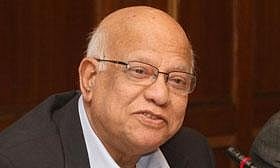
Credit rating same as last year: Muhith
Bangladesh has received the same credit rating of BB- this year as it did last year as it maintained stable macroeconomic condition, the finance minister said on Tuesday.
bdnews24.com News Service
bdnews24.com
Published :
31 Jan 2012, 02:27 PM
Updated :
09 Aug 2022, 03:22 PM
Dhaka, Jan 31 (bdnews24.com)—Bangladesh has received the same credit rating of BB- this year as it did last year as it maintained stable macroeconomic condition, the finance minister said on Tuesday.
In response to a supplementary question of K M Khaled, A M A Muhith informed parliament, "Yesterday (Monday) the government received the annual credit rating and it was the same as last year."
Bangladesh got the moderate BB- rating last year from Moody's and Standard and Poor's.
The minister hoped that the country would have a better balance of payment situation and stable foreign currency regime in a short time.
Increased import against slowing export put pressure on foreign currency reserves and taka is being continuously devalued because of this, Muhith said.
About the open market sale of foreign currency from the reserve, he said, "Every day we are monitoring the situation."
He cautioned that if the foreign exchange reserve falls to the danger level, it would have adverse impact on the economy.
To another supplementary query of Mainuddin Khan Badal, the minister said investment dearth, subsidy and inflation are the three problems in the economy.
"We need foreign investment as it is not possible for us to mobilise domestic savings for such investment," the finance minister said.
Subsidy and inflation put people in hardship but the government has taken steps to reduce subsidy, explaining, "Lower subsidy is good for people as the beneficiaries of subsidy are mostly wealthy people."
The minister, however, said strong rural economy and agriculture are the driving force of the healthy economy of Bangladesh.
"We are constantly enjoying 4 per cent growth in agriculture sector and problems in power sector are mostly resolved.
"If we can continue this farm growth rate, then the country would not need to worry much about its development."
About manufacturing and export sectors, he said the real sector experienced over 10 per cent growth in the last fiscal while export continues to grow beyond target.
Answering Golam Dastagir Gazi, Muhith said Bangladesh is not an aid-dependent country as foreign aid constitutes only 22.3 per cent of its GDP.
The foreign loan balance at present is $22.3 billion which is much lower than the indicators of aid-dependent country, Muhith said.
"This is why Bangladesh is known as a less indebted country."
He said if Bangladesh needs to achieve 7 to 8 per cent growth, the country must have an investment of 30 to 35 per cent of the GDP.
"Under present context, it is not possible to raise such investment from domestic sources and foreign assistance can play an important role in this regard."
The minister said per capita foreign aid was $160 in June, 2011 while total foreign aid received from 1972 to until June 2011 was $55.18 billion.
Out of it, $31.55 billion was loan and $23.63 billion was grant and Bangladesh repaid over $9 billion.
The minister emphasised that as a developing country Bangladesh is entitled to get foreign aid as developed countries have committed to provide aid at a rate 0.7 per cent of their GDP.
"If the amount of soft loan is decreased then lending from domestic sources increases and interest rate in domestic sources is much higher," the minister pointed out.
NEW BANK, INSURANCE COS
Muhith said the government is considering allowing new banks and insurance companies. "Guidelines to get licence for new banks and insurance are under process," he said.
ADP IMPLEMENTATION
In response to a question from Mohammad Shafiqul Islam, the minister told parliament that only 28 per cent of ADP have been implemented during July-December period of the current fiscal.
The annual development programme for the current fiscal is Tk 460 billion and out of that Tk 127 billion has been spent, he said.
To a question of Rehana Akhter Ranu, he said until June 2011, agriculture lending has Tk 254.92 billion worth of bad debt and industrial lending has Tk 1.26 trillion bad debt.
bdnews24.com/ssz/bd/1910h